NEW
NEW RESEARCH
AI Spend Report: See how 172 leaders are budgeting for AI Get the report
WEBINAR
What’s New at SpendHound: Live Nov 5 at 1 PM ET Register now


Most SaaS spend platforms sell the same pitch: full visibility, reliable benchmarks, and negotiation leverage that pays for itself. Then the invoice arrives—$50K or more a year—and the platform still requires months of setup, manual cleanup, and workarounds to deliver on half of what was promised.
It’s a pattern procurement and finance teams know well. The tools meant to control SaaS spend become part of the spend problem.
SpendHound was built as a response to that pattern, inside an 800-person data company that was growing fast and needed SaaS visibility but couldn’t justify the cost or complexity of existing platforms.
The result is a free tool designed to give finance and procurement teams a view of every vendor, contract, and dollar without the overhead.
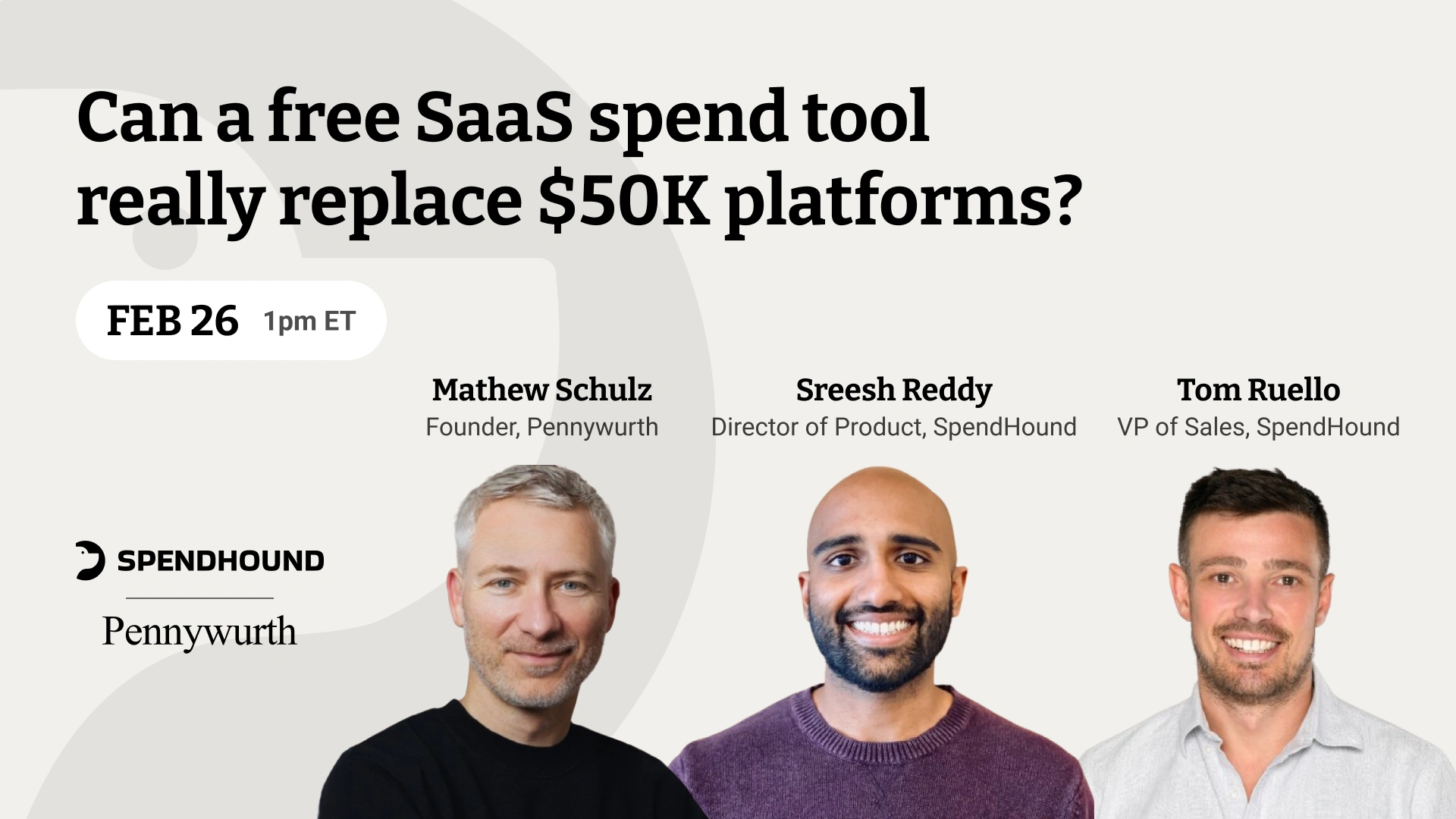
That’s a bold claim. So in SpendHound’s latest webinar, Mathew Schulz, former global procurement leader at Forrester and the voice behind Pennywurth’s 36,000+ followers, put it to the test.
Tom Ruello, VP of GTM at SpendHound, walked through the platform live, showing the catalog, benchmarks, workflows, and integrations—while Sreesh Reddy, SpendHound’s Director of Product, focused on the capabilities still in development.
Mathew kept asking the questions a real procurement leader would and pressure-testing the areas where free (and most paid) tools usually fall short.
The session you can watch here explored where SpendHound replaces paid tools, where it layers alongside your existing stack, and why the business model doesn’t require a subscription to sustain itself.
Procurement gained visibility during COVID, supply chain disruptions, and the market volatility that followed. Every company started asking how to cut costs, and procurement kept getting the call. A wave of tools entered the space to meet that demand.
SpendHound didn’t start as one of those tools. It started as an internal workaround.
Tom Ruello explained how the parent company, YipitData, ran into the same problem most scaling companies face. They were growing fast—and buying software just as fast. When leadership decided to get spending under control, they went to the usual SaaS management vendors for help.
“They quoted us about a hundred thousand dollars. And we were trying to save money, not go out and buy additional tools. We couldn’t justify it.”
They also didn’t have a full-time procurement person. So even if the tool made sense on paper, there was no one to manage it, adding headcount costs on top of an already steep licence fee. The math didn’t work.
The team ended up doing it the hard way. They pulled everything out of NetSuite, cleaned it up manually, identified every vendor, flagged redundancies, and figured out where to cut.
It was painful. But it was also exactly the kind of unstructured data problem YipitData was built to solve—the company had already attracted investment from Carlyle and Norwest Venture Partners, doing this kind of work for other industries.
This is the question most people ask almost immediately after learning about SpendHound.
The model works on two revenue streams, neither of which involves charging the core user base.
First, SpendHound now offers an enterprise product for companies with 1,000+ employees at $10,000 per year—while guaranteeing $150,000 in savings. That product exists because the free platform created the data asset to support it. With over a thousand customers contributing spend data, SpendHound built the benchmarking depth needed to underwrite that guarantee.
Second, the aggregated, de-identified data itself has value beyond the platform, as YipitData uses it to provide market research insights. Tom described the logic:
“It’s a data play. It doesn’t work unless you have a bunch of data. So, building this free product allowed us to sign up a lot of customers, get a lot of benchmarking data to understand what you should be paying, how vendors are performing.”
Mathew compared it to the model that existed before, where the value of participation creates the product. The more companies join, the richer the benchmarking data becomes, and the more useful the G2’s #1-rated SaaS spend tool gets for everyone on it.
During the session, Tom pulled up the live platform to walk through how a finance or procurement leader would actually use it day to day.
The starting point is the vendor catalog. SpendHound connects directly to your tools and builds a complete list of every vendor you’re paying, along with trailing 12-month spend based on actual transactions.
“We do all that painstaking work of identifying the vendors, and we go to great lengths to do that, going through notes and memos. We’ve built a very good system where we use AI in conjunction with a team that does QA checks to make sure the data is accurate.”
There’s no manual data entry, and you don’t upload a vendor list. The integration runs, SpendHound’s team cleans and verifies the data, and a few weeks later you get a kickoff call where they present everything back to you.
From there, you can drill into any individual vendor, see the contract value, number of licenses, active users, and the full transaction history. Mathew paused there to emphasize the value: real-time data showing what you’ve contracted versus what you’re actually spending, visible to anyone who needs it.
Each vendor can be assigned an app owner, which serves two purposes. It’s a permissioning system, where only admins and designated owners can access contracts and invoices for that vendor. And it’s a reminder system, where customizable renewal alerts are sent via email or Slack, so the right person gets notified without ever logging into the platform.
Sreesh added that some customers never log into SpendHound at all. They run everything through Slack and email notifications, renewals, approvals, the entire workflow—without opening the dashboard.
The contract repository rounds out the core. Contracts and invoices are pulled automatically, or uploaded via drag-and-drop or a dedicated forwarding email address. Everything is organized and permission-gated.
The dashboard ties it all together, surfacing vendors without renewal dates, apps without assigned owners, and redundancies across the entire tech stack.
They walked through SpendHound’s approval and intake system, where any user can submit a vendor request for new purchases or renewals. From there, the request moves through a customizable workflow with conditional routing: if it’s over a certain amount, finance gets pulled in; if it involves a new category, security reviews it. Steps can run in sequence or in parallel, and the entire process integrates with Slack so approvals happen where people already work.
What surprised Sreesh was how procurement teams started using the workflow to enforce benchmarking before a request could proceed.
“We’ve had procurement teams that use this to enforce having the different department heads get benchmarking before they proceed with the requests.”
That turns benchmarking from an optional step into a gate. Every renewal and new purchase can be pressure-tested against real pricing data before anyone signs. As Mathew highlighted, it shifts the conversation from “are we saving money” to “are we investing money well”, which is a stronger position to hold with leadership.
Tom showed the vendor intelligence dashboard, which draws aggregated, de-identified data from SpendHound’s full customer panel—now over a thousand companies. For any given software category, you can see which vendors are gaining customers, which are losing them, and how average contract values are trending over time.
Beyond the dashboard, SpendHound has a team of procurement experts who deliver bespoke benchmarking reports. For a specific renewal, they’ll pull comparable agreements from across the panel, match them at the SKU level, and tell you exactly where your pricing stands.
Tom made a point that knowing that you already have a good price is just as valuable as finding savings: it tells procurement where not to spend time negotiating.
Sreesh then shared designs of two features in development. The first is in-platform benchmarking, where you’ll see your contract SKUs ranked against benchmarking cohorts directly inside the vendor detail page, with each flagged as favorable or unfavorable. The second is an AI agent that will pull from internal data, vendor intelligence trends, and external market signals to surface negotiation tactics or alternative vendors.
The session also focused on integrations, the step that often stalls adoption for tools like this. Tom walked through the specifics.
“It’s super quick. If you use QuickBooks, it’s going to take you one minute. If you use NetSuite, 10 minutes. We guarantee we’ll get all your integrations set up during a 30-minute call or we’ll send you a $100 giftcard. And we don’t send a lot of those.”
For teams migrating from spreadsheets, the customer success team takes the existing file, uses it to validate ERP data, and pre-populates the platform with app owners, ACVs, or renewal dates already tracked. The goal is that when you see SpendHound for the first time during the kickoff call, it already looks like a better version of what you were managing manually.
Watch the full session recording to see the platform walkthrough, benchmarking data, and Figma previews that didn’t make it into this recap.
And if you want to see what SpendHound surfaces in your SaaS spend data, without a contract, a fee, or a three-month onboarding, sign up here for free.