NEW
NEW RESEARCH
AI Spend Report: See how 172 leaders are budgeting for AI Get the report
WEBINAR
AI Spend in 2026: What finance should do next Watch now


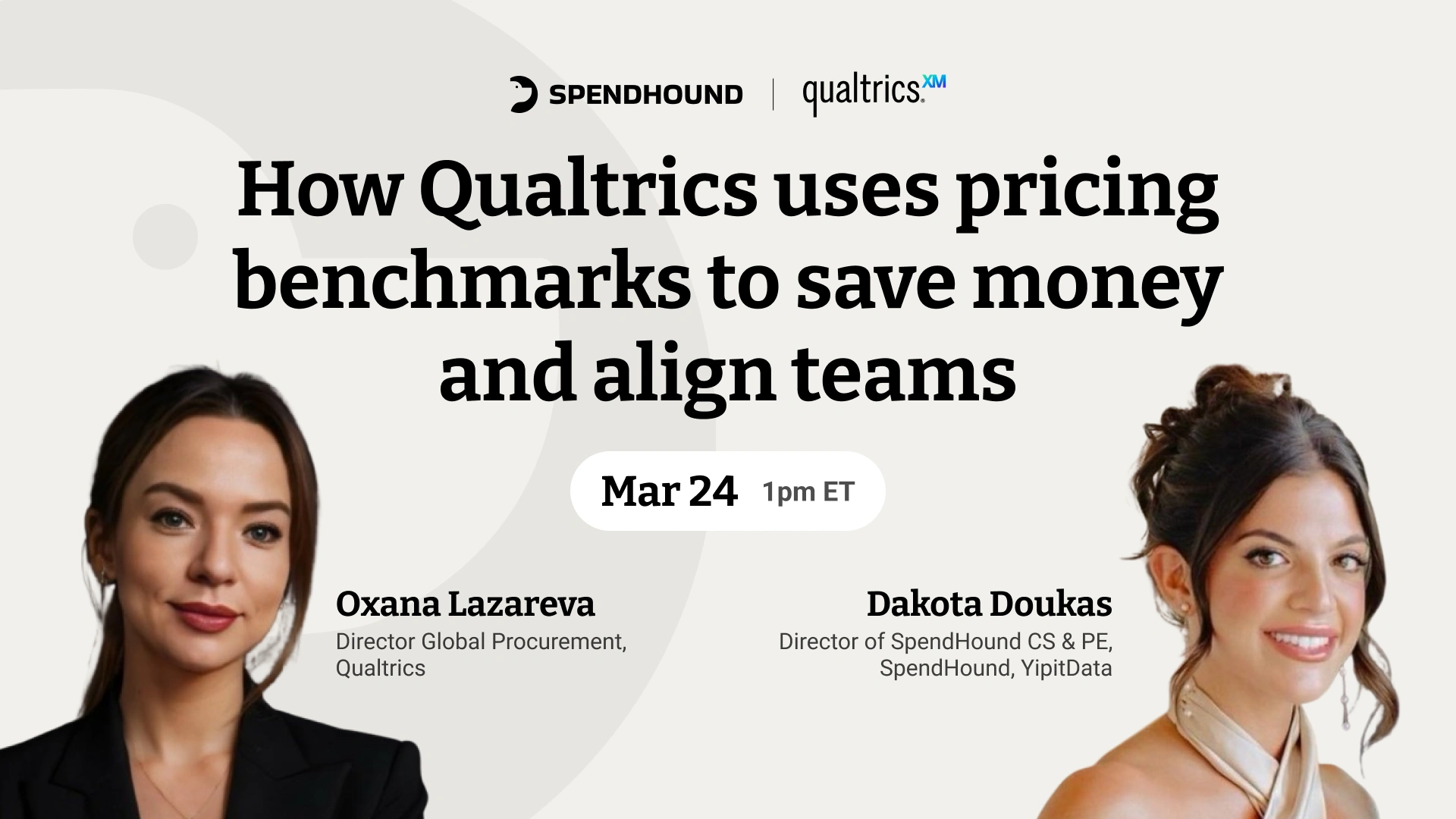
Qualtrics’ Director of Global Procurement on using pricing benchmarks to separate the SaaS renewals that need attention from the ones that don’t, and to give every stakeholder the same data to work from.
If a procurement team manages hundreds of SaaS vendors, most renewals come and go without a deep pricing review.
The team has no fast way to tell whether a contract is priced competitively or just priced normally. Without benchmark data specific enough to compare against, every price looks reasonable, and the renewals worth renegotiating are invisible.
That makes internal conversations harder. When procurement flags a renewal without data showing where the pricing sits relative to market, finance and IT each bring a different assumption about whether the spend is justified.
Benchmarks give everyone the same reference point, turning the conversation into a shared evaluation instead of a series of competing opinions.
SpendHound works with procurement teams that face this exact scenario at scale, providing pricing benchmarks built from real transaction data across its panel of over a thousand companies.
In our latest webinar, Dakota Doukas, Director of Client Strategy at SpendHound, hosted Oxana Lazareva, Director of Global Procurement at Qualtrics. Oxana shared how her team uses benchmarks to prioritize renewals, run better conversations with internal stakeholders, and maintain vendor relationships while still driving savings.
The session covered:
You can watch the full session recording here to see everything that didn’t make it into our recap.
At Qualtrics, procurement manages hundreds of software deals, and Oxana made clear that the complexity starts before negotiations begin.
“Some suppliers are charging per seat, per license. Some of them have consumption-based pricing. The next one has some super creative SaaS fees you’ve never seen before, with platform tiers”.
Every deal has a different pricing structure, and they don’t arrive on a manageable schedule. Renewals stack up simultaneously, each with its own stakeholders, timelines, and business case requirements.
Business owners want tools renewed. Finance wants justification. Procurement is building a case with ROI, savings, and efficiencies, all while managing volume that makes a thorough review impossible for every deal.
Oxana pointed out that vendors understand this dynamic and use it to their advantage.
“They are counting on the fact that you don’t have time to figure out whether it’s competitive or not. And of course, they’re going to tell you that you’re getting the best deal, that this is the best discount you’ve ever gotten in your life”.
Oxana described the core problem as an information imbalance. Vendors often set pricing based on what they believe they can charge, and without external data, procurement has no way to verify whether a quoted rate is competitive, average, or inflated.
“The vendors are really holding the cards on pricing, or at least they think they do”.
The internal consequence matters just as much. Without benchmark data, procurement goes to stakeholders and finance with statements like “I think I can do better on this deal, but I’m not sure”, referencing past experience or vague recollections of similar negotiations.
It’s what Oxana and Dakota described as the gap between gut feeling and confidence.
“One thing is when you tell your stakeholders that you have a gut feeling. Another thing is when you’re telling them, I know for sure—here’s what companies like us are paying today”.
Benchmarks move the conversation from estimation to evidence, showing what the market actually looks like for a specific product at a given scale. That changes how savings targets are set, how strategies are developed, and how confidently procurement can pursue specific opportunities.
When a quoted rate sits above the fair market range, Oxana’s team can quantify the gap—identifying, for example, that an offer is 10% higher than what similar companies are paying—and use that as a specific negotiation target rather than an open-ended request for price improvement.
“Benchmarks change the whole foundation of the conversation. Instead of debating whether a discount is good, I can see exactly where it sits relative to best-in-class ranges at comparable volume”.
Oxana and Dakota emphasized that benchmarks reveal what renewal caps other companies are securing, which vendors are flexible on terms and which consistently hold firm, and what support pricing looks like.
SpendHound’s benchmarks also filter which renewals deserve attention in the first place. When Oxana’s team pulls benchmarks across a pipeline of upcoming renewals, some show large gaps between the current deal and market rates, while others confirm the pricing is already sound.
For a team managing Qualtrics’ volume, that filtering is what makes the workload manageable.
When Dakota asked which signals actually drive decisions, Oxana outlined three things she looks for in every benchmark report.
“The pricing benchmark needs to be specific enough to point to the gap and allow you to build a strategy”.
Oxana was equally clear about what she filters out. She emphasized evaluating deals holistically—user rates, renewal caps, support pricing, add-on fees, consumption thresholds—and modeling scenarios for headcount changes to test whether a deal holds up under different conditions.
Oxana and Dakota highlighted how much pricing variation exists, even between companies that look similar on paper.
“You can have two very similar companies paying completely different rates for the same product. And it can be so many reasons why. It could be that they bought it at a different time. Some of them negotiated harder. Some of them have benchmarks, some of them don’t”.
Oxana’s conclusion from seeing these patterns is that pricing in SaaS is not set by an objective formula. It reflects what the vendor believes they can charge in a specific deal, which means rates differ by region, by vendor maturity, by when the contract is signed, and by how much market data the buyer brought to the table.
She also pointed to broader market dynamics that make benchmarks especially important right now. Technology categories are shifting fast, and the top vendors in a Gartner quadrant last year may not hold those positions today. AI-related tools are getting more expensive as pricing models incorporate consumption-based charges for model usage. Meanwhile, other categories are commoditizing, which creates downward pricing pressure that buyers won’t capture if they aren’t tracking the trend.
Dakota expanded on this, noting that SpendHound also provides alternative vendor options and rough benchmarks for substitutes in each category. If a team is approaching a CRM renewal, for example, SpendHound can surface which newer vendors are gaining traction alongside incumbents like Salesforce and HubSpot, giving procurement a genuine alternative to evaluate.
Oxana called this her favorite topic and said it deserved its own webinar.
“Benchmarks completely change the internal conversation. You never work alone, and you never win alone. You always have stakeholders, partners, executives, and finance. And what benchmarks help do is create a shared internal language”.
Procurement can now show where each contract is compared to market rates, backed by data on what companies with a similar profile are paying. And when the benchmark confirms that the deal is already competitive, it validates past negotiation work, reinforces the relationship between procurement and the business unit, and adds to procurement’s credibility for future conversations.
“It builds trust and relationships. You’re not looked at as the bad guy that just cuts everything and has unrealistic targets. You become a reasonable ally”.
Oxana described presenting savings results to leadership and executives on a monthly basis, tracking progress against annual targets, breaking down which strategies generated results, and keeping everyone informed throughout.
Dakota and Oxana raised the tension many procurement leaders navigate: how to push for savings without damaging the vendor relationship their team might depend on.
They challenged the assumption that aggressive targets and strong relationships are in conflict.
“When you do it the right way, it actually strengthens your relationship. You’re not walking in and saying that what they’re giving you is not worth it. You’re saying, we’re in a true partnership here”.
She described how her team uses benchmark data to ask specific, grounded questions, like why a company at the same scale and user count is getting better pricing for the same product. Vendors respond to that approach differently because it demonstrates preparation and market knowledge, which makes the negotiation more productive for both sides.
“Benchmarks make you look more credible. Nobody wants to talk to a person who’s just sitting there bluffing”.
Oxana also shared a practical signal she watches for during negotiations. When a vendor gets defensive about benchmark data, it usually indicates that the data is close to their actual pricing flexibility. Vendors who have genuinely offered their best price tend to hold their position calmly without challenging the data’s validity.
Oxana was clear that benchmarks are one input into a broader negotiation strategy. She also brings in long-term partnership plans, category strategy, and competitive alternatives, sometimes inviting multiple vendors to compete for the business and using their pricing as an additional reference point alongside the benchmark data.
Watch the full session recording to hear Oxana’s complete answers to Dakota’s and the audience's questions on vendor pushback tactics, benchmark thresholds, and savings tracking that didn’t make it into this recap.
And if you want to see how SpendHound’s pricing benchmarks and vendor intelligence can help your team prioritize renewals and negotiate from a stronger position, book a demo here.