NEW
NEW RESEARCH
AI Spend Report: See how 172 leaders are budgeting for AI Get the report
WEBINAR
AI Spend in 2026: What finance should do next Save your spot


The top Vendr alternatives in 2026 include SpendHound, Tropic, Spendflo, CloudEagle, Zylo, Torii, Zluri, and Cledara. While some compete directly with Vendr on pricing benchmarks and negotiations, others take a broader approach to managing AI and SaaS spend or focus more heavily on procurement and software governance.
Vendr is known for its software pricing intelligence and negotiation services. In June 2026, Vertice acquired Vendr, bringing those capabilities into its broader procurement platform. That changes the decision for teams evaluating alternatives. Rather than comparing similar procurement services on price alone, Finance and Procurement teams should consider how much of the purchasing process they want a platform to manage and how they want vendor negotiations handled.
This guide compares the strengths, limitations, pricing, and best-fit use cases of the leading Vendr alternatives so you can determine which approach best matches your priorities.
One note before we start: SpendHound is included in this list, and we’ve tried to evaluate every vendor as fairly and transparently as possible.
Most companies evaluating Vendr alternatives are trying to solve for one or more of these three things: wanting more control over vendor negotiations, needing broader AI and SaaS spend management, or looking for a different approach to procurement. The majority of Vendr’s overall customer reviews on G2 and Capterra are positive, but a few recurring themes are worth considering:
Vendr puts software pricing and negotiations at the center of its offering, with AI negotiation agents and procurement experts available to help teams execute deals. Many organizations value that support, while others prefer to keep vendor relationships and negotiation execution primarily in-house.
Some lower-rated customer reviews have noted that introducing an intermediary into vendor conversations can add steps to the process or slow simpler renewals. In one example, the internal team ultimately stepped back into a negotiation after Vendr was unable to materially improve the terms. Another reviewer said renewals that previously took days became slower after adding an intermediary.
The tradeoff comes down to how your team wants negotiations handled. Some organizations want more execution support, while others want market pricing context and expert guidance without giving up ownership of the vendor relationship.
Vendr is primarily focused on software pricing intelligence and negotiations. For some Finance and Procurement teams, however, evaluating a contract is only one part of managing software spend.
Those teams may also need ongoing visibility between purchasing decisions and renewals. Understanding software usage or tracking variable AI consumption can become just as important as negotiating the original agreement. In that case, buyers may evaluate alternatives that approach purchasing and negotiations as part of a broader AI and SaaS spend management lifecycle.
Some Vendr reviewers have cited navigation, in-platform collaboration, and reporting depth as areas for improvement. One enterprise reviewer described Vendr as lacking “effective reporting and functionalities that make it easy to navigate around the solution.” Vendr actively solicits customer feedback and continues investing in the platform, but these workflow concerns appear frequently enough in reviews that they’re worth considering during evaluation.
This becomes especially relevant for organizations with more complex reporting, collaboration, or workflow requirements. When evaluating alternatives, consider how well the platform fits into the processes your team already uses and how much operational customization you actually need.
*All pricing checked as of 9/3/26. Vendor pricing models change frequently.
The best Vendr alternatives differ on pricing structure, benchmark data quality, procurement workflows, SaaS visibility, and time-to-value, not just feature checklists.
Most alternatives lists collapse into a feature checklist: does it benchmark prices, track renewals, integrate with NetSuite? Nearly every tool in this category does all of those things. The differences that actually matter are structural.
Vendr no longer publishes platform pricing, and many alternatives in this category also require a sales conversation. That makes it important to understand not only the quoted price, but what causes that price to change.
Ask how platform fees are calculated, whether negotiation services cost extra, and whether implementation or additional modules affect the total cost. A lower starting price doesn't necessarily mean a lower long-term cost if important capabilities sit outside the base platform.
Some platforms charge primarily for software access. Some charge for negotiation labor. Some charge for benchmark dataset access. Others bundle all three together without clearly separating the components.
Understanding exactly what’s included in the price is critical during evaluation. It’s often the difference between a predictable procurement operating cost and an unexpected scope-creep problem six months later.
Benchmark coverage varies significantly across vendors. Ask:
Benchmark quality is one of the biggest differentiators between Vendr competitors like SpendHound, Tropic, and Spendflo, but it’s also one of the hardest things to evaluate from a marketing website alone. Ask whether benchmarks come from actual customer contracts and transactions or vendor-supplied rate cards, and how many companies contribute data.
Vendr combines pricing intelligence with AI and human support for software negotiations. Alternatives take different approaches. Some give your internal team data and expert guidance, while others can take a more active role in executing the negotiation.
Decide how much ownership you want to retain before comparing platforms. A team with experienced procurement professionals may value direct access to benchmarks and expert advice differently from one that wants negotiations handled on its behalf.
Vendr is centered primarily on software pricing and negotiations. Other alternatives extend further into procurement orchestration or AI and SaaS spend management, while platforms such as Zylo, Torii, and Zluri put more emphasis on software governance, usage, or identity.
The right choice depends on the problem you're actually trying to solve. If you already have procurement processes in place, you may not need another system to run them. If you're trying to centralize procurement itself, workflow depth becomes much more important.
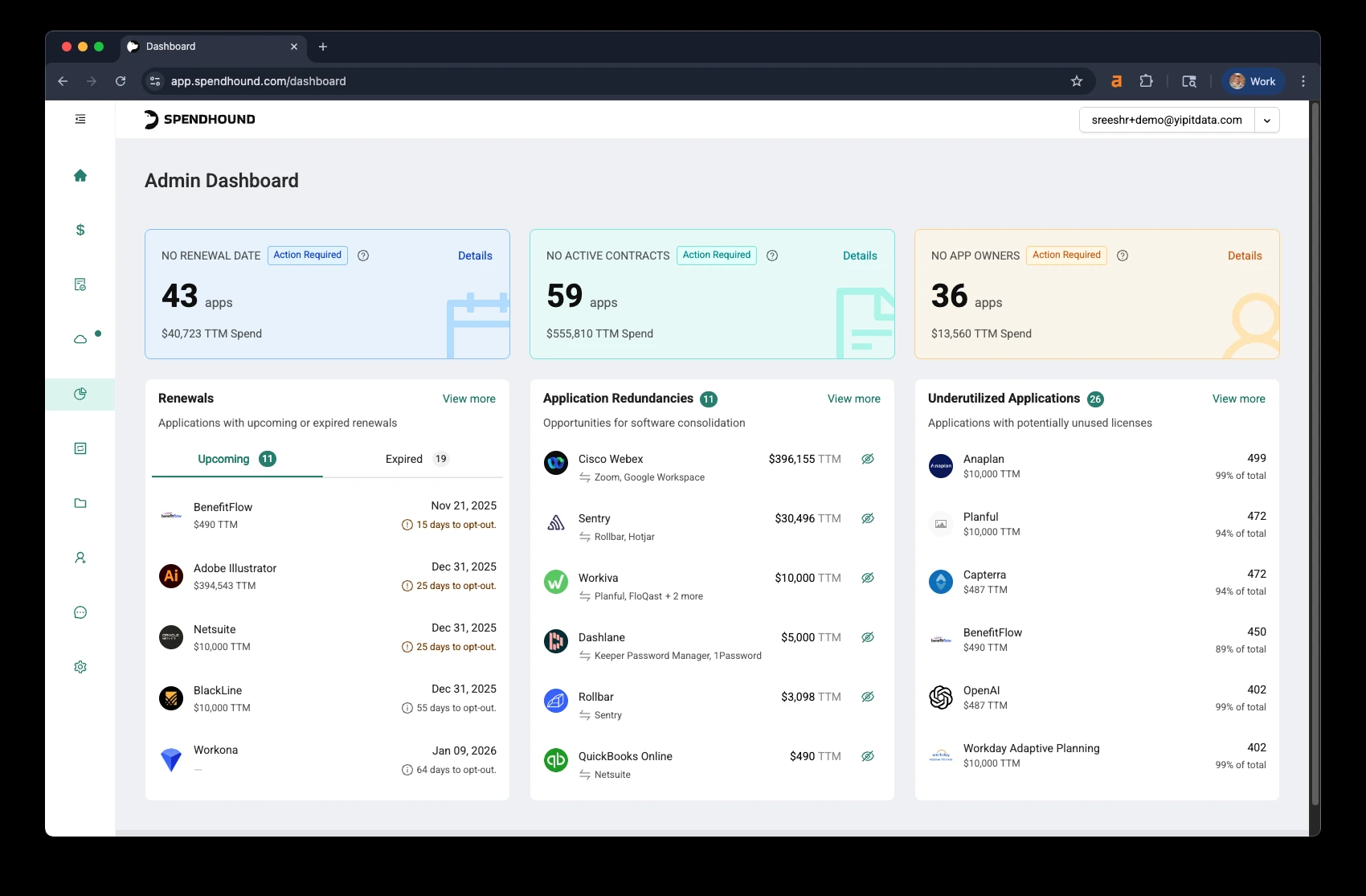
SpendHound is an AI and SaaS spend management platform that helps Finance, Procurement, and IT teams manage software spend while making more informed purchasing and renewal decisions. The platform combines AI and SaaS spend visibility with renewal management, license usage insights, Vendor Intelligence, and procurement support.
A key differentiator is Vendor Intelligence. SpendHound gives teams direct access to market pricing benchmarks and vendor insights alongside their own spend and contract data. Teams can use this market context to negotiate internally with support from SpendHound's procurement experts, while Managed Negotiations are available as an optional service for organizations that want SpendHound to take a more active role.
Not the right fit if: You want a platform to run complex procurement processes end to end, including strategic sourcing and RFP management. SpendHound is designed to work with existing procurement processes while adding AI and SaaS spend management, Vendor Intelligence, renewal management, and procurement expertise.
Compared with Vendr: Both platforms provide software pricing intelligence and negotiation support, but they emphasize different parts of the vendor lifecycle. Vendr puts greater emphasis on software pricing and negotiation execution. SpendHound combines Vendor Intelligence with broader AI and SaaS spend management, giving teams market context alongside their spend, renewals, and usage data. SpendHound also gives teams flexibility to retain ownership of negotiations with support from procurement experts or use optional Managed Negotiations when they want SpendHound to execute the negotiation.
See our full Vendr vs. SpendHound comparison for a feature-by-feature breakdown.
Benepass used SpendHound’s benchmark reports to negotiate better software pricing without a dedicated procurement team. Instead of relying on Slack groups for pricing intel, the team received benchmark ranges and negotiation recommendations within a day. One upgrade alone saved $7,000, and the company estimates overall software savings of up to 30%.
Fusion92 connected SpendHound to NetSuite and their AP system to consolidate software visibility after multiple mergers. The team reviewed more than 200 tools, completed 12 consolidations, and identified $345,000 in savings for 2025, with another $900,000 projected for 2026. According to VP of Operations Michelle Gawley, benchmark data gave their team significantly more leverage in vendor negotiations.
Kit evaluated larger procurement platforms before choosing SpendHound. Within three weeks, the company achieved full vendor visibility and negotiated more value from HubSpot at a lower cost. Head of Finance Anthony Wakim described SpendHound as “leverage,” not just software.
Tropic is a SaaS spend management and procurement orchestration platform built for companies that want a structured, process-driven approach to software purchasing and renewals. Compared with SaaS management tools focused more heavily on visibility and usage, Tropic emphasizes procurement workflows, Supplier Intelligence, and managed negotiation support.
*Pricing per Tropic’s pricing page, accessed September 3, 2026.
Not the right fit if: You primarily want software pricing intelligence and negotiation support without adopting broader procurement workflows. Tropic is better suited to teams that want to structure more of the SaaS purchasing process within a procurement platform.
Want to see how SpendHound and Tropic compare? Check out our Tropic vs. SpendHound article.
Spendflo is an AI-native procurement platform that combines intake and procurement workflow automation with pricing benchmarks and vendor negotiations. Compared with Vendr's emphasis on software pricing intelligence and negotiation execution, Spendflo puts more emphasis on automating the broader procurement process from request through approval and purchasing.
Its conversational intake experience allows employees to initiate procurement requests in natural language, which are then routed through the appropriate workflows. This makes Spendflo particularly relevant for teams that want negotiation support alongside more structured procurement automation.
Not the right fit if: You primarily want software pricing intelligence and negotiation support without implementing broader procurement workflows. Spendflo is better suited to organizations that want AI-powered intake and workflow automation alongside purchasing and negotiation capabilities.
Want to see how SpendHound and Spendflo compare? Check out our Spendflo vs. SpendHound article.
CloudEagle is a SaaS, identity, and AI governance platform that combines software management with procurement capabilities. Compared with Vendr's emphasis on software pricing intelligence and negotiations, CloudEagle extends further into application governance, identity, security, and AI management while still supporting software procurement and pricing benchmarks.
This makes CloudEagle particularly relevant for organizations that want procurement capabilities within a broader platform for managing and governing their software and AI environment.
Not the right fit if: Your primary need is software pricing intelligence and negotiation execution rather than broader SaaS and AI governance. CloudEagle is better suited to organizations that want procurement capabilities alongside software management, identity, and governance in the same platform.
Zylo is a SaaS management platform focused on helping organizations manage software and AI spend, application discovery, license utilization, renewals, and governance. It is particularly well suited to teams that need deep visibility and control across a large software portfolio.
Compared with Vendr's focus on software pricing intelligence and negotiations, Zylo puts greater emphasis on portfolio management and operational optimization. Its capabilities help teams understand what applications they have, how they're being used, and where licenses or spend can be optimized across the organization.
Not the right fit if: Your primary need is software pricing intelligence, procurement expertise, or vendor negotiation execution. Zylo is designed more heavily around SaaS and AI portfolio management, governance, and license optimization.
Want to see how SpendHound and Zylo compare? Check out our Zylo vs. SpendHound article.
Torii is a SaaS, identity, and AI management platform focused on helping IT teams discover and manage applications, optimize licenses, automate employee lifecycle workflows, and govern AI usage. The platform places a strong emphasis on automation and operational control across the software environment.
Its workflow capabilities can automate tasks such as onboarding, offboarding, and license reclamation, while its AI management capabilities give organizations visibility into AI applications, usage, token consumption, and spend.
Not the right fit if: Your primary need is software pricing intelligence, procurement support, or vendor negotiations. Torii is designed more heavily around SaaS and AI management, identity governance, and IT automation.
Zluri is an identity governance and security platform designed to help organizations manage access across human and non-human identities, including employees, service accounts, and AI agents. Its capabilities span Identity Governance and Administration (IGA), identity security, and SaaS management.
Zluri has expanded beyond its roots in SaaS management to put greater emphasis on identity governance and security. Its SaaS management capabilities still provide application discovery and usage visibility, while its identity products focus on controlling access and managing identity risks across increasingly complex environments.
Not the right fit if: Your primary need is software pricing intelligence, procurement support, or vendor negotiations. Zluri is designed more heavily around identity governance, access management, and identity security.
Cledara is a software purchasing and subscription management platform that combines payments, virtual cards, spend controls, and renewal tracking. Unlike procurement platforms centered on negotiations or pricing intelligence, Cledara gives Finance teams control over software purchasing through the payment layer itself.
Each software subscription can be assigned its own virtual card with configurable budgets and spend controls. Cledara also centralizes subscription data, invoices, and renewals, making it particularly relevant for Finance teams that want greater control over how software is purchased and paid for.
*Pricing per the Cledara pricing page, accessed September 3, 2026.
Not the right fit if: Your primary need is software pricing intelligence, vendor negotiation support, or broader procurement workflows. Cledara is designed more heavily around controlling how software is purchased and paid for than managing the commercial negotiation process.
The best Vendr alternative depends on what your team needs beyond software pricing and negotiations. Some organizations want broader visibility and control across their AI and SaaS spend. Others need more structured procurement workflows or are primarily trying to improve how software is governed and used.
The right fit also depends on how your team wants negotiations handled. Consider whether you want to retain ownership with expert support, have a provider execute negotiations on your behalf, or make negotiation one part of a broader procurement process.
Vendr and SpendHound both help Finance and Procurement teams make better software purchasing decisions, but they emphasize different parts of the vendor lifecycle.
SpendHound is the best Vendr alternative for organizations that want AI and SaaS spend management alongside Vendor Intelligence and procurement expertise. Teams get market pricing context as part of a broader view of their software spend, while retaining flexibility in how negotiations are handled. They can negotiate directly with support from SpendHound's procurement experts or use optional Managed Negotiations when they want SpendHound to execute the deal.
Still evaluating? Compare Vendr vs. SpendHound side by side, or book a demo to see SpendHound for yourself.
<p>Vendr is a software pricing intelligence and negotiation platform that helps Finance and Procurement teams benchmark software pricing and negotiate vendor agreements. Its capabilities include SaaS pricing data, negotiation insights, contract intelligence, and AI negotiation agents. Vertice acquired Vendr in June 2026, but Vendr continues to be available as a standalone offering focused primarily on software pricing and negotiations.</p>
<p>The best Vendr alternative depends on your priorities. SpendHound is a strong alternative for organizations that want AI and SaaS spend management alongside Vendor Intelligence, renewal management, and procurement expertise. Tropic and Spendflo are better suited to broader procurement workflows, while CloudEagle combines procurement with SaaS and AI governance. Zylo and Torii are stronger options when software portfolio management and optimization are the priority.</p>
<p>When comparing Vendr alternatives, consider the depth and accessibility of pricing benchmarks, how negotiations are handled, and how the platform fits into your existing procurement process. You should also evaluate whether you need broader AI and SaaS spend management or a more comprehensive procurement platform. Finally, compare pricing models and what services are included so you understand the total cost of each option.</p>
<p>Vendr does not currently publish platform pricing. Organizations need to contact Vendr for pricing based on their requirements. When comparing Vendr with alternatives, look beyond the quoted platform price and determine what is included, particularly access to pricing intelligence, negotiation services, and other procurement capabilities. This can help you compare the total cost of different pricing and service models.</p>
<p>SpendHound and Vendr both provide software pricing intelligence and negotiation support, but they emphasize different parts of the vendor lifecycle. SpendHound combines Vendor Intelligence with broader AI and SaaS spend management, including spend visibility, renewals, and usage insights. Teams can retain ownership of negotiations with support from SpendHound's procurement experts or use optional Managed Negotiations. Vendr focuses more heavily on software pricing intelligence and negotiation execution.</p>
<p>Yes. SpendHound and several other software procurement platforms offer pricing benchmarks similar to Vendr. SpendHound provides vendor, product, and tier-level pricing intelligence across more than 10,000 AI and SaaS vendors, using data contributed by over 1,300 companies. Tropic and other procurement platforms also provide software pricing intelligence, although benchmark coverage, granularity, methodology, and accessibility vary by provider.</p>