NEW
NEW RESEARCH
AI Spend Report: See how 172 leaders are budgeting for AI Get the report
WEBINAR
AI Spend in 2026: What finance should do next Save your spot


Finance and procurement teams have more SaaS data than ever, but most still can’t tell you what they should be paying for a vendor. Sure, the data exists (vendors have it, teams share pieces of it in Slack) but it’s all over the place and mostly self-reported. Getting a number you can act on takes more time than most teams have.
That tension (between insight and execution) is what SpendHound’s April product webinar was all about. Sam Voshall, Sr. Product Marketing Manager, and Sreesh Reddy, Director of Product, walked through three new features: Approvals, Vendor Trends, and In-Platform Benchmarking (coming soon). Dakota Doukas, Director of Client Strategy & PE, joined to cover the Procurement Expert team and the results they’re delivering for customers.
Top takeaways:
Every team we work with is managing more vendors than they were two years ago. AI tools are accelerating that spread significantly, and unlike traditional SaaS seats, AI costs expand mid-contract based on usage.
Sam framed the current environment:
“More tools, different models, more experimentation, more spend. It's not just the challenge of seeing it, but it's actually managing, executing, and supporting all of this.”
YipitData’s data put context behind what most finance and procurement leaders are already sensing: When a single vendor’s average annual cost rises from $1,800 to $23,000 in a year, the old way (quarterly spreadsheets, manual renewal tracking) breaks down entirely.
One of the biggest gaps we see across 1,300+ customers is around intake. Even teams with solid visibility struggle with new vendors entering their environment outside any formal process.
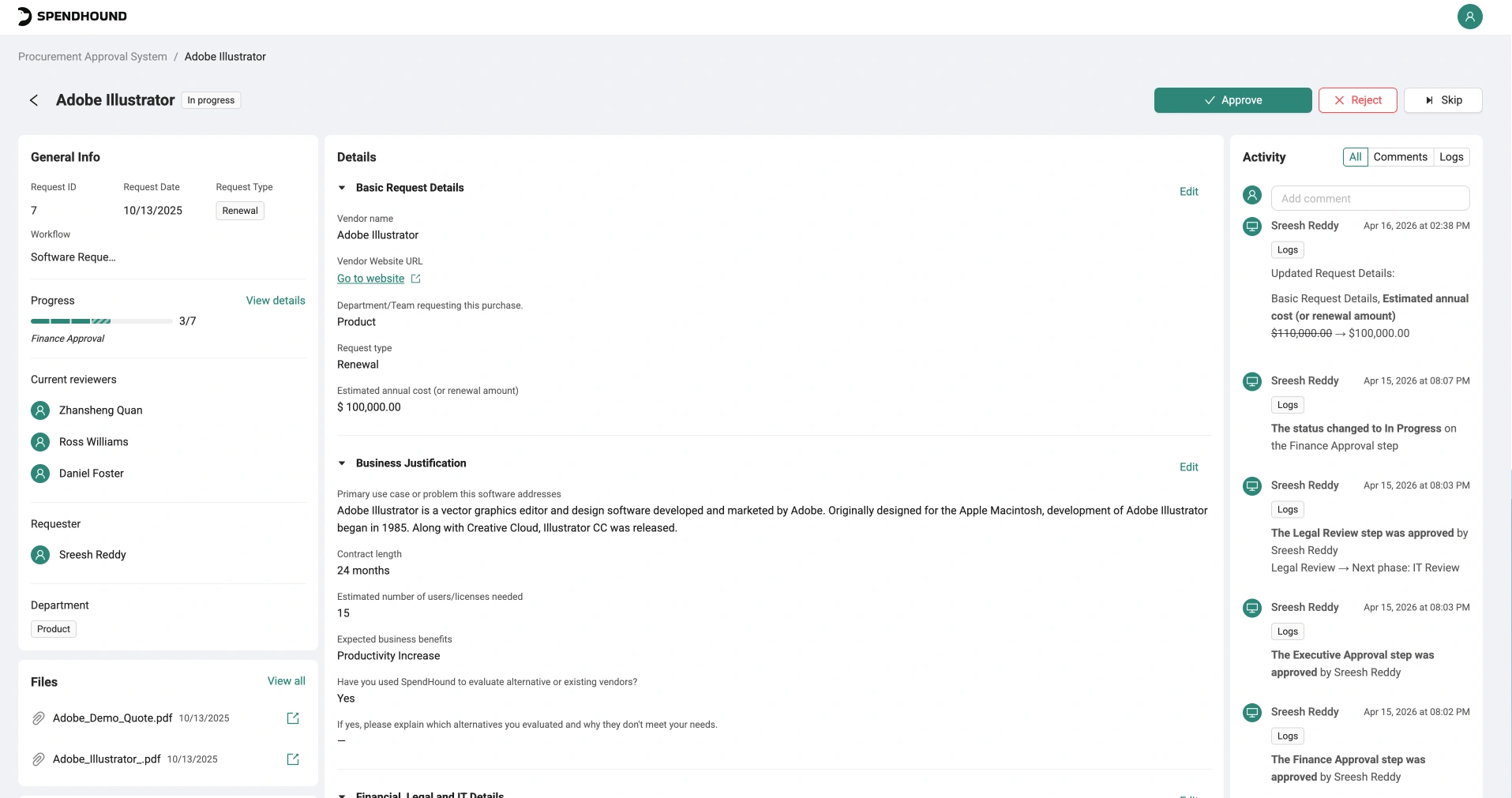
With our new Procurement Approval Workflows feature, now available in-platform to all customers, every employee can access a lightweight approvals module where purchase requests route through customizable workflows before any spend is committed.
Sreesh walked through the design philosophy behind it:
“We want to help you get more control and organization around the process, but we don't want to add so much control and process that it becomes a huge burden on your requesters and approvers.”
A few design decisions are worth noting from the demo:
The approvals workflow also maintains full audit trails (who approved, who rejected, when, and why) which matters more as procurement teams are asked to demonstrate governance to finance and legal.
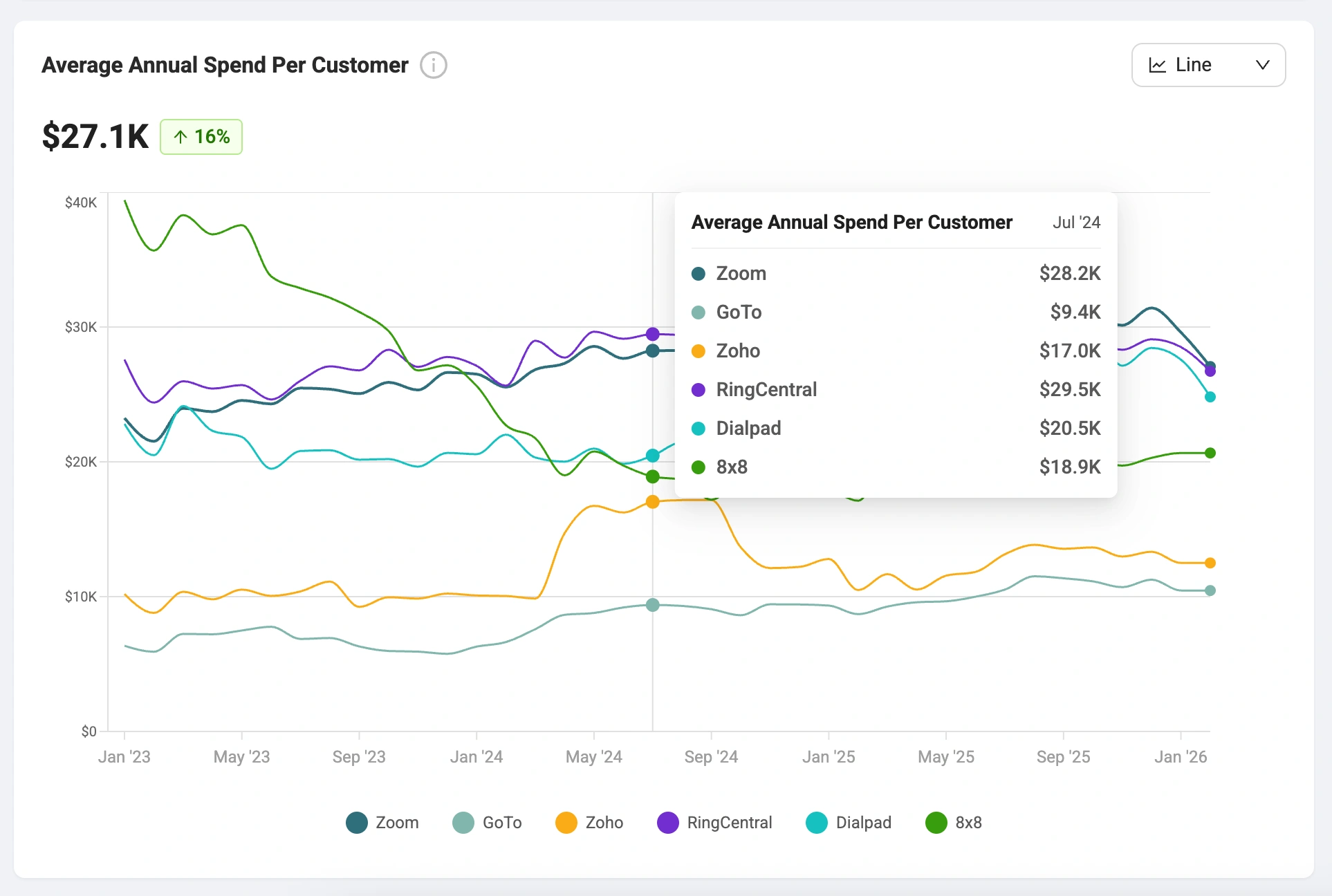
Vendor Trends covers over 10,000 SaaS and non-SaaS vendors across SpendHound’s panel. Its intended use case is early-state sourcing research: before the first call, not as a replacement for benchmarking.
Sreesh used recruiting software as an example (Lever, Greenhouse, and Ashby) to compare customer count and average spend trends over time. The data comes from SpendHound’s customer panel, which means it reflects actual adoption and spend behavior, not self-reported figures or analyst estimates.
What we heard from Sreesh was that one vendor has been increasing prices while simultaneously growing its customer count:
"As a finance, procurement, or HR person, what that tells me is that this vendor isn't increasing its customer count by undercutting on pricing. What it's actually doing is increasing pricing, which means their product suite must be much better.”
The competing vendor, by contrast, showed customer count on a gradual decline. Relevant context if you're heading into a renewal and want to understand your negotiation levers.
Sreesh's recommendation was to make Vendor Trends a shared resource:
“Finance and procurement should have access, but you should also share this with your department heads so they can better rationalize their tech stack in advance of renewals or new purchases.”
For teams that have historically struggled to get business unit leaders engaged in vendor reviews, this kind of market data may be a more practical lever than a spreadsheet.
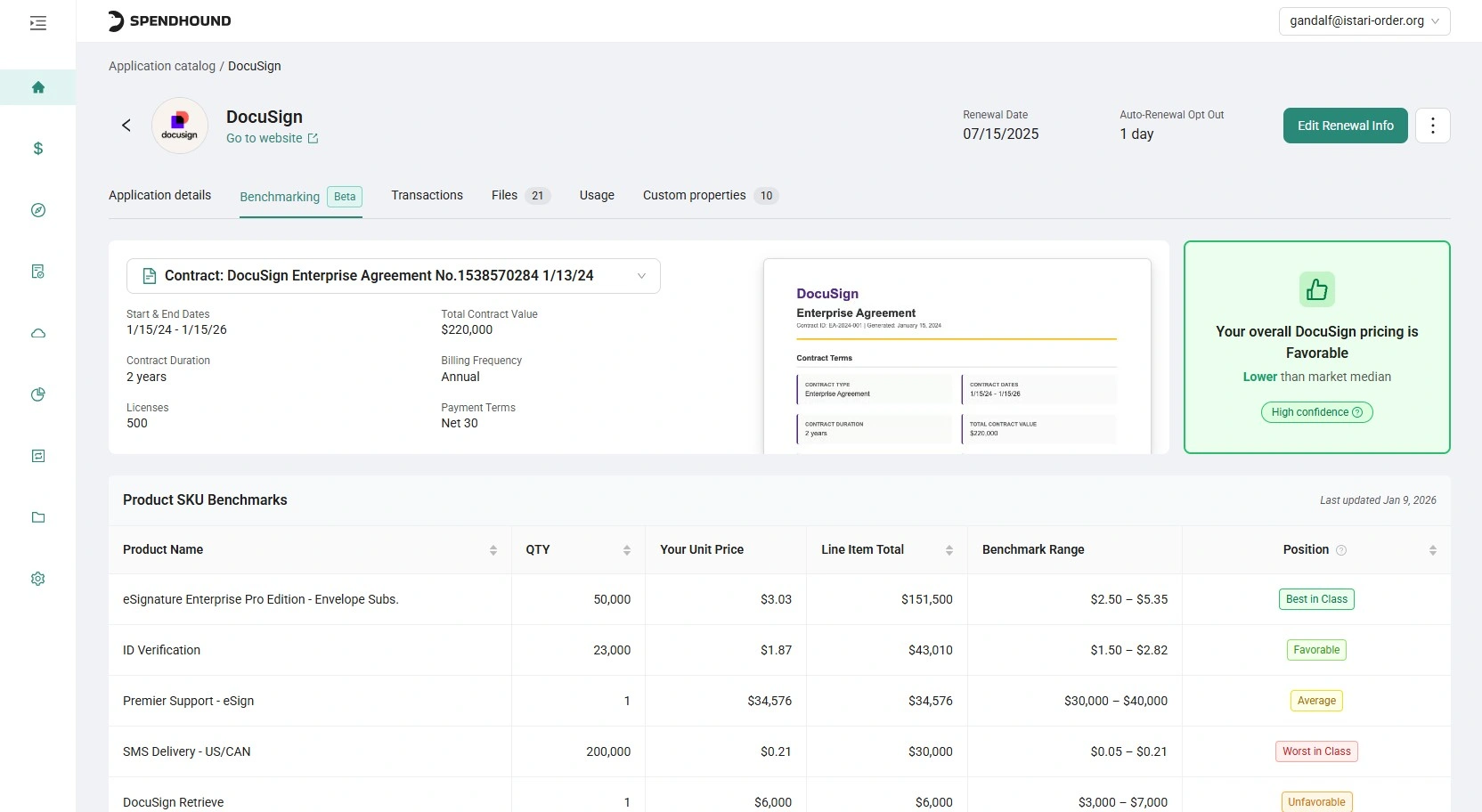
One of the more exciting previews during our session was In-Platform Benchmarking, currently in final development and launching soon.
In-Platform Benchmarking addresses a huge triage gap: A user opens a vendor in SpendHound, uploads a contract (or selects an existing one), and the platform parses the document automatically, extracting contract-level details like total contract value and duration, plus product line items including SKU, quantities, and unit price. The system then groups each product's unit pricing into a benchmarking cohort and returns a percentile ranking: best-in-class, competitive, above market, or worst-in-class.
Sreesh was clear about its intended use:
“Finance and procurement teams don't have a lot of time. This is not your core job. What this allows you to do is quickly see: is this a contract worth digging into and trying to negotiate?”
If the benchmark shows your pricing is competitive, move on. If it shows you’re above market, escalate to the SpendHound Procurement Expert team for negotiation strategy. We’re not replacing the deeper work, but instead showing you when more work is worth pursuing.
Sam made a point of separating insight from outcomes early in the session: “We know that insight alone doesn't save our customers money.”
Dakota then walked through what the Procurement Expert team delivered for customers this month:
“$300K in savings [for one], $250K in savings [for another]. This month alone, we helped customers reduce costs across key vendors by double-digit percentages.”
The Procurement Expert service is included for every SpendHound customer, and it’s the service they’re most likely to return to repeatedly. It covers any vendor, with no cap on requests. Every engagement is tailored to your specific contract with vendor benchmarks, talk tracks, and ghostwritten emails included.
When asked about deal size thresholds, Dakota gave a rule of thumb: deals over $10,000 tend to have more room to negotiate, but SpendHound will look at any request of any size. And we’re transparent when benchmarking coverage is limited.
Sam’s closing made things clear: Vendor Trends and In-Platform Benchmarking answer the questions of what to buy and what to pay, while Approvals controls how new spend enters the system. Then the Procurement Expert team arms you with custom insights whenever you need them.
Heading into a renewal without a clear sense of what’s worth negotiating? Book a demo to see how SpendHound gives you the data and Procurement Expert support to act on every opportunity.