NEW
NEW RESEARCH
AI Spend Report: See how 172 leaders are budgeting for AI Get the report
WEBINAR
AI Spend in 2026: What finance should do next Watch now


AI spending is growing faster than most organizations know how to manage.
For more than a decade, software budgets were relatively predictable. Companies bought licenses, negotiated annual contracts, and forecasted spending based primarily on headcount. AI has changed that.
AI spend no longer depends only on how many people have access to a tool. It also depends on how often those tools are used. Subscription fees are increasingly layered with API consumption, token usage, and other variable costs, so a budget approved at the beginning of the year can look completely different just a few months later.
While usage-based pricing isn't new, AI makes usage far harder to predict. A single prompt costs almost nothing, but thousands of employees using AI throughout the day — or autonomous agents running continuously in the background — can drive usage far beyond what companies expect and have budgeted for.
Recent headlines suggest this isn't an isolated budgeting mistake. It's a structural shift in how software is purchased and consumed. Processes built around predictable SaaS renewals don't translate well to AI, where costs can change dramatically as adoption grows.
At SpendHound, our procurement experts are seeing a new pattern play out across AI vendor negotiations. The organizations managing AI spend most effectively aren't slowing adoption. They're gaining visibility into where money is going, using market benchmarks to understand what comparable companies pay, and negotiating contracts that reflect how AI is actually consumed.
This guide explains what AI spend management is, why it differs from traditional SaaS spend management, and how leading organizations keep AI costs predictable without slowing innovation.
AI spend management is the practice of tracking, forecasting, benchmarking, and optimizing AI spending across the organization. It includes subscription-based AI tools, API usage, token consumption, AI infrastructure, and other AI-related costs. The goal of AI spend management is to give finance, procurement, and IT leaders visibility into where AI dollars are going, whether spending is aligned with budget, and whether they're paying competitive market rates.
Traditional SaaS budgeting works because costs are relatively easy to predict. A company buys a fixed number of licenses, negotiates a contract, and expects spending to remain largely unchanged until the next renewal. Finance can build an annual forecast with reasonable confidence because both pricing and adoption tend to move gradually.
The budgeting model starts to break down when costs depend on consumption instead of seat count. Though usage-based pricing isn’t new, the scale, volume, and uncertainty of usage sparked by AI can throw even the best laid budgets out of whack. Many AI vendors charge for API usage, token consumption, or other usage-based metrics that increase as adoption grows. A small pilot can become a company-wide workflow in a matter of weeks, while usage continues to climb long after the contract is signed.
That's what makes AI spending fundamentally harder to forecast. Budget assumptions don't just depend on negotiated pricing. They also depend on how employees use AI over time.
Two companies with identical contracts can end the quarter with dramatically different bills simply because one adopted AI more broadly than the other.
In SpendHound's 2026 AI Spend Report, we found that 46% of finance and procurement leaders exceeded their AI budget in 2025, compared with 37% who went over on traditional finance and accounting software. At first glance, a nine-point difference may not seem significant. But these are the same organizations forecasting two different categories of spend. The gap exists because AI spending is inherently less predictable, not because finance teams suddenly became worse at budgeting.
The trend isn’t leveling off, either. Run-rate spend across OpenAI, Anthropic, and Cursor in SpendHound’s own benchmark data grew nearly fourfold between December 2024 and December 2025, then climbed another 70% by April 2026. Organizations that built their 2026 budgets using 2025 spending trends found those assumptions outdated almost immediately.
When spending can change this quickly, annual budgets and renewal calendars aren't enough. Organizations need ongoing visibility into where AI dollars are going so they can monitor spend against forecasts.
Most finance leaders have a rough idea of what they're spending on AI today. Fewer can say where that number is heading, which teams are driving it, or whether the current pace is expected. That's the difference between reporting on AI spend and actually managing it.
Effective AI spend visibility answers three questions:
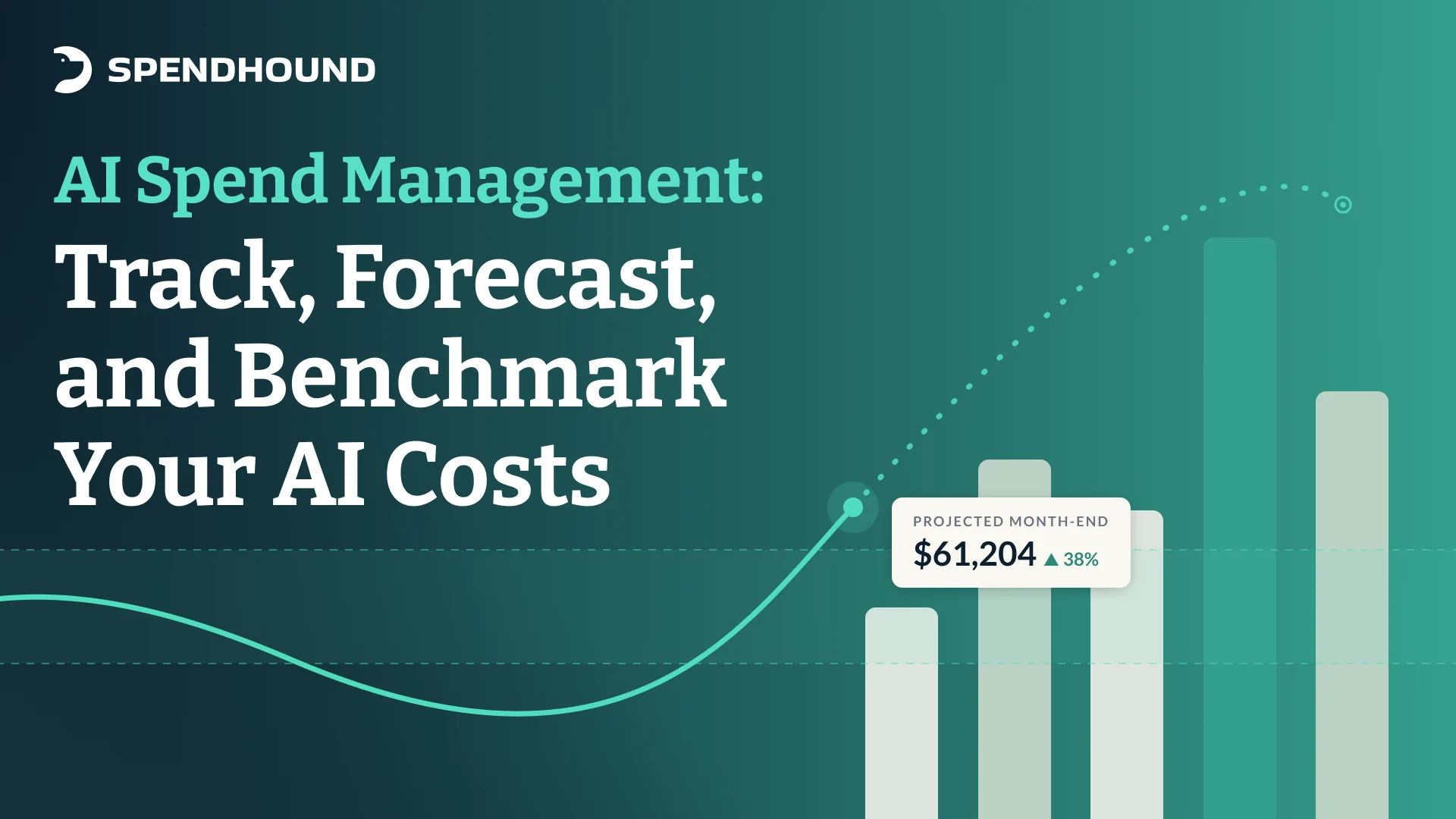
Knowing last month's invoice isn't enough when AI costs change throughout the month. Finance teams need visibility into current spending alongside projected month-end costs based on recent usage trends. That makes it possible to spot budget issues before invoices arrive instead of explaining them afterward.
The total bill only tells part of the story. AI spend visibility should show where costs are coming from, whether that's a specific vendor, model, team, project, or user. That context helps separate healthy adoption from unexpected increases and gives finance and procurement a common language for discussing spend with engineering and business leaders.
AI spending rarely becomes a problem overnight. Consumption usually increases gradually until someone notices the invoice. Effective AI spend visibility identifies those changes as they're happening, giving organizations time to investigate increased usage, adjust forecasts, or optimize costs before the end of the month.
AI spend visibility tells you what you’re spending, but it doesn’t tell you whether you’re spending too much.
That's the question finance and procurement teams eventually have to answer. A dashboard can show that AI costs increased 40% last quarter, but it can't tell you whether that growth is expected, whether you're paying above market rates, or whether comparable companies negotiated a better deal.
That's where AI pricing benchmarks become essential.
In SpendHound’s own survey data, only 43% of finance and procurement leaders said they were confident they were paying a fair price for their AI tools. More than half were either unsure or believed they were overpaying. The challenge isn't just a lack of visibility. It's a lack of context.
Benchmark data helps. It doesn't just show what one company is spending. It reveals patterns that only become visible across the broader market. In SpendHound research, for example, we found that companies using Claude reported exceeding their AI budgets at roughly three times the rate of organizations that weren't. That doesn't mean Claude is inherently more expensive or a poor choice. It highlights how benchmarking across many organizations can reveal trends that are impossible to identify from a single company's data.
Most companies don't design an AI spend management process intentionally. It just evolves piecemeal. One team adopts AI independently, another expenses an API subscription, engineering launches a pilot, and finance doesn't get a complete picture until budget planning exposes the gaps.
The organizations getting ahead of AI spend have a few practices in common.
Someone needs to be accountable for AI spending across the organization, even if engineering, IT, procurement, and finance all play a role. Without clear ownership, forecasting, vendor management, and renewals quickly become fragmented.
In SpendHound's research, 22% of finance and procurement leaders said no one owns their AI budget. That's a difficult starting point for managing a category that's growing as quickly as AI.
Traditional SaaS budgets often begin with last year's renewal value. AI requires a different approach.
Usage, not contract value, is what changes most quickly. Organizations that forecast using actual consumption trends are far better positioned to identify budget issues before they become surprises.
Visibility tells you how much you're spending. Benchmarking tells you whether that spending is competitive.
Before renewing an AI vendor, compare pricing with similar organizations and evaluate whether your contract still reflects how the product is actually being used. Usage data strengthens the conversation. Market benchmarks strengthen your negotiating position.
AI isn't just creating new vendors to manage. It's changing how organizations evaluate the software they already own.
Our recent survey revealed that 76% of finance and procurement leaders said AI is causing them to reconsider their existing vendor relationships. As more software vendors introduce AI capabilities, organizations are reevaluating where functionality overlaps, which products still justify their cost, and whether — and where — separate AI tools are still necessary.
AI spend management isn't a one-time budgeting exercise. It's an ongoing process of understanding where AI dollars are going, whether those investments are delivering value, and how they compare with the broader market.
AI spend management platforms are evolving quickly, and not every product solves the same problem. Before choosing one, ask whether it helps your team answer four questions.
A monthly invoice isn't enough. Look for real-time visibility into usage, spending, and projected costs before the billing cycle ends.
Total spend tells you very little on its own. Effective platforms let finance drill into costs by vendor, model, team, project, or user to identify what's actually changing.
Visibility explains your spending. Benchmark data explains whether your spend is competitive. That's the difference between reporting on AI costs and making informed procurement decisions.
Good AI spend management platforms don't stop at dashboards. They help organizations forecast more accurately, prepare for renewals, identify AI cost optimization opportunities, and make better vendor decisions over time.
AI isn't just another vendor to manage. It's becoming embedded across the technology stack, introducing new usage-based costs while reshaping how organizations evaluate the software they already own.
That changes the job of finance and procurement. Managing AI costs is no longer just about approving purchases or reconciling invoices. Effective AI cost management requires understanding how AI is being used across the organization, forecasting costs before they hit the budget, and using market data to make better purchasing and renewal decisions.
Organizations that succeed won't necessarily spend less on AI. They'll invest in AI more intentionally. They'll understand where AI dollars are going, know whether they're paying a competitive price, and make informed decisions that support innovation without losing control of costs.
SpendHound helps finance and procurement teams manage AI spend by combining real-time AI spend visibility with pricing benchmarks and procurement expertise. Instead of relying on provider billing dashboards alone, organizations can see how AI spending is changing across vendors, understand what's driving those costs, and compare pricing against similar companies before entering renewal discussions.
As AI adoption continues to accelerate, that combination helps teams move beyond tracking AI costs to managing them.
Request a demo to learn how SpendHound's AI Spend Visibility helps finance and procurement teams forecast AI spending and make more informed procurement decisions.
AI spend management is the practice of tracking, forecasting, and benchmarking what a company spends on AI tools and API usage. It's a different category from AI-powered procurement software, which uses machine learning to automate traditional expense and invoice workflows. Both may be generically referred to as “AI spend management,” but one manages spend on AI, and the other uses AI to manage spend on everything else.
To forecast AI budgets, start with actual consumption data rather than last year's contract value, since AI spend rarely stays flat the way traditional SaaS licenses do. Companies that build forecasts around real usage trends, with some buffer for the kind of adoption spikes seen across the industry recently, tend to land closer to their actual number than those forecasting off last year's invoice.
Seat pricing charges a fixed amount per license regardless of how much someone uses the tool. Consumption-based AI pricing charges based on actual usage, typically tokens processed, so two employees on the same plan can generate very different bills depending on how they work. That variability is what makes AI spend harder to predict with traditional budgeting methods.
To know whether you’re spending too much on AI, you need benchmark data. This is the gap most AI spend visibility tools leave open. A platform built on real spend data from other companies, not just your own usage history, is the only way to tell whether your AI bill is high, low, or right where you'd expect it to land for a company your size.
OpenAI and Anthropic’s billing dashboards are built for admins and engineers, not finance. They typically require engineering-level credentials, show only one provider at a time, and offer no benchmarking context, so there's no way to tell whether the number in front of you is reasonable. They also tend to stay high-level, without breaking spend down by user, project, or model the way finance teams need.
Yes. In SpendHound's 2026 AI Spend Report, 46% of finance and procurement leaders said they exceeded their AI budget in 2025, compared with 37% who went over budget on traditional finance software. That's not surprising. AI spending is in early stages. Many organizations are still learning how to forecast usage and establish procurement processes for new AI tools. As companies gain better visibility into AI spend, benchmark pricing against the market, and negotiate stronger vendor agreements, spending should become more predictable and budgets easier to manage.