NEW
NEW RESEARCH
AI Spend Report: See how 172 leaders are budgeting for AI Get the report
WEBINAR
AI Spend in 2026: What finance should do next Save your spot


Learn how enterprise procurement teams negotiate OpenAI, Anthropic, and other AI vendors. See benchmark pricing insights, contract terms to watch, and tactics to avoid overpaying.
.webp)
Uber burned through its entire 2026 AI coding budget by April. Not a department's budget — the company's full annual allocation, gone in four months, mostly on token consumption from tools engineers couldn't stop using.
Uber is not an outlier. According to Axios, companies are telling vendors their annual AI budgets are getting exhausted in one or two months. One unnamed enterprise client reportedly racked up roughly $500 million in a single month on Claude after failing to set usage limits.
Microsoft has begun canceling most of its internal Claude Code licenses as of June 2026, months after rolling them out company-wide, because per-engineer API costs were running $500 to $2,000 a month.
We spoke with SpendHound procurement experts who negotiate AI vendor contracts every day to understand what's actually happening inside enterprise renewals.
Zack Hildenbrandt, a Procurement Team Lead at SpendHound, says the cause is consistent across the renewals he sees. “Most enterprise teams negotiate AI contracts the same way they negotiate SaaS,” he says. “They focus on the seat count and the headline rate, and they completely underestimate how fast the usage-based charges compound. By the time the overage bill arrives, the negotiating window is closed.”
If you're negotiating generative AI pricing for an enterprise, the biggest priorities are understanding how usage-based costs can scale, preserving flexibility between vendors, benchmarking pricing against comparable companies, and negotiating protections before adoption accelerates. Based on conversations with SpendHound procurement experts, these are the negotiation tactics that matter most in today's AI contracts.
Not all AI contracts are the same negotiation. Hildenbrandt breaks the landscape into three distinct buckets: foundation model AI providers, AI-native SaaS, and traditional SaaS with AI added. The pricing mechanics, the leverage, and the right opening move are different in each one.
Examples: OpenAI, Anthropic, Microsoft Copilot, Google Gemini
These are the foundation-model providers — the companies selling access to the underlying models, either directly via enterprise tiers or through platform wrappers like Copilot. Pricing is typically a mix of per-seat fees for productivity tools and token/credit-based consumption for API access, and the same vendor often sells you both simultaneously.
The hard truth here: there’s not a lot of flexibility on price. High demand and thinner margins than traditional SaaS mean the rate card doesn’t move much. “There’s generally not a ton of flexibility with these suppliers,” says Hildenbrandt. The negotiation is structural. Don’t over-commit on usage. There’s no standard token definition, and consumption can compound quickly as agents and automated workflows scale. Get a rate card built into the agreement so you have predictability as usage grows.
Where these vendors do budge: commit to a sizeable token purchase and the vendor may waive seat fees entirely. We've seen companies exchange a $50K annual API commitment for the elimination of $20/user/month seat fees. Look for the trade, not the discount.
Examples: Clay, Cursor, Fireflies, Glean, Lovable
This bucket is the opposite end of the leverage spectrum. Outside the handful of big-name AI foundation models, most AI-native SaaS vendors are competing hard for market share and revenue — and it shows in negotiations. “We’re seeing a ton of flexibility on structure with these suppliers,” says Hildenbrandt. “Most of these suppliers are struggling for market share and willing to negotiate on just about anything in order to get a new customer.”
That means credit pools, overage rates, credit expiry, true-up mechanics, and rate caps are all genuinely in play — not just the headline seat count. Push on structure, not just price. A favorable credit rollover policy or a hard overage cap can be worth more over a two-year contract than a 15% discount on list. These vendors also tend to be easiest to negotiate with early — before they’ve established pricing precedent for your account — so don’t treat the first contract as a trial run.
Examples: Adobe, Atlassian, Figma, Notion, ZoomInfo
When a legacy SaaS vendor bundles AI into an existing seat-based contract, the negotiation posture is different again. The AI features are often newer and less proven than the core product. That’s the opening. “Historically, it’s been possible to get AI add-ons included from traditional SaaS suppliers for free or very low cost by questioning the ‘readiness’ of the platform and its ability to add value in the short term,” says Hildenbrandt.
That window is closing. These products are maturing and vendors are starting to monetize in earnest. But it’s still the right opening move if the vendor is pushing AI functionality or trying to make it mandatory in a renewal. Before you accept the bundled price, ask specifically what the AI adds to your workflows today — not in theory, not on the roadmap — and whether you can opt out of the AI tier and renew the core product at last year’s rate. The answer tells you how much flexibility is actually left.
"The deeper issue across all three buckets is the same. Consumption contracts aren't hard to understand structurally — they're hard to forecast,” says Hildenbrandt.
"Projecting how many tokens or credits a group will burn is far harder than counting how many employees will log into a seat-based tool. The unit itself is slippery: there's no standard definition of a token, so it's genuinely difficult to know what you're buying at a given token price."
Then there are the terms that don’t show up on the quote at all.
Credits expire before you burn them. The overage rate kicks in the moment you pass the committed pool, and it’s rarely the rate you thought you agreed to. Governance and security controls you assumed were included turn out to sit one tier up. Somewhere in the same fine print is the data-training clause you signed without reading.
Worst of the bunch, for Hildenbrandt, is auto-renewal: “It can lock you into a supplier you’d prefer to move away from, sometimes for multiple additional years. Especially with how rapidly AI tools are evolving, it’s important to make sure you don’t get locked in to a tool that could potentially fall behind the rest of the market.”
Here’s the part that should bother you. The vendor’s account rep can see the distribution of what hundreds of comparable companies signed for this exact product. You can see just two data points: your own last invoice and anecdotal one-off price insights from peers. That’s not a negotiation. That’s a quote you either accept or push back on with a gut feeling.
What closes the gap is benchmark data. Not the vendor’s list price. Not a range a consultant posted. The real spend across a large set of comparable buyers, matched to your company size, use case, and commit structure.
Sample SpendHound Benchmark
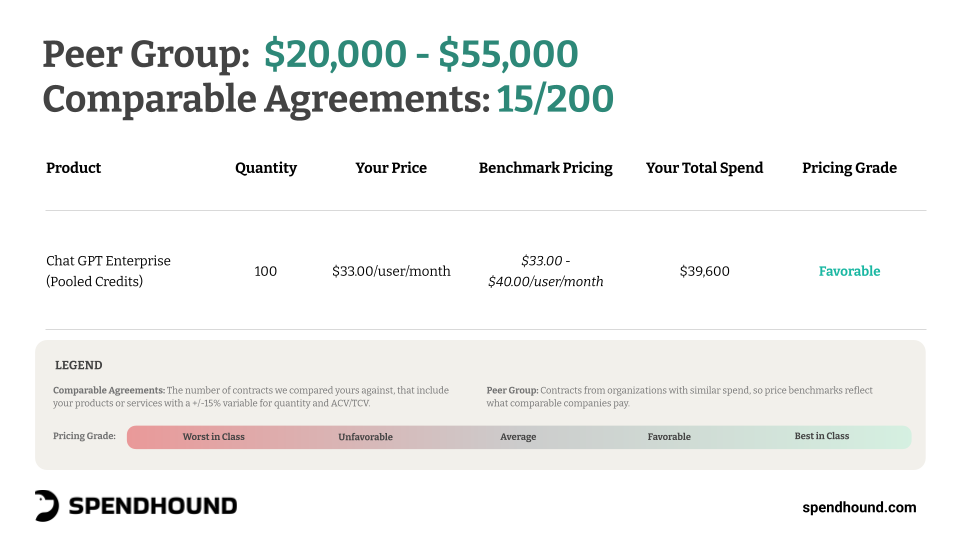
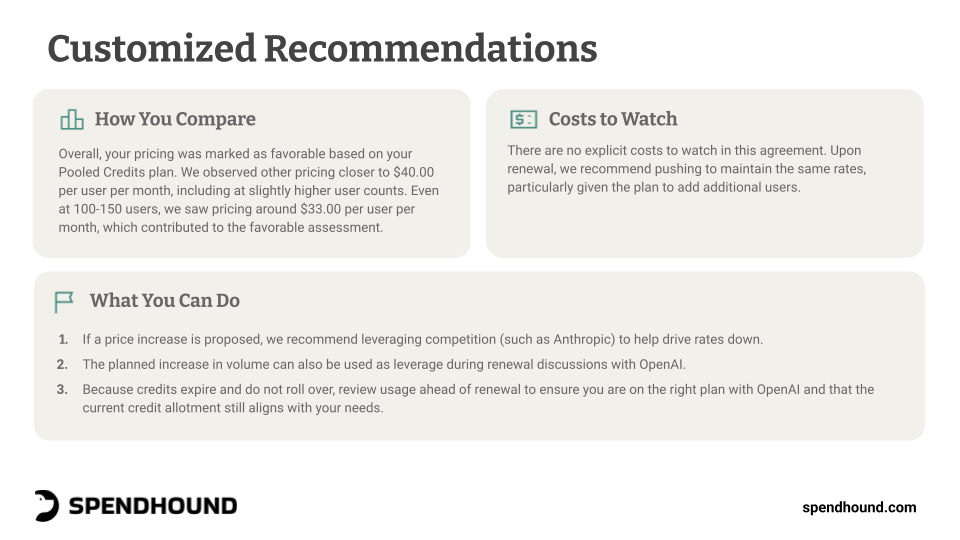
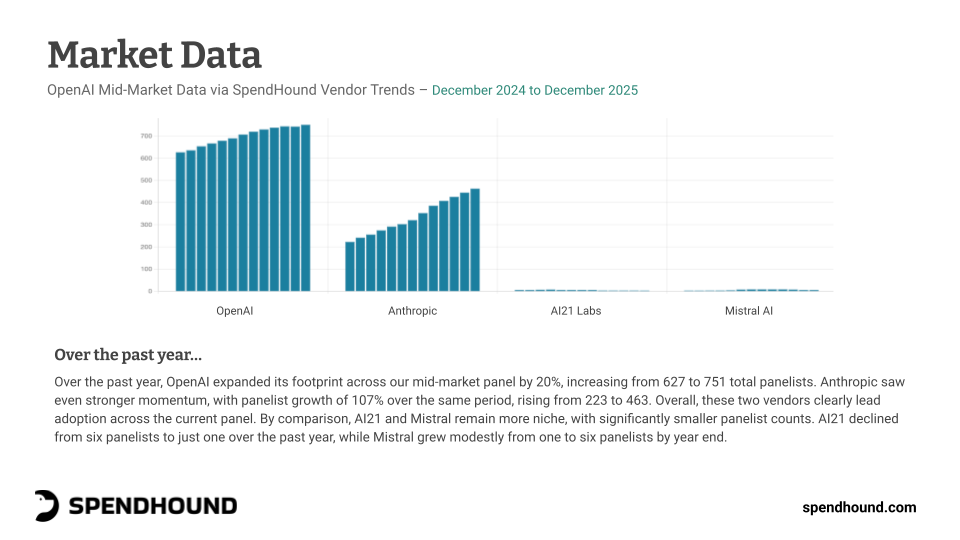
SpendHound’s benchmark dataset is built from 1,300+ companies that contribute de-identified spend data across 10,000+ AI and SaaS vendors. It’s not a survey — it’s product-level pricing from companies actually buying these tools.
“In our data repository alone, we have tens of millions of data points,” says Jason Edick, who is also a Procurement Team Lead at SpendHound. That volume does more than set a number — it shows whether a vendor is raising prices because it’s winning customers or losing ground, which tells you how hard you can actually push. The benchmarks show contract-level data measured against other companies within a 10–15% range on cost, license quantity, and usage, so the comparison reflects companies in genuinely similar situations.
To see how spending varies across companies, visit our OpenAI pricing page or Anthropic pricing page for average spend data across SMB and Enterprise organizations. You can also explore our Marketplace to browse vendor spend data across hundreds of AI and SaaS vendors to better understand where your own spend may sit relative to the market.
Figure out whether your real usage looks like seats, consumption, or a mix. A team using an AI assistant a few times a day is different from a product team piping documents through an API all night. Before negotiating price, understand how the vendor charges and estimate what your actual usage is likely to be under that model.
Before you respond to the quote, find out what companies your size pay for this vendor. This is an important step that gives you a real number based on market context. Use our OpenAI pricing page or Anthropic pricing page to see the high-level average spend for Enterprise companies. For a free benchmark, reach out to us on that same page using the “Want to pay less?” form on the page.
The headline rate is only one line on the order form. What matters just as much are the terms around it: how renewal increases are handled, whether unused credits expire, and what happens when you exceed your committed usage. Saving a few percentage points on the per-seat rate doesn't help much if you're locked into uncapped annual increases. That's why the terms deserve as much attention as the price itself.
“The order you play your cards sometimes matters as much as the cards themselves,” says Zack Hildenbrandt. A benchmark tells you the target number; sequencing the leverage — growth, a competing quote, a multi-year commitment — is what gets you there.
Here’s how that played out in a recent foundation-model negotiation. A fintech payments company was evaluating an upgrade from a Teams plan to an Enterprise tier with a leading AI model provider, initially quoted at $20 per user per month plus API costs. Based on projected usage, the company expected to spend at least $50,000 annually on API consumption alone, in addition to its per-seat licensing costs. By benchmarking against similar agreements, the procurement team found that vendors at this commitment level were often willing to waive seat fees in exchange for a committed API spend. The customer negotiated a $50,000 annual API commitment and eliminated the per-seat costs altogether, resulting in nearly $25,000 in immediate annual savings while still securing Enterprise-level access.
The leverage is in the weeks before the renewal date, not the day the invoice hits. Once you’re inside the auto-renewal window, you’re negotiating from the back foot. Calendar the date, the notice period, and the opt-out window the moment you sign.
This matters more for AI contracts than for most SaaS. Our procurement experts rate timing as the single biggest lever they see — “being well ahead and well prepared for those renewals is the most effective lever we’ve seen from our customer base,” says Hildenbrandt. And unlike a CRM that’s been stable for five years, AI tools are evolving fast enough that auto-renewal can lock you into a vendor that falls behind the market, sometimes for multiple contract years before you can exit. Strip auto-renewal entirely if you can. If the vendor won’t move, get a short notice window and put a hard expiry in the calendar the day you sign.
AI pricing and model performance are changing faster than almost any software category. The model that leads today may not be the best option six months from now. Avoid contract terms that make switching difficult, whether that's long-term commitments, restrictive minimums, or pricing structures that only work if you stay with a single provider.
“The biggest thing I'd look to optimize in terms of AI model spend is flexibility between vendors,” says Hildenbrandt. “Models are regularly leapfrogging each other in terms of performance and cost effectiveness, so not locking yourself into one vendor is the most important piece.”
Multi-year agreements can still make sense, but make sure you understand your exit options before you sign.
If you only have room to fight for a few things beyond the price, these are the ones that matter most on an AI contract:
A few tradeoffs are worth keeping in mind. Usage caps can be helpful when AI demand is unpredictable, but if usage is already growing quickly, a hard cap may simply create another negotiation in six months. Multi-year agreements come with similar tradeoffs. The discount is only valuable if you can reasonably forecast future usage. If you're still learning how teams will adopt the product, flexibility may matter more than a few points off the price.
Renewal increases deserve a separate conversation. If you're already planning to expand usage, add users, or increase your spend commitment, the vendor is receiving additional revenue through that growth alone. There's little reason to agree to an automatic price increase on top of it. In a high-growth year, push to remove the uplift entirely rather than accepting both expansion spend and a built-in rate increase. “You’re always able to change contract terms,” Jason Edick says. “You just need to take a firm stance and give them the reasons why.”
Some teams have a procurement function that does this in their sleep. Most companies negotiating their first enterprise AI contract don’t — and that’s where benchmark data plus someone who’s run the play changes the outcome.
At Fusion92, that combination surfaced $345,000 in savings in 2025, with roughly $900,000 in savings projected for 2026.
That's what SpendHound does. We provide real spend data on what companies actually pay for AI vendors, along with access to procurement experts who negotiate these contracts every day. Whether you're evaluating OpenAI, Anthropic, or another AI supplier, the goal is the same: help you understand what's reasonable to pay and negotiate from a stronger position. SpendHound is free for companies with fewer than 1,300 employees and costs $10,000 per year for enterprise organizations, backed by a $150,000 savings guarantee.
If you're staring at an AI renewal right now, start with the number: see what comparable companies pay for your vendor before you reply to the quote. And keep Zack Hildenbrandt's advice in mind: prioritize flexibility between vendors so you're not locked into a provider as AI models continue to evolve.
Before you sign an AI contract, know what's reasonable to pay.
See how SpendHound uses real spend data and procurement expertise to help teams negotiate OpenAI, Anthropic, and other AI and SaaS vendors. Reach out to our team to request a demo.
Usually, enterprise generative AI pricing is negotiable — more than buyers assume. Seat counts, committed usage tiers, multi-year terms, credit mechanics, and the annual price-increase cap are all negotiable, especially at enterprise volume. The headline rate is often the least flexible line; the terms around it are where most of the savings actually sit.
Traditional SaaS negotiations often focus on seats, feature tiers, and predictable growth. AI contracts frequently combine seat-based fees with token, credit, or API consumption charges that can scale much faster than expected. They also introduce considerations like data-training rights and model access. The biggest mistake is focusing on the headline rate instead of long-term usage costs.
Whether seat-based or usage-based AI pricing is cheaper depends on how the product will be used. Seat-based pricing is often easier to manage when AI is being deployed broadly across employees with relatively predictable usage patterns. Usage-based pricing can be more efficient for limited deployments or specialized use cases, but costs can increase rapidly when AI is embedded into workflows, automations, or customer-facing products. Before comparing prices, model your expected usage and evaluate how costs would scale under each structure.
The AI vendor contract terms that matter most are the ones that compound. A capped annual price increase protects you at every renewal after the first, and credit rollover stops unused capacity from becoming a built-in markup. Capped overage rates, a data-training opt-out, and model-version flexibility round out the list. Over the life of an AI deal, these move more money than a small win on the per-seat or per-token rate.
To evaluate the fairness of an AI vendor’s quote, compare it to what companies your size actually pay for the same vendor — not the list price, and not a single peer’s anecdote. Benchmark data on real spend across many comparable buyers is the only way to tell whether a quote is competitive or padded.
Enterprises should use every opportunity to negotiate AI vendor pricing: pilot, scale-up, and renewal. llBut the highest-leverage moment is before you commit at scale. Negotiate data rights and pricing model at the pilot, lock the unit economics and caps when you scale up, and calendar the renewal window the day you sign so you’re never negotiating inside the auto-renewal period.