NEW
NEW RESEARCH
AI Spend Report: See how 172 leaders are budgeting for AI Get the report
WEBINAR
AI Spend in 2026: What finance should do next Watch now


While AI spending is growing, proof that it’s paying off is taking a little longer.
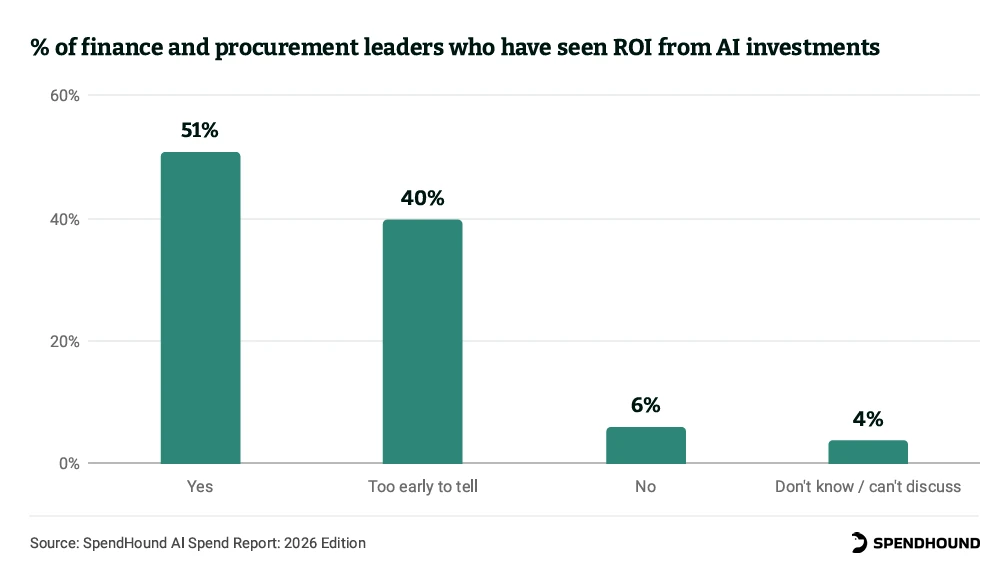
According to SpendHound’s 2026 AI Spend Report, 51% of finance and procurement leaders say their organizations are seeing clear, measurable ROI from AI investments. That’s encouraging. But 40% say it’s still too early to tell, while 6% report no measurable ROI.
With AI budgets exponentially growing, the pressure to demonstrate value is only going to increase.
So what should finance look for?
Finance leaders are already experts in evaluating investments and measuring ROI. That’s core to their work. The challenge with AI is determining where the economic value is showing up, how much of it can reasonably be attributed to AI, and whether it’s enough to justify continued investment.
Here are four questions that can help you measure AI ROI.
A common assumption about AI is that the return will show up in headcount.
So far, that’s not what finance teams are reporting.
Only 6% of respondents in our AI Spend Report say AI has reduced finance headcount. A much larger group, 37%, say teams have stayed the same size with employees being redeployed to higher-value work. Another 24% report no meaningful change to team structure, while 29% say it’s still too early to tell.
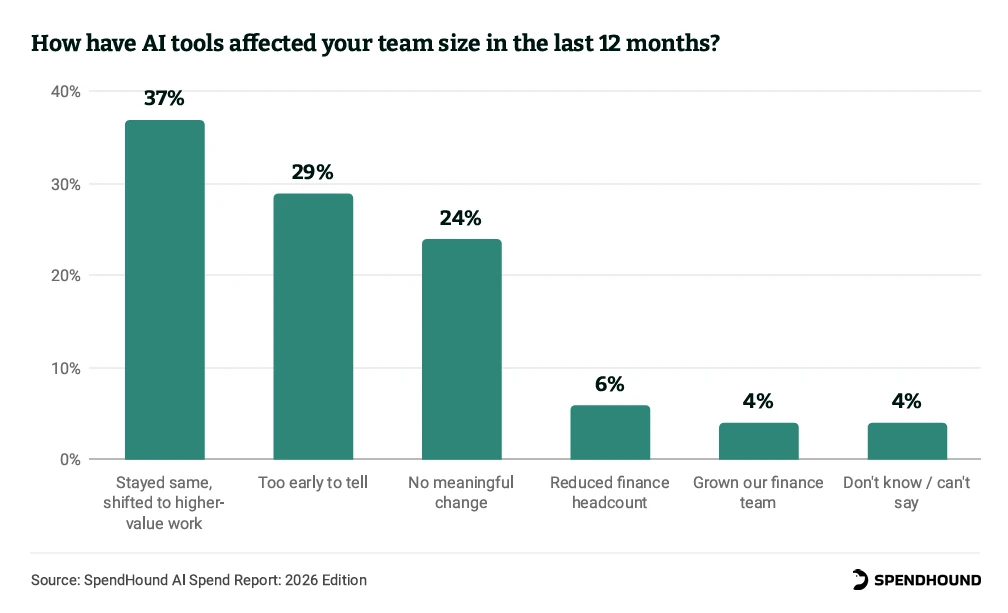
That suggests the near-term economic value of AI is showing up more often as increased capacity than labor reduction.
We also saw this in recent 1:1 interviews with 30+ CFOs, summarized in our CFO AI Report.
For example, one CFO using LLMs for financial analysis said AI cut his analysis time by almost half. His team could analyze larger datasets and explore more scenarios without adding headcount. Other CFOs told us AI was helping shorten close timelines, automate invoice coding, and reduce the manual work required to prepare and analyze financial data.
The key is to look at what that additional capacity allows the business to do. “AI saved us 10 hours a week” is useful information, but that found time can represent different kinds of value depending on how they’re used.
Beyond eliminating positions, finance leaders can look at whether their teams, with the assistance of AI, can now:
Our CFO interviews surfaced some specific ways to measure these gains. Finance teams using AI-assisted financial modeling looked at measures such as the number of scenarios they could evaluate during a planning cycle, time spent reviewing rather than gathering data, and their ability to refresh analysis as inputs changed.
One of the most obvious ways to measure AI ROI is to compare the investment with the real alternative.
In our CFO interviews, we saw a good example of this in accounts payable.
Some of the CFOs we interviewed had historically relied on temporary support during high-volume periods to keep up with invoice coding. AI-assisted AP tools changed the workflow from manual data entry to review and approval of suggested coding.
One CFO described the economics simply: the company could pay for AP automation instead of hiring a temp.
Depending on the use case, there could be a number of alternatives:
The gross benefit of AI is only half the calculation.
If a tool produces work faster but requires substantial human review, potentially introduces errors, creates new infrastructure costs, or needs extensive implementation and integration work, those costs affect the actual return.
Finance leaders are acutely aware of that tradeoff.
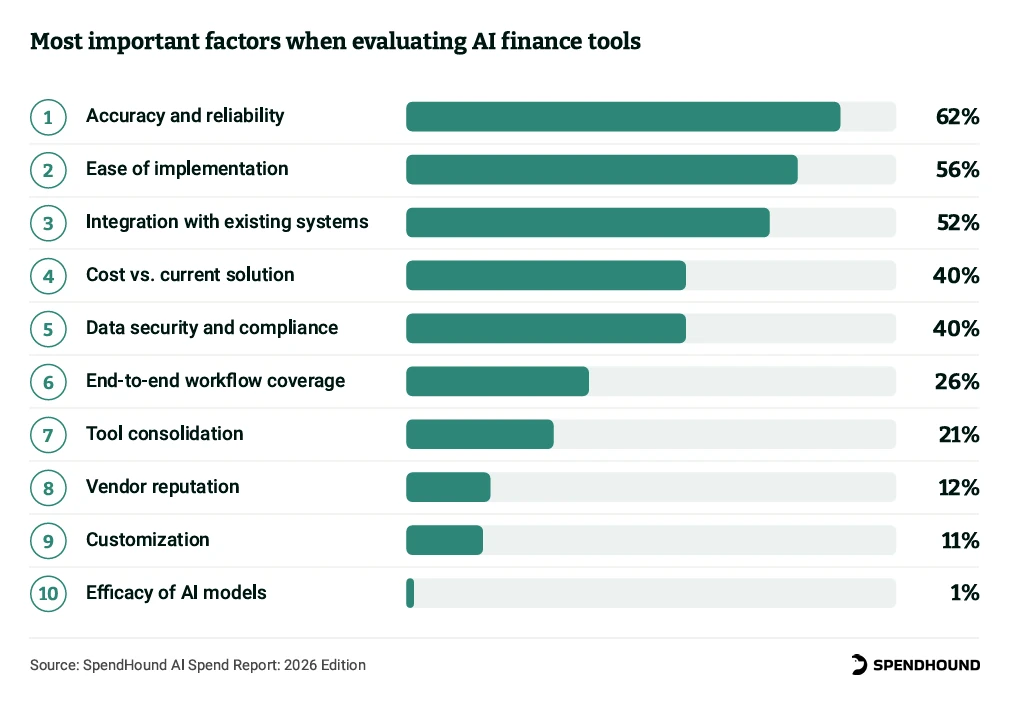
In our AI Spend Report, accuracy was the most commonly cited criterion for evaluating AI finance tools, per 62% of respondents.
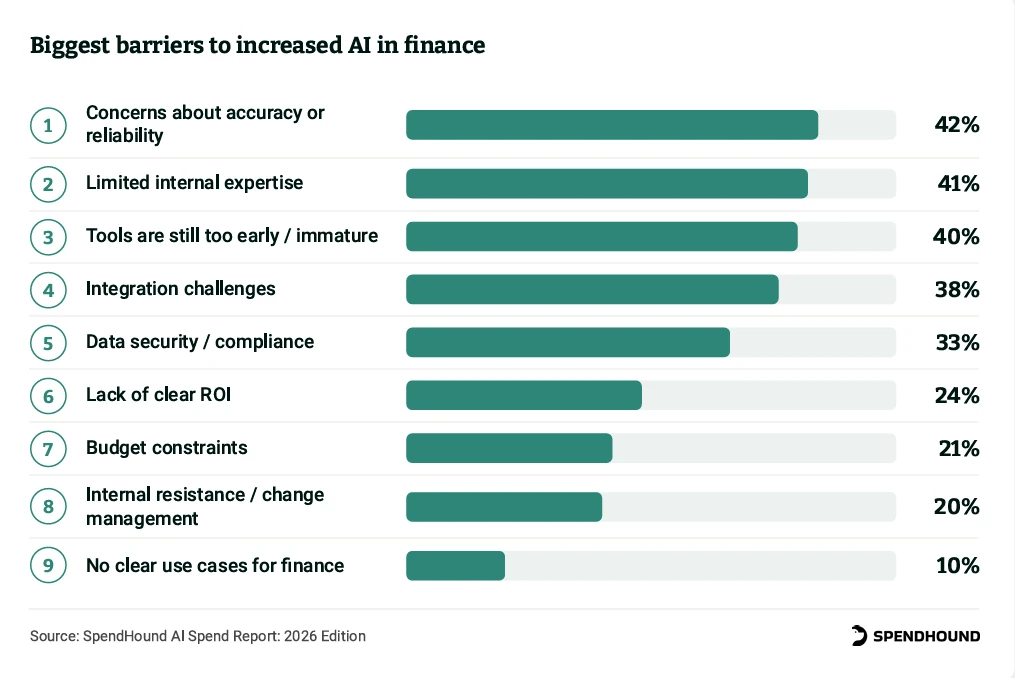
And when we asked what was slowing broader AI adoption, accuracy and reliability concerns again ranked first, ahead even of budget constraints.
That same concern came through clearly in our CFO interviews.
Finance teams using AI for invoice coding, for example, didn’t measure success solely by how much manual work the technology eliminated. They also monitored whether coding remained accurate, whether mistakes surfaced downstream during close, and whether the new workflow required additional oversight.
Here are additional factors to work into your ROI calculation:
Taking into consideration these additional factors is especially important as AI moves deeper into production workflows because the cost of an experiment may bear little resemblance to the cost of running that same use case at scale.
For many organizations, the most important AI ROI decision right now is whether to keep funding an experiment.
Our research found that 42% of finance and procurement leaders are currently piloting finance-specific AI tools, while only 20% have deployed them in production workflows. Another 27% evaluated finance-specific AI and decided not to deploy it.

That leaves a large number of companies in the middle: spending money and gathering evidence, while trying to decide what deserves to move forward.
Finance can make that transition more disciplined by establishing what an AI investment needs to demonstrate before experimental spend becomes recurring spend.
That doesn’t necessarily mean you need to see immediate cost savings to justify an investment in AI. But there should be evidence that the investment is creating a meaningful improvement in the workflow it was intended to change.
Before moving a pilot into your permanent budget, finance should be able to answer questions such as:
That last question is particularly important with consumption-based AI.
A pilot can look inexpensive when a small group of employees is testing it. But, if the use case succeeds and adoption expands across teams or moves into automated production workloads, costs can rise quickly.
As AI moves from pilot to production, finance needs visibility into how usage and costs are changing alongside the value being created. SpendHound’s AI Spend Visibility consolidates OpenAI, Anthropic, and Cursor spend and usage and lets teams drill down by workspace/project, API key, model, and user to help finance see where costs are headed.
With so many AI investments still in early stages, there’s nothing particularly surprising about the fact that 40% of finance and procurement leaders say it’s too early to determine AI ROI. But, as pilots mature and AI becomes a larger, recurring part of the software budget, finance needs to be able to distinguish between investments that deserve more funding, those that need more time, and those that simply aren’t delivering enough value to make the cut.
That evidence may look different from one use case to another and could look different for different types of business. For example, our AI Spend Report indicates that the type of industry can impact ROI.
Among the industries with enough respondents to compare, 89% of manufacturing finance and procurement leaders report measurable AI ROI, compared with 44% in software/SaaS and just 21% in healthcare.
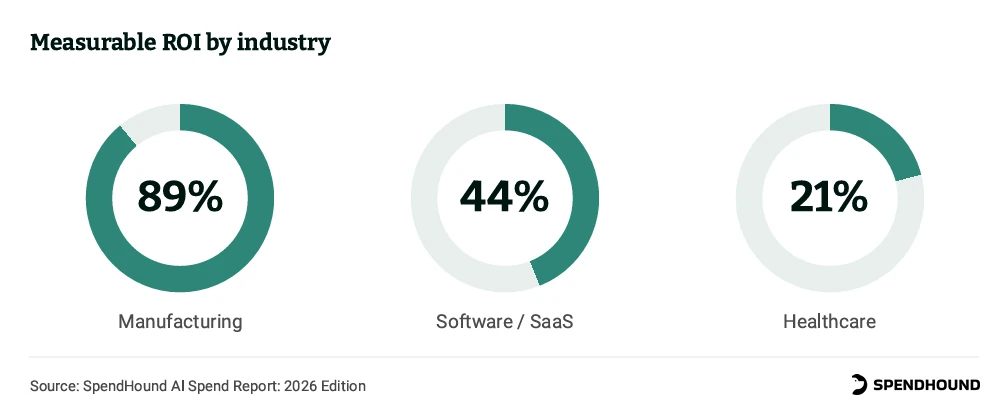
This wide range of perceived ROI intuitively makes sense: Manufacturing has a long history of applying automation to well-defined operational processes while healthcare organizations have substantial security, privacy, compliance, and implementation considerations to navigate. The takeaway is to keep in mind your industry and specific business as you’re trying to assess the value of the AI you deploy. Your AI ROI may look different than another company’s. And that’s okay.
And be a little patient — but not too patient. AI investments don’t need to deliver immediate returns to be worthwhile. But the expectations should change as an investment moves from experimentation to adoption to ongoing spend.
An early pilot may only need to demonstrate that a use case works and is worth exploring further. Once that tool becomes a recurring budget item, finance should expect stronger evidence that it’s creating value. And as usage and costs grow, the question becomes whether the return is keeping pace.
SpendHound’s 2026 AI Spend Report examines how 172 finance and procurement leaders are investing in AI, where they’re seeing returns, what’s driving costs, and how AI is changing software stacks and vendor decisions.
Download the 2026 AI Spend Report →
With consumption-based AI, the cost side of the ROI equation can change quickly. SpendHound’s AI Spend Visibility gives finance, IT, engineering, and procurement teams a consolidated view of OpenAI, Anthropic, and Cursor usage and spend, with visibility by workspace/project, API key, model, and user.
See where costs are growing, track usage as AI moves into production, and make more informed decisions about which investments are earning their place in the budget. Plus, benchmark your enterprise AI contracts against what companies your size actually pay.
To measure AI ROI, compare the total value an AI investment creates with the full cost of implementing, operating, and reviewing its output. Depending on the use case, that value could include direct cost savings, avoided hiring, increased capacity, faster processes, or the ability to complete more work with the same resources. SpendHound’s 2026 AI Spend Report found that 51% of finance and procurement leaders say their organizations are already seeing clear, measurable ROI from AI investments, while 40% say it’s still too early to tell.
AI can generate ROI without reducing headcount by helping existing teams work faster, handle more volume, or take on higher-value work. Only 6% of respondents in SpendHound’s AI Spend Report said AI has reduced finance headcount, while 37% said employees have instead been redeployed to higher-value work. Finance teams can look for gains such as shorter close or planning cycles, greater transaction volume, more scenarios analyzed, or the ability to support business growth without adding headcount.
An AI ROI calculation should include the cost of the technology as well as implementation, integration, human review, error correction, training, infrastructure, and usage-based costs. These additional expenses can materially affect the return, particularly as an AI use case moves from a small pilot into production. Accuracy also matters: 62% of finance and procurement leaders surveyed by SpendHound said accuracy is a top criterion when evaluating AI finance tools, so the cost of validating and correcting AI output should be part of the calculation.
SpendHound found that 42% of finance and procurement leaders are piloting finance-specific AI tools, compared with just 20% that have deployed them in production workflows. As teams move beyond pilots, they should evaluate whether the pilot creates enough measurable value to justify becoming an ongoing investment. Before moving a pilot into the permanent budget, teams should look at adoption, improvements in productivity or capacity, output accuracy and reliability, the total cost of producing a usable result, and how those economics are likely to change as usage scales..
There is no single timeline for achieving AI ROI because returns can vary significantly by use case, industry, and stage of adoption. In SpendHound’s 2026 AI Spend Report, 40% of finance and procurement leaders said it was still too early to determine whether their AI investments were producing measurable ROI. Results also varied considerably by industry: 89% of manufacturing respondents reported measurable ROI, compared with 44% in software/SaaS and 21% in healthcare. Finance teams should give early investments time to prove themselves while raising the standard of evidence as AI moves from experimentation into recurring spend.
SpendHound’s AI research combines original survey research with proprietary software purchasing and spend data. The 2026 AI Spend Report includes survey responses from 172 finance and procurement leaders alongside SpendHound and YipitData data on software purchasing, AI adoption, procurement trends, and SaaS pricing dynamics. SpendHound’s broader benchmark data is derived from actual software purchasing data from more than 1,300 contributing companies, helping finance and procurement teams compare their own AI and software spending with what companies are actually paying in the market.