NEW
NEW RESEARCH
AI Spend Report: See how 172 leaders are budgeting for AI Get the report
WEBINAR
What’s New at SpendHound: Live Nov 5 at 1 PM ET Register now


Claude looks straightforward at first glance. Team plans have published seat pricing. Enterprise starts at $20 per user per month. API rates are public. It seems like Claude is billed like any typical SaaS platform until the invoice arrives.
The problem isn't that Claude is unusually expensive. It's that one contract combines predictable subscription pricing with usage that changes as employees adopt Claude. Forecasting that mix is much harder than forecasting a traditional software renewal. In SpendHound's 2026 AI Spend Report, 46% of finance and procurement leaders exceeded their AI budgets in 2025, more than any other software category they track.
SpendHound's procurement team sees the same pattern repeatedly. Companies budget around the published seat price because that's the easiest number to find. Months later, growing API usage, heavier Claude Code adoption, and broader rollout across the organization push spending well beyond the original forecast.
This guide goes beyond Anthropic's public pricing page. You'll learn how each Claude plan is priced, what actually drives Enterprise costs, and what organizations typically spend based on aggregated market data. We also include negotiation guidance from SpendHound's Procurement Experts, who help customers negotiate Claude agreements with Anthropic every week.
Claude Team costs between $20 and $100 per user per month. Claude Enterprise starts at $20 per user per month plus usage billed at Claude API rates. Organizations building with Claude pay separately for API usage based on token consumption.
Individual users can also choose Free, Pro, and Max plans, but most finance and procurement teams evaluating Claude will focus on Team, Enterprise, and the API.
Claude offers plans for both individual users and organizations. The table below summarizes every publicly available option, from Free and Pro through Team, Enterprise, and the Claude API.
Prices reflect Anthropic's published rates as of July 2026 and don't include tax. Anthropic can change pricing at its discretion.
Most of this guide is written for a business evaluating Claude at the organization level, but a fair number of individual users and/or small teams that don’t yet meet the five-seat Team minimum may start on Claude with a personal account.
So, briefly:
Claude Team is designed for organizations with 5 to 150 users and offers two seat types:
Organizations can mix Standard and Premium seats within the same workspace, so not every employee needs a Premium license.
Procurement tip: Many buyers assume everyone needs the same seat type. In practice, assigning Premium seats only to heavy users can significantly reduce costs. For example, a 50-person organization with 10 Premium seats and 40 Standard seats would save roughly $38,400 per year compared with putting every user on Premium.
Claude Enterprise is Anthropic's custom offering for larger organizations that need advanced security, governance, and deployment controls. Although Anthropic publishes a starting seat price, every Enterprise agreement is customized based on usage, deployment requirements, and commercial terms. As a result, the published seat price is only one component of the total contract value.
Claude Enterprise pricing starts with a $20 per-user monthly seat fee and adds usage billed at Claude API rates. Contracts are annual and sold through Anthropic's sales team rather than self-service checkout. As Anthropic continues shifting customers toward usage-based pricing, Enterprise agreements increasingly emphasize API consumption over seat licensing, making usage commitments a key part of commercial negotiations.
Unlike Claude Team, Enterprise doesn't offer separate Standard and Premium seat types. Instead, every user is licensed under the same base subscription while AI usage is billed separately. As employee adoption grows, usage frequently becomes the largest driver of total spend rather than seat licenses themselves.
Several variables determine what a company ultimately pays for Claude Enterprise:
Because Enterprise combines fixed subscription costs with variable usage, two companies with similar employee counts can have dramatically different annual spend depending on how heavily employees use Claude and which models they deploy.
Anthropic doesn't publish average Enterprise contract values, making it difficult for buyers to understand what organizations actually spend.
Based on aggregated spend data from SpendHound's vendor dataset, average annual Anthropic spend (as of July 2026) is:
These figures reflect average customer spend rather than Anthropic's published list prices, illustrating how quickly usage-based AI costs can scale beyond the initial seat subscription.
Market averages provide useful context, but they don't answer the question every procurement team ultimately asks: Are we paying more than companies like us?
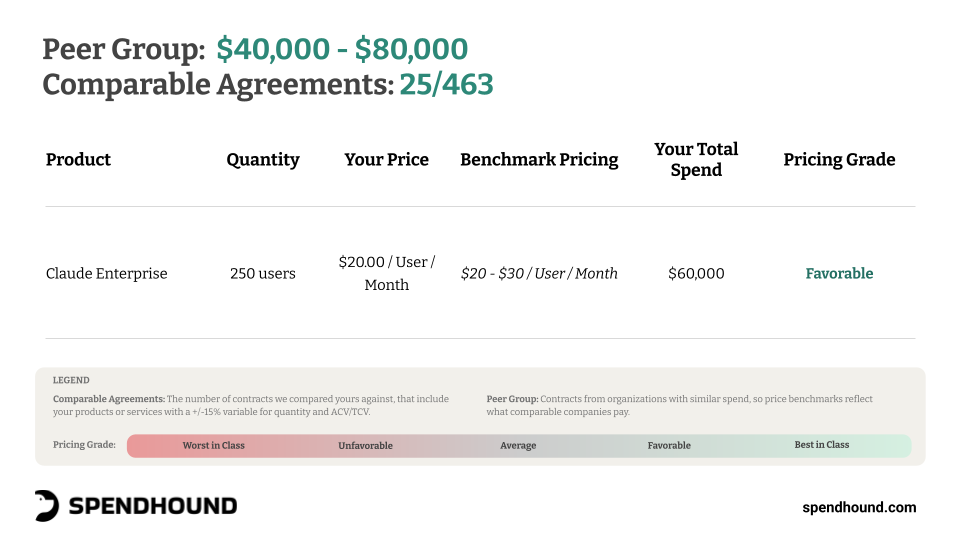
That's where company-specific pricing benchmarks become valuable. Instead of comparing your agreement against an overall market average, SpendHound benchmarks your pricing against organizations with similar characteristics, such as company size, deployment profile, and contract structure. That gives finance and procurement teams a more realistic view of what a competitive agreement looks like before negotiations begin.
Example of a SpendHound Anthropic pricing benchmark showing how a company's pricing compares to similar organizations.
Claude API pricing is usage-based and billed per million tokens (MTok). Rates vary by model, with more capable models carrying higher input and output token prices.
The published rate card is only part of the equation. Total API spend depends on which models you choose, how frequently applications call the API, and how much context each request includes. Two organizations can use the same model yet end up with dramatically different bills because one processes far more requests or relies on much longer conversations.
Several platform features can reduce the effective cost of API usage. Prompt cache reads are billed at just 10% of the standard input rate when applications repeatedly reuse the same prompts or reference material. Batch processing cuts input and output costs by 50% for workloads that don't require real-time responses. Organizations using US-only data residency, however, pay a 1.1× premium across token categories.
Anthropic has also updated its tokenizer over time. Beginning with Claude Opus 4.7, some workloads generate 1.0–1.35x more tokens than earlier models, particularly code and technical documentation. The price per token stays the same, but the same workload can still cost more because it consumes more tokens.
Claude Code is included with every paid Claude plan and draws from the plan's shared usage limits rather than carrying a separate subscription fee. Once those limits are exceeded, additional coding activity shifts to pay-as-you-go API billing through Anthropic's Console.
Developer adoption is often one of the largest variables in forecasting AI costs. Engineering teams typically embrace AI coding tools faster than other functions, so usage can grow quickly after rollout. Budgeting for Claude Code is less about the price of the tool itself and more about estimating how broadly engineering teams will use it over time.
Choosing the right Claude plan depends less on company size than on how your organization plans to use AI. Most businesses begin with Team for employee productivity, then move to Enterprise once governance, security, and large-scale deployment become priorities. Organizations building AI products or internal applications typically add API access regardless of which subscription plan they use.
Choose Claude Team if your organization has 5 to 150 users, most work happens in Projects or Claude Code, and you want predictable per-user pricing. Plan for API usage as soon as engineering starts calling Claude programmatically. That's often the point where Team alone no longer represents your total Claude spend.
Choose Claude Enterprise when security and governance become procurement requirements. Features like SSO, SCIM, audit logs, and compliance APIs are usually the real reason organizations upgrade, not employee count. A 200-person company without strict compliance requirements may run comfortably on Team, while a 60-person healthcare startup may need Enterprise from day one.
Choose API-only when the primary users are engineering or product teams building internal tools, agents, or automation. In those environments, usage is tied to applications rather than individual employees, making token-based pricing a better fit than seat licenses.
Many midmarket and enterprise organizations ultimately use more than one option. Team supports the broader workforce while the API powers engineering workloads, creating a hybrid deployment that's harder to forecast than a traditional SaaS subscription.
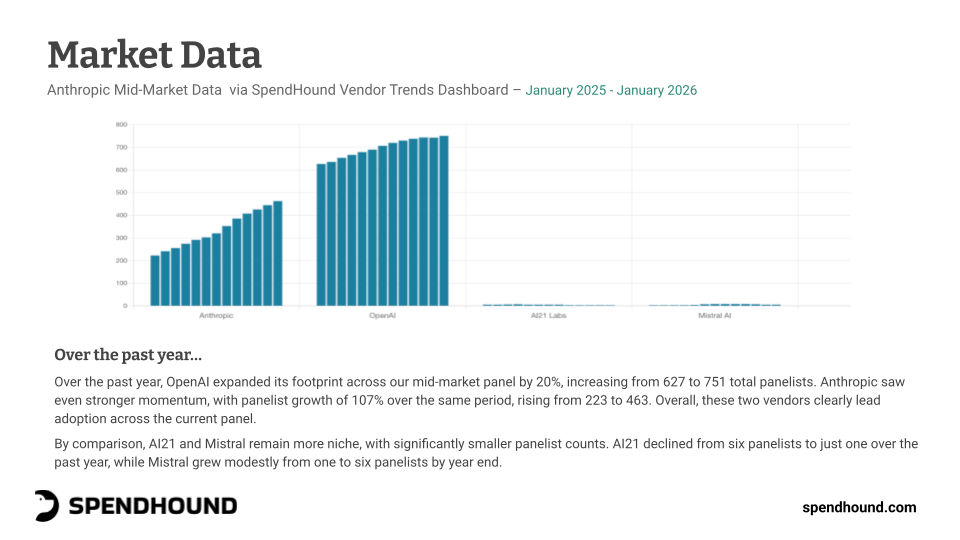
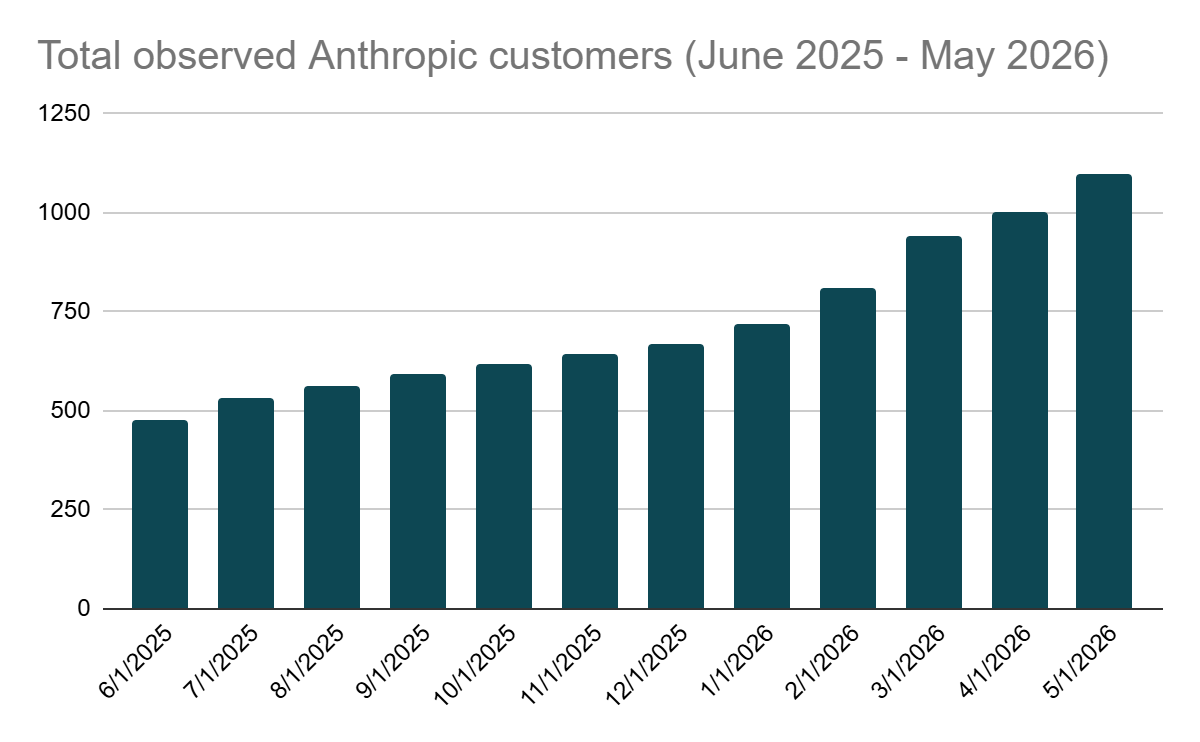
Claude has quickly become a mainstream enterprise AI platform. Across SpendHound's vendor dataset, the number of organizations with Anthropic spend more than doubled over the past year, increasing from 478 observed customers in June 2025 to more than 1,100 by May 2026.
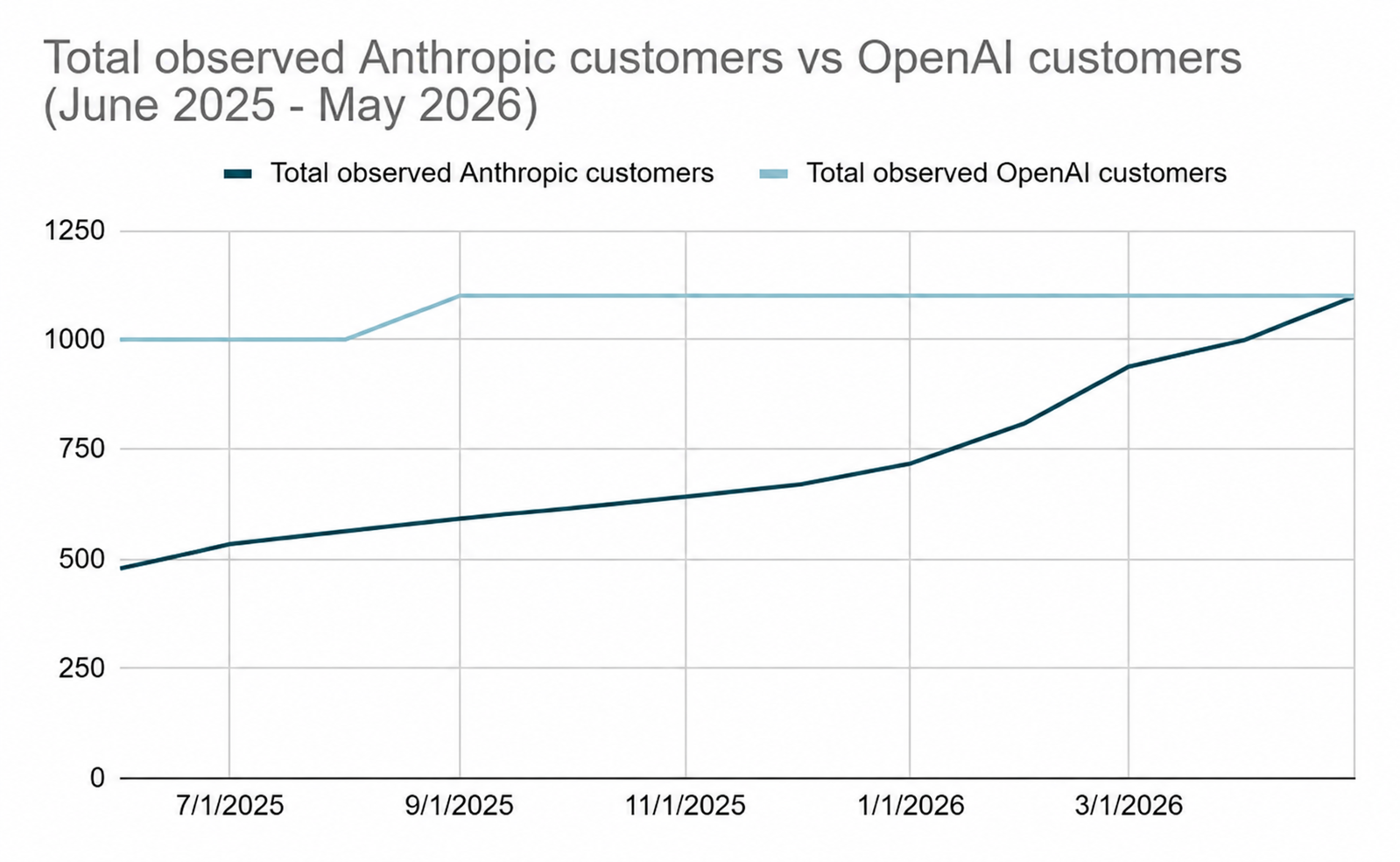
Anthropic's growth has significantly outpaced OpenAI across SpendHound's vendor dataset. Between June 2025 and May 2026, the number of organizations with Anthropic spend increased from 478 to 1,100, while OpenAI remained relatively stable at approximately 1,100 observed customers. By May 2026, Anthropic had caught up to OpenAI in observed customer adoption, underscoring how quickly Claude has become a mainstream enterprise AI platform.
For finance and procurement teams, rapid adoption creates a new budgeting challenge. Many organizations begin with a small Team deployment or limited API usage before expanding Claude across engineering, operations, and other business functions. Because Enterprise pricing combines predictable seat licenses with variable usage, costs can increase much faster than a traditional SaaS deployment, making forecasting and spend visibility increasingly important as adoption grows.
Anthropic generally offers limited flexibility on token pricing. "There's not a ton of flexibility on token prices for these suppliers, as there is very high demand and much lower profit margins than traditional SaaS suppliers," says Zack Hildenbrandt, Procurement Team Lead at SpendHound.
That doesn't mean there's nothing to negotiate. The biggest opportunities usually come from the commercial structure around the agreement rather than token pricing itself. Procurement teams can often negotiate usage commitments, seat structure, future price protections, and other commercial terms even when token prices remain unchanged.
The following strategies come directly from SpendHound's Procurement Experts, who help customers negotiate Claude agreements with Anthropic every week.
Many procurement teams begin preparing for renewals about 90 days before expiration. That's often enough time to finish a negotiation, but not enough time to create real leverage. Earlier in the renewal cycle, the possibility of switching vendors is still credible. As the renewal date approaches, both sides know the likelihood of making a change drops dramatically.
"You may have no intention of leaving Claude, but you're in a much stronger negotiating position six to nine months before renewal than you are six to nine weeks before. By then, everyone in the room knows it's much less feasible," Hildenbrandt says. "Being well ahead and well prepared for those renewals is the most effective lever we've seen."
Calendar the renewal date, notice period, and opt-out window the day the contract is signed. Once you're inside the final few weeks before renewal, your negotiating leverage drops dramatically.
The foundation model market is still evolving rapidly. Unlike traditional enterprise software, the foundation model that's best for your organization today may not be the best option a year from now.
"The biggest thing I'd look to optimize in terms of AI model spend is flexibility between vendors," Hildenbrandt says. "Models are regularly leapfrogging each other in terms of performance and cost effectiveness, so not locking yourself into one vendor is the most important piece."
When negotiating a Claude Enterprise agreement, avoid commercial terms that unnecessarily limit future flexibility. Long commitments, restrictive minimum spend requirements, or pricing structures that only make sense if you stay with a single model provider can reduce your options as the AI market continues to evolve.
Claude negotiations rarely come down to a single discount percentage. The biggest savings often come from improving contract structure, forecasting usage more accurately, and preserving flexibility over the life of the agreement. Organizations that start early and negotiate around those variables consistently put themselves in a stronger position than those focused solely on the published seat price.
Most buyers walk into the first renewal meeting with only their previous invoice and secondhand peer conversations. Vendors walk in knowing the full range of comparable commercial agreements. Benchmarking helps close that information gap before negotiations begin.
Anthropic is increasingly willing to trade commercial structure for larger usage commitments. Instead of asking for a lower token price, organizations committing to meaningful API usage may be able to negotiate concessions elsewhere in the agreement.
"We've recently seen AI vendors include user licenses for free if there is a sizeable token purchase," Hildenbrandt says.
How you sequence the negotiation matters. "The order you play your cards sometimes matters as much as the cards themselves," he adds. Start by discussing your expected usage commitment, then negotiate seat costs and contract structure.
Annual price-increase caps are one of the highest-value contract terms procurement teams can negotiate. Hildenbrandt recommends targeting anything below 5%. A 3% cap is a strong outcome, while 0% is typically reserved for exceptional cases.
“Even after an AI renewal is finalized, there are often meaningful savings opportunities that get overlooked. One of the first things we evaluate is usage tier thresholds and automatic overage pricing, since many customers focus heavily on seat costs during negotiations and underestimate how quickly usage-based charges can grow over time,” Hildenbrandt says.
A favorable seat price won't offset unexpected overage charges if usage thresholds and pricing tiers aren't fully understood before signing.
“For most of the model providers, the vendor not training on your company data is table stakes for a business or enterprise agreement, but the smaller suppliers will sometimes not include language prohibiting that in their initial documents,” Hildenbrandt says. Confirm the language is explicit in the contract, not just a sales conversation.
“Auto renewals can lock you into a supplier you'd prefer to move away from, sometimes for multiple additional years if not removed. Especially with how rapidly AI tools are evolving, it's important to make sure you don't get locked into a tool that could potentially fall behind the rest of the market,” Hildenbrandt says.
Auto-renewal terms, notice periods, and contract length are all negotiable. If the renewal language doesn't work for your organization, ask to change it. “You're always able to change contract terms, you just really need to take a firm stance and give them an understanding of the reasons why,” says Jason Edick, a Procurement Team Lead at SpendHound. “Most of the time, they won't ignore the request.”
Comparing AI pricing isn't as simple as comparing published seat prices or API rates. The table below summarizes how Claude compares with other leading AI vendors on both dimensions. Microsoft's Copilot is included because it's the AI assistant most enterprise buyers already have access to through Microsoft 365.
On published pricing, Claude is broadly competitive with other leading AI vendors. Opus 4.8 is priced similarly to OpenAI's flagship model, while Google's Gemini 3.1 Pro has the lowest published API pricing in this comparison.
Those published rates tell only part of the story, however. SpendHound's aggregated vendor spend data shows Anthropic customers spending more than OpenAI customers on average at both the SMB tier ($55,993 vs. $44,318 annually) and the Enterprise tier ($441,517 vs. $318,506). The difference is more likely driven by deployment patterns, usage volume, and model selection than by list pricing alone.
Claude pricing becomes harder to manage as adoption grows. What starts as a handful of Team seats often expands into Enterprise licenses, API usage, and Claude Code consumption across multiple departments. Without visibility into how that usage is changing, it becomes increasingly difficult to forecast renewals and control spend.
SpendHound helps finance, procurement, and IT teams understand both sides of the equation: what they're spending internally and what comparable organizations are paying externally. Our platform provides vendor pricing benchmarks to help you negotiate with confidence, while AI Spend Visibility gives you a centralized view of your AI usage and spend across models and users so you can forecast costs before they become budget surprises.
Whether you're evaluating Claude for the first time or preparing for an Enterprise renewal, SpendHound can help you understand what you're spending, what comparable organizations are paying, and where you have opportunities to negotiate better commercial terms.
Ready to see how SpendHound can help? Request a demo to see AI Spend Visibility, Anthropic pricing benchmarks, and procurement insights in action.
Claude costs between $20 and $100 per user per month for Team plans, while Enterprise starts at $20 per user per month plus usage billed at Claude API rates. Individual Pro ($17–20/month) and Max ($100–200/month) plans are designed for single users rather than organization-wide deployments.
Claude Enterprise doesn't have fixed published pricing. Contracts start with a $20 per-user monthly seat fee and add usage billed at Claude API rates. Total cost depends on deployment size, API usage, model selection, and negotiated commercial terms.
Claude uses both seat-based and usage-based pricing. Team, Pro, and Max are billed per user. API access is billed by token usage, while Claude Enterprise combines per-user licensing with usage-based pricing.
Yes, Claude Enterprise pricing can be negotiated, but not in the same way as traditional SaaS contracts. Anthropic generally has limited flexibility on token pricing, but procurement teams can often negotiate contract structure, usage commitments, annual price caps, and other commercial terms.
Claude's published pricing is similar to ChatGPT's, but organizations often spend more on Anthropic in practice. Claude Team and ChatGPT Business both start around $20–25 per user per month, with broadly comparable flagship API pricing. SpendHound's aggregated vendor spend data shows Anthropic customers spending more on average than OpenAI customers across both SMB and Enterprise organizations, suggesting deployment patterns and usage have a greater impact than list pricing alone.
Claude Code is included with every paid Claude plan and draws from that plan's shared usage pool. Once those usage limits are exceeded, additional coding activity shifts to pay-as-you-go API billing through Anthropic's Console.