NEW
NEW RESEARCH
AI Spend Report: See how 172 leaders are budgeting for AI Get the report
WEBINAR
AI Spend in 2026: What finance should do next Watch now


As new AI tools and capabilities multiply, here are five factors IT leaders should consider before adding another tool to the tech stack.
AI is giving organizations plenty of reasons to reconsider what’s already in their tech stack.
For IT leaders, the fundamentals of evaluating tools haven’t changed. Security, reliability, integration, scalability, cost and business value still matter.
But AI is making those decisions more complex. New capabilities are quickly emerging and overlapping. Usage and costs can scale in ways that are difficult to predict. And adding one AI tool can increase consumption and costs elsewhere in the technology stack.
Here are five things IT teams need to account for as they evaluate the next wave of AI tools.
One of AI’s biggest potential benefits — and promises — is consolidation. If AI can automate more of a workflow, expand the capabilities of an existing platform, or replace a point solution entirely, companies may eventually need fewer individual tools.
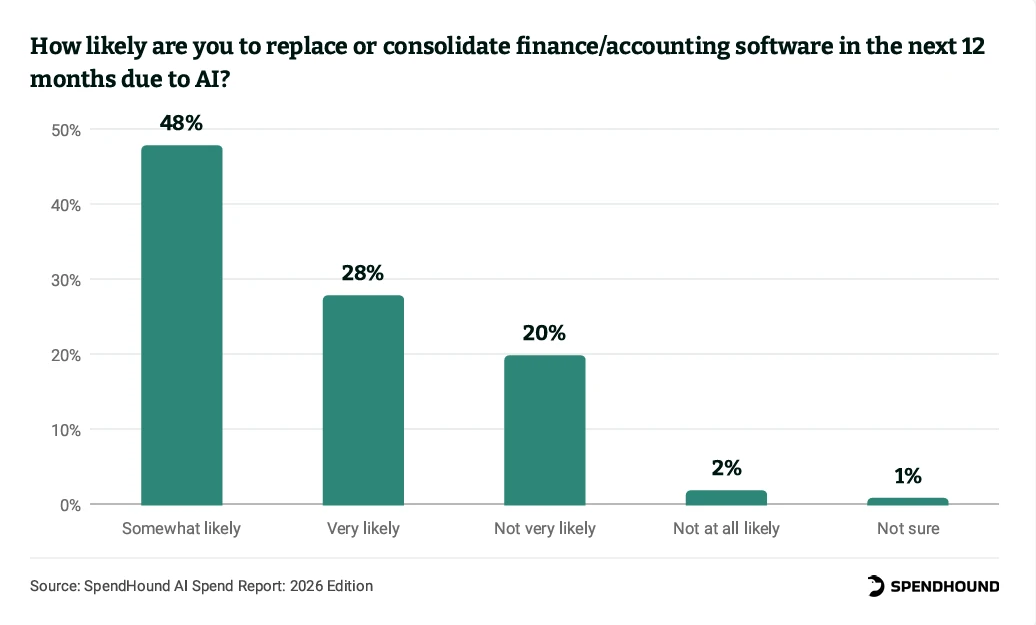
That’s likely why, 76% of finance and procurement leaders say they’re somewhat or very likely to replace or consolidate finance and accounting tools in the next 12 months specifically because of AI capabilities, according to SpendHound’s 2026 AI Spend Report.
But we’re not quite there yet.
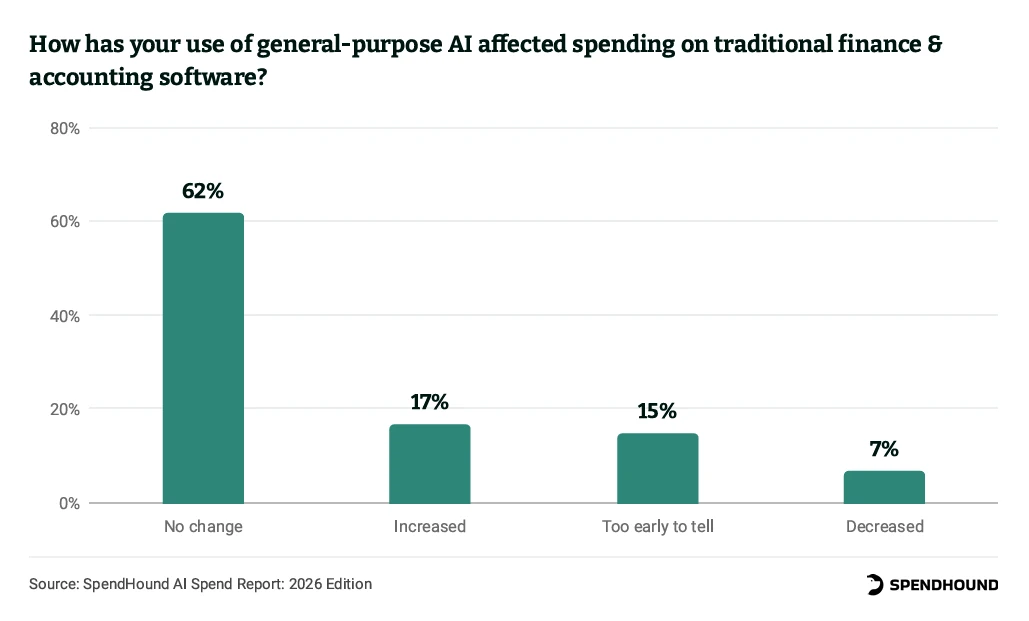
Right now, AI tools are being added much faster than existing software is being removed. Only 7% of finance and procurement leaders surveyed by SpendHound say general-purpose AI has decreased their spending on traditional finance software. Most (62%) report no change, while 17% say AI has actually increased their traditional software spend.
At the same time, 65% say adding AI-native tools is one of the top reasons they expect their overall software spend to increase.
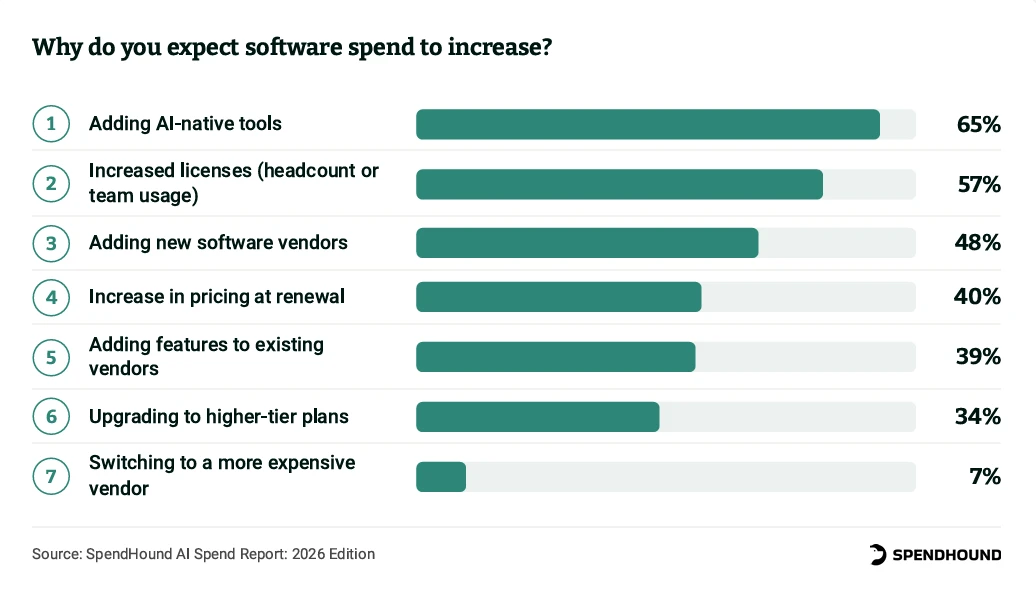
In other words, many companies aren’t replacing their existing software with AI yet. They’re adding AI on top.
That makes each new AI investment an opportunity to look at the surrounding stack. What existing capability could this replace? Could usage or licenses for another product be reduced? Is the new tool eliminating steps from a workflow or adding another system employees need to use and IT needs to manage?
Software capabilities have always overlapped. What’s different now is how quickly that overlap can happen — and change.
Existing vendors are adding AI capabilities to their platforms while AI-native companies are building new ways to perform work that previously required established applications. That means the capability you’re considering buying from a new vendor may also be emerging somewhere else in your stack.
Churn is on the horizon. SpendHound found that 28% of finance and procurement leaders say they’re very likely to replace or consolidate finance and accounting tools in the next 12 months specifically because of AI capabilities, while another 48% say they’re somewhat likely.
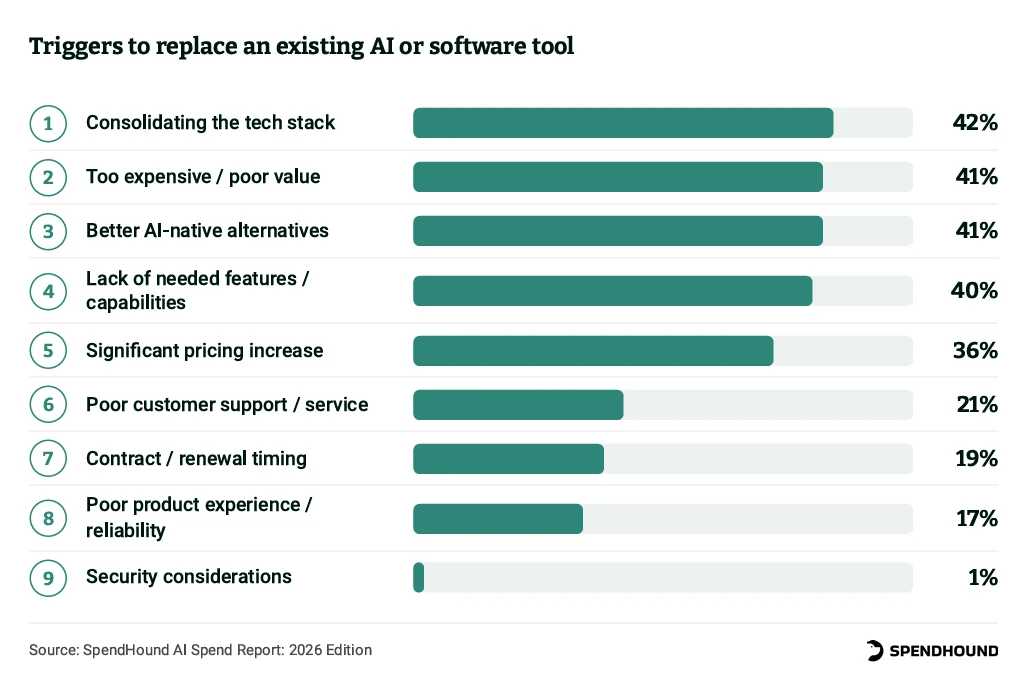
And AI is becoming a replacement trigger in its own right. When SpendHound asked what would prompt organizations to switch vendors, 42% cited consolidating the technology stack, 41% cited tools that were too expensive or delivered poor value and 41% cited the availability of better AI-native alternatives.
For IT, that makes capability mapping increasingly important.
Evaluating a new AI tool means looking not only at how its functionality compares with an incumbent today, but also at where else similar capabilities exist or are emerging across the stack. A point solution that fills an important gap now could become redundant as an existing platform expands what its AI can do.
SpendHound's Intake & Approvals suite builds this check into the purchasing process itself, flagging overlap with a new vendor request automatically — so the redundancy gets caught before the contract is signed, not after it shows up in an audit.
AI capabilities can arrive in different forms. They may come from a general-purpose AI platform, an AI feature embedded in software the organization already uses, a specialized AI-native application, or a workflow built on top of an AI model or API.
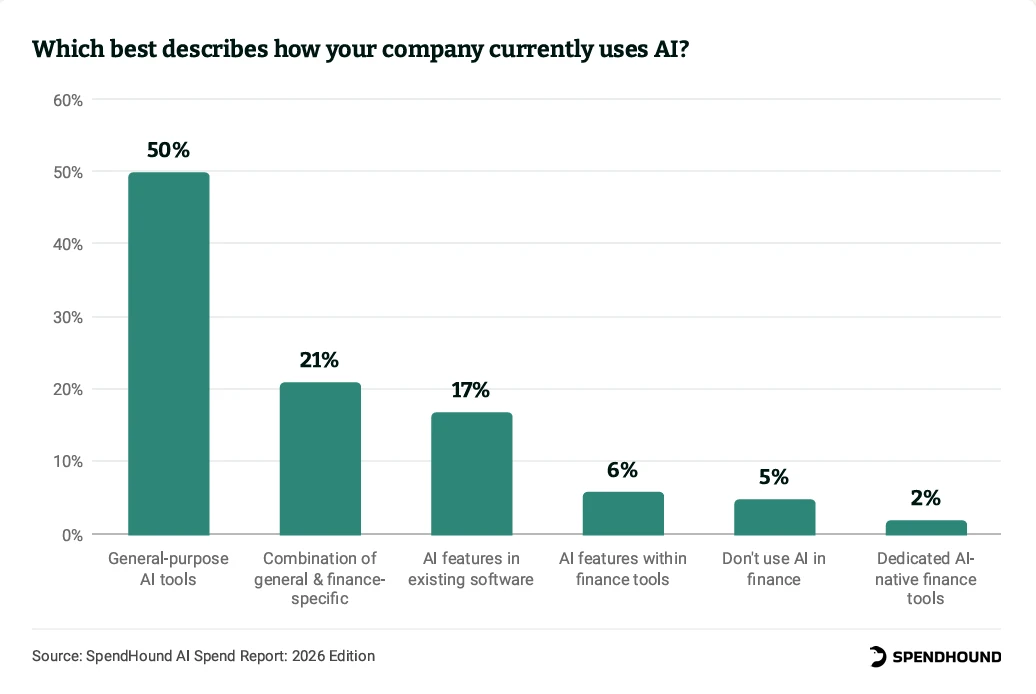
SpendHound’s research shows how mixed the current environment is. Half of survey respondents are using general-purpose AI tools such as ChatGPT, Claude, Copilot and Gemini alongside their existing finance software. Only 2% say they’re using dedicated AI-native tools for finance workflows, while 42% are currently piloting finance-specific AI tools.
That creates a different architecture question for IT: What’s the best way to deliver a capability the business needs?
A request for a new AI application doesn’t necessarily mean another application is the right answer. The capability might already exist within a general-purpose AI platform the company has adopted, be available from an incumbent vendor, or be something the organization can enable through an existing model or platform.
Looking at AI through a capability lens rather than strictly a product lens can help IT avoid accumulating multiple tools that ultimately solve versions of the same problem.
The cost of many traditional SaaS applications is relatively straightforward to model. Add employees or licenses and spend generally increases in a way IT and finance can anticipate.
As we’re seeing over and over, AI behaves differently, with costs dependent on tokens, API calls, models, credits, workloads, and other forms of consumption. Adoption can also spread quickly across teams, while individual users and applications can dramatically increase how much AI they consume.
SpendHound’s research shows how difficult that has already been to predict. In 2025, 46% of finance and procurement leaders exceeded their budgets for general-purpose AI.
Actual spend has been growing quickly. SpendHound’s proprietary B2B spend data found that run-rate spend across OpenAI, Anthropic and Cursor grew nearly 4x from December 2024 to December 2025, then another 70% between December 2025 and April 2026.
That means evaluating an AI tool based on its initial deployment can give IT an incomplete picture of what it may ultimately require.
Before bringing a new AI tool into the environment, teams need to consider what happens if a successful pilot becomes a widely adopted production workload. How does consumption change? What controls and visibility will IT need? How will usage be monitored? And what does significantly higher adoption mean for the architecture supporting it?
This is where model-level cost attribution matters. Tools like SpendHound’s AI Spend Visibility module can show IT and finance the moment a usage spike traces back to a specific model — including cases where a premium model is handling tasks a cheaper one could manage just as well — turning "spend went up" into "here's exactly what drove it."
The cost of an AI investment may not stop with the AI vendor.
SpendHound’s proprietary spend data provides an early indication of this effect. Among companies identified as aggressive AI adopters, SpendHound hasn’t seen broad cuts to traditional software. In fact, some infrastructure vendors, including Datadog, Snowflake, and Fivetran, are among the tools these companies are spending more on.
One possible explanation is straightforward: As AI workloads grow, so can the demand for the data, cloud, and observability infrastructure supporting them.
What that can mean is that the contract price of an AI product may represent only part of its architectural cost.
IT teams need to consider what additional consumption a new AI workload could create elsewhere. Will it increase queries or compute? Require additional data movement or storage? Increase observability requirements? Put more demand on usage-based platforms already in the stack?
Those effects may be small during a pilot but become much more significant as adoption grows. Understanding the true cost of an AI investment therefore requires visibility across the broader technology environment, not simply the AI vendor invoice.
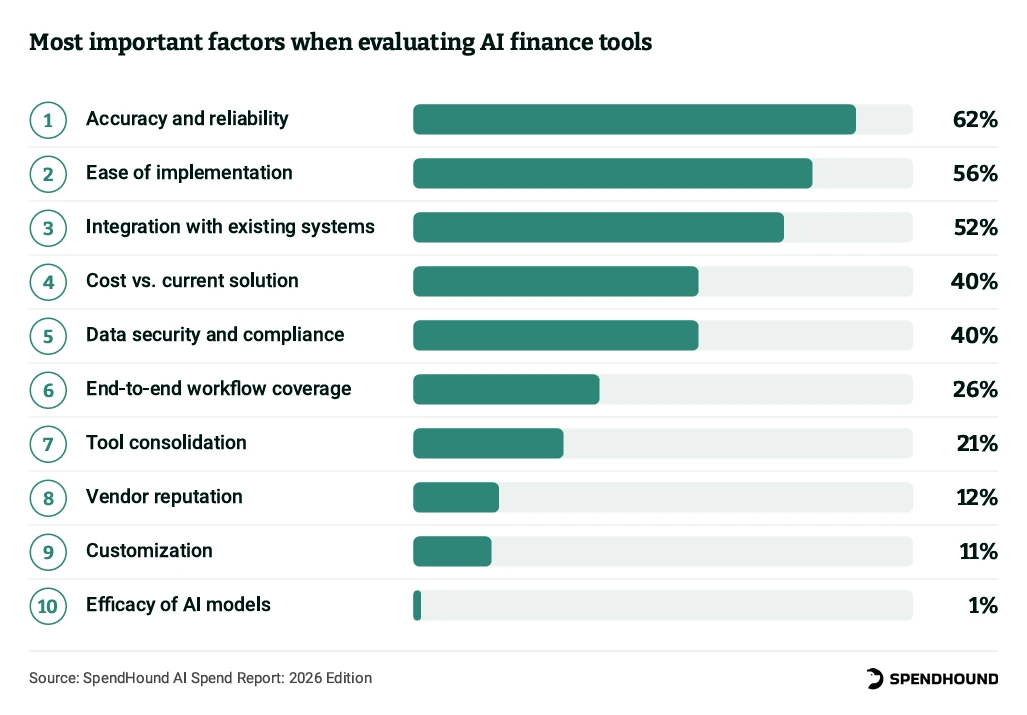
The fundamentals of good software evaluation still apply to AI. In fact, SpendHound’s research found that accuracy and reliability (62%), ease of implementation (56%), and integration with existing systems (52%) are still the top criteria finance and procurement leaders consider when evaluating replacement software.
But AI adds another layer.
Usage can accelerate faster than expected. Costs can appear elsewhere in the infrastructure stack. Similar capabilities can emerge across multiple products at once. And adding tools in pursuit of future consolidation can leave organizations managing a larger and more expensive technology environment in the near-term.
That means that every investment IT makes goes beyond the individual product decision to encompass the surrounding architecture: what it replaces, what it duplicates, what it causes the organization to consume, and how it changes the technology environment as adoption grows.
To learn more about how organizations are managing AI budgets, vendors and ROI, download SpendHound’s 2026 AI Spend Report, based on a survey of 172 finance and procurement leaders combined with proprietary B2B spend data.
Get the 2026 AI Spend Report →
Want greater visibility into what your AI investments actually cost as usage grows? SpendHound's AI Spend Visibility module gives IT, finance, and procurement teams daily insight into OpenAI, Anthropic, Amazon Bedrock, and Cursor spend and usage, including spend by model, team, department, and top users by token volume.
IT teams evaluate AI tools using many of the same criteria they use for other software, including security, reliability, integration, scalability, cost and business value. But AI also requires teams to consider the tool’s impact on the broader technology stack. That includes whether it duplicates or could replace existing capabilities, how usage and costs could change as adoption grows, what additional infrastructure it may require, and whether adding it will ultimately simplify or add complexity to the organization’s technology environment.
AI has the potential to help companies consolidate their technology stacks by replacing existing capabilities or allowing fewer tools to handle more work. So far, however, AI is expanding software stacks faster than it is shrinking them. According to SpendHound’s 2026 AI Spend Report, only 7% of finance and procurement leaders say general-purpose AI has reduced their spending on traditional finance software, while 65% say adding AI-native tools is one of the top reasons they expect software spend to increase.
IT teams can reduce AI tool sprawl by evaluating capabilities across the entire technology stack rather than assessing each new product in isolation. Before adding an AI tool, teams should determine what existing capabilities it overlaps with, what it could replace or reduce, and whether similar functionality is already available through an incumbent vendor or general-purpose AI platform. This is increasingly important as established software vendors add AI features while AI-native vendors introduce new ways to perform many of the same workflows.
AI costs can be difficult to predict because they may depend on tokens, API calls, models, workloads, and other forms of consumption rather than a fixed number of software licenses. Costs can also increase quickly as adoption spreads or individual workloads consume more AI. SpendHound found that 46% of finance and procurement leaders exceeded their general-purpose AI budgets in 2025, highlighting the importance of monitoring actual usage and modeling what costs could look like as AI moves from pilots to broader production use. SpendHound's AI Spend Visibility module gives IT and finance teams that day-to-day monitoring — daily usage and cost updates by model and user, so teams can catch unpredictable scaling before it shows up as a budget overrun.
The cost of an AI tool can extend beyond the vendor’s own contract. As AI workloads grow, they can increase demand for data infrastructure, cloud resources, storage, observability, and other usage-based platforms. SpendHound’s proprietary spend data found that aggressive AI adopters were spending more with some infrastructure vendors, including Datadog, Snowflake, and Fivetran. So IT teams should consider both the direct cost of an AI product and the additional consumption it may create elsewhere in the technology stack.
SpendHound’s AI research combines original survey research with proprietary software purchasing and spend data. The 2026 AI Spend Report includes survey responses from 172 finance and procurement leaders alongside SpendHound and YipitData data on software and AI spend. SpendHound’s broader benchmark data is derived from actual software purchasing data from more than 1,300 contributing companies, helping IT, finance and procurement teams compare their own AI and software spending with what companies are actually paying in the market.