NEW
NEW RESEARCH
AI Spend Report: See how 172 leaders are budgeting for AI Get the report
WEBINAR
AI Spend in 2026: What finance should do next Watch now


Most advice on SaaS cost reduction follows the same playbook: audit your stack, cancel unused tools, and reclaim idle licenses. Those are worthwhile steps, but they’re only part of the equation.
The bigger SaaS savings sit in the contracts for the software you’re keeping. They’re the tools nobody questions because the product works, and the team would complain if you cut them. Those are exactly the contracts vendors count on you to renew at full price or above.
SpendHound defines SaaS spend optimization as the process of reducing software costs by improving the commercial performance of your SaaS contracts. It focuses on right-sizing licenses, benchmarking vendor pricing, negotiating better renewal terms, and securing more favorable contract terms over time. The goal isn't to buy less software — it's to ensure you're paying the right price for the software you use.
Effective SaaS spend optimization has two phases. The first eliminates unnecessary software through license optimization and vendor consolidation. The second reduces the cost of the software you keep through pricing benchmarks and renewal negotiations. Most organizations complete the first phase but never fully execute the second. Effective SaaS spend optimization requires both.
If you're still building visibility into your software inventory, renewals, license usage, and contract ownership, start with our guide to SaaS spend management. Then come back here to learn how to reduce what you pay for the software you keep.
The right place to start is usage data. Who's logged in, how often, and which seats are dormant. If you're paying for 200 Salesforce licenses and only 60 people use them, the fix is obvious. The four levers in this phase — right-sizing license counts, canceling unused tools, eliminating duplicate apps, and improving utilization on tools worth keeping — address spend that shouldn't exist in the first place. Shadow IT, seat waste, and redundant software are real costs, and eliminating them creates a cleaner software portfolio.
The biggest gains from this phase usually come during the first optimization pass. Once you've eliminated unused licenses and redundant tools, future reviews become incremental. At that point, the question shifts from "What can we cut?" to "What are we paying for the software we're keeping, and is that price competitive?"
SaaS vendors price renewals differently than new business. When a company buys a new tool, vendors compete on price, features, and service because they know they have to win your business. Renewals are different. The switching cost is real, the users are embedded, and the vendor has more information than you do going in: they know your usage patterns, your seat count, your renewal date, and what thousands of other customers pay for the same contract.
What changes that dynamic is pricing benchmark data. Not your own usage data — they already know that. What SaaS vendors don't know is whether you know what comparable companies pay. Walking into a renewal with data showing that 80 midmarket companies at your size pay 22% less for the same contract changes the conversation. The vendor can no longer frame an 8% uplift as market-standard when you can show them it isn't.
Most teams going into renewals have a vague sense of whether a price feels right — maybe a number from a Slack group or what a peer mentioned at a conference. Vendors have structured pricing intelligence. That asymmetry is why the standard renewal tilts toward the vendor, and why phase two is where the larger recurring savings live.
SpendHound Procurement Expert Jason Edick says that's especially true for mission-critical software. "The applications that are hardest to negotiate are the ones you can't simply rip and replace," he says, pointing to platforms like Salesforce, Google, and Microsoft where migration can take months. In those situations, understanding your leverage before renewal becomes even more important.
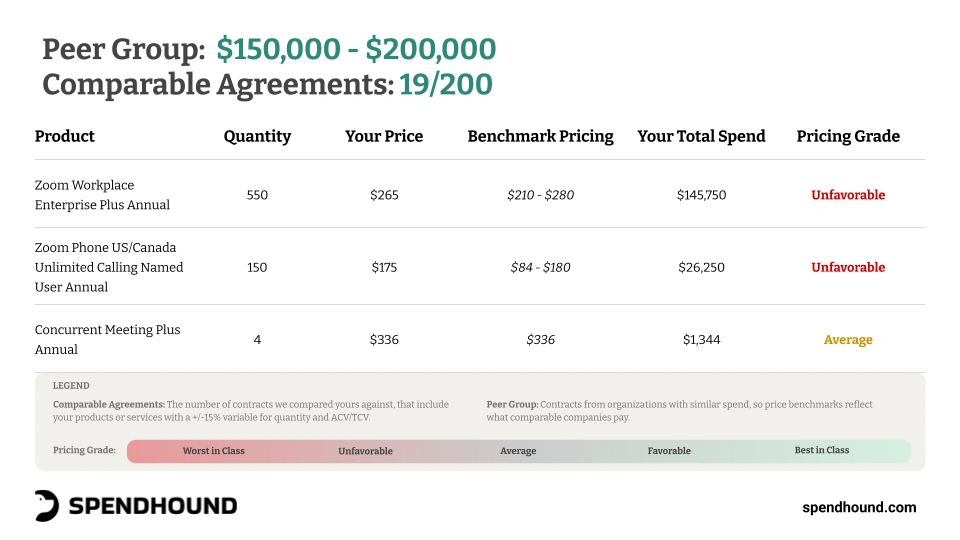
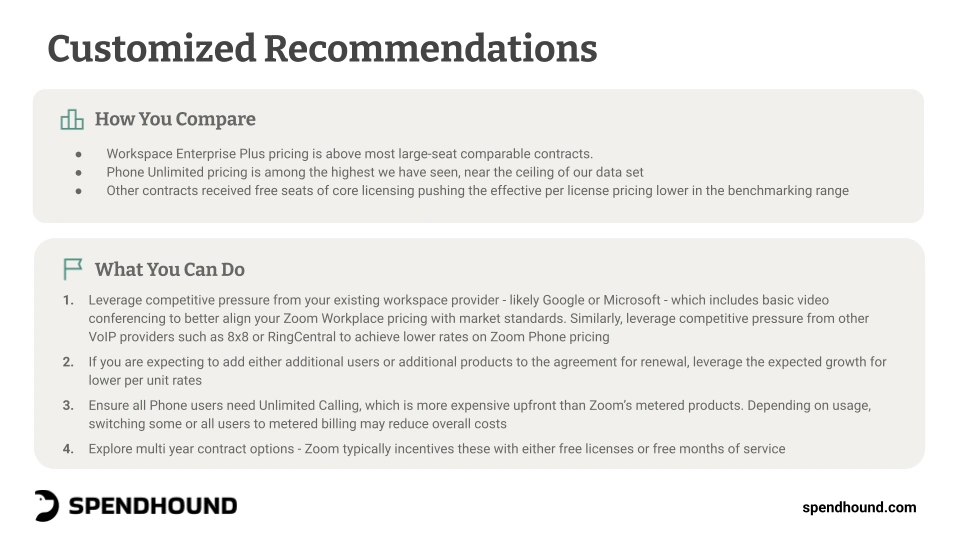
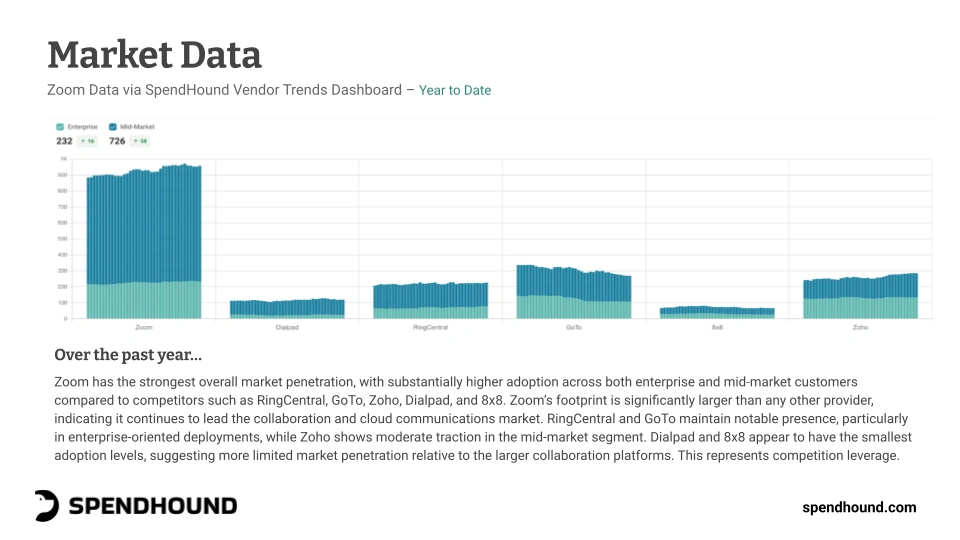
Sample Zoom Benchmark
SpendHound provides in-platform benchmarking for 10,000+ SaaS and AI vendors so you can see how your price measures against your peer group based on a cohort of comparable agreements.
Here’s an example of what a pricing benchmark might look like for Zoom for an enterprise company.
Effective SaaS spend optimization means improving both what you buy and what you pay. Every software renewal has two levers: volume (licenses, seats, or products) and price (the commercial terms of the agreement). Here’s how you can optimize SaaS savings at renewal.
Not every contract deserves the same level of attention. Focus first on the vendors that represent the largest share of your SaaS budget. Improving pricing on a handful of strategic contracts typically produces far greater savings than optimizing dozens of smaller subscriptions.
Time is one of your biggest negotiating advantages. As renewal dates approach, switching becomes less realistic and vendors gain leverage. Beginning discussions 90 days in advance gives you time to evaluate alternatives, gather internal feedback, and negotiate from a stronger position.
While 90 days is a practical minimum for most organizations, SpendHound Procurement Expert Zack Hildenbrandt says the most successful negotiations often begin even earlier. "Being well ahead and well prepared for renewals is the most effective lever we've seen from our customer base," he says. "If you're six to nine months ahead of a renewal, you can credibly evaluate alternatives. Six to nine weeks before renewal, everyone in the room knows that's no longer realistic.”
Review actual license usage, product adoption, and feature utilization before renewing. Remove inactive users, downgrade unnecessary license tiers, and eliminate products that no longer deliver value. There's little benefit to negotiating a discount on software you don't need.
Don't negotiate against the vendor's first proposal. Go into every renewal knowing what comparable companies actually pay for the same product. A budget tells you what you can spend. A pricing benchmark shows you how your pricing compares to the market, where you’re overpaying, and by how much.
Price is only one part of the negotiation. Evaluate contract length, annual price increases, payment terms, renewal protections, product bundles, and seat flexibility alongside the headline price. Small improvements across multiple contract terms often create larger long-term savings than focusing on discount percentage alone.
SaaS spend optimization isn't a one-time project. Track negotiated savings, pricing improvements, and renewal outcomes over time so each renewal becomes more informed than the last. Organizations that consistently benchmark and negotiate every material contract typically outperform those that only optimize after costs become a problem.
One place both phases break down right now is AI tooling. The spend pattern is different — consumption-based pricing, departmental credit cards, subscriptions that started as individual experiments and scaled into team-wide usage. A company with good visibility into Salesforce and Workday may have no structured view of what it's spending on OpenAI, Anthropic, Cursor, or Glean.
Both phases apply here the same way they do for traditional SaaS. Phase one is discovery and consolidation; phase two is benchmarking what you're keeping. Benchmarking is especially important for negotiating pricing for AI because AI vendor pricing is moving fast, and the spread between what different companies pay for the same tools is significant.
Most SaaS spend management tools deliver phase one well. They surface what you're spending, flag renewals, and identify unused seats. That's necessary infrastructure — you can't optimize what you can't see.
But knowing you spend $625,000 per year on Adobe is the starting point, not the outcome. Knowing that comparable enterprise companies pay closer to $500,000 for a similar Adobe contract tells you you're overpaying by roughly 25% and gives you a defensible target before the renewal conversation begins. That's what moves you from visibility into actual spend reduction
Case in point: Fusion92 used SpendHound to review more than 200 tools, identifying 12 consolidation opportunities and surfacing relevant benchmark data that showed companies paying significantly less for the same tools. As Michelle Gawley, VP of Operations for Fusion92 notes: “That leverage has completely changed how we negotiate.” The result: $345,000 in savings identified for 2025, with $900,000 projected for 2026.
SaaS spend optimization isn't just about removing unused software — it's about ensuring every dollar you continue to spend is justified and that you’re getting your best price. License optimizations reduce waste. But the biggest savings often come from negotiating better pricing on the contracts you keep.
SpendHound helps finance, procurement, and IT teams do both. Our SaaS spend management platform gives you complete renewal visibility, benchmarks what similar companies pay for 10,000+ software vendors, and provides procurement expertise to help you negotiate better renewals. If you're ready to stop overpaying for SaaS, request a demo to see how SpendHound can help.
SaaS spend optimization is the process of reducing what a company pays for software. It covers rightsizing licenses, eliminating unused or duplicate tools, improving utilization, and negotiating renewal pricing against market benchmarks. Most teams complete the license and usage work first — that's phase one. Phase two is pricing negotiation, which is where the larger recurring savings typically live on contracts that have been auto-renewing without challenge.
Spend management is the operating system — visibility, ownership, governance, and renewal processes. SaaS spend optimization is the actual process of reducing SaaS spend. A team can have excellent spend management and still be overpaying on every major contract if they're renewing at vendor-quoted prices without benchmarking them. Management makes optimization possible; it doesn't make it automatic.
Benchmark data shows you what comparable companies at your size are actually paying for the same contract — and is the key to knowing if you’re overpaying for a SaaS tool. Without it, you're relying on what the vendor tells you or anecdotal peer data. A 20% gap between your contract rate and the midmarket median isn't unusual on contracts that have auto-renewed for two or three years without a formal negotiation.
Ninety days before renewal is the practical minimum to renegotiate a SaaS contract. That's enough time to pull benchmarks, prepare your negotiation strategy, engage the vendor, and evaluate alternatives if needed. However, SpendHound's procurement experts have seen the best results when companies begin planning three to six months before renewal. The additional time strengthens your negotiating position, makes competitive alternatives more credible, and reduces the time pressure that shifts leverage to the vendor.
For teams that have been auto-renewing without pushback, it’s possible to achieve 10–30% reductions on renegotiated contracts. SpendHound customers average 30% reduction in software spend.
No, SaaS spend optimization doesn’t require a dedicated procurement team. Many mid-market companies manage SaaS spend without a dedicated procurement function. What matters is having visibility into upcoming renewals, access to market pricing benchmarks, and a repeatable negotiation process. Platforms like SpendHound combine renewal management, pricing benchmarks, and procurement expertise to help finance, IT, and procurement teams negotiate better software contracts without adding headcount.