NEW
NEW RESEARCH
AI Spend Report: See how 172 leaders are budgeting for AI Get the report
WEBINAR
AI Spend in 2026: What finance should do next Save your spot


AI is expanding what businesses can do and providing new reasons for teams to reconsider their existing vendors. Here’s a practical framework to help finance and procurement leaders decide what deserves a place in the stack.
What makes you start researching new vendor solutions? For years, the reasons to reconsider a software vendor were fairly familiar: The price on your existing platform went up. The product was missing functionality you needed. The UI was painful or the customer service was lacking.
Those are definitely still valid reasons to go on the hunt for new solutions. But AI is changing what businesses expect from their software — and introducing new reasons to take another look at the tools you already have.
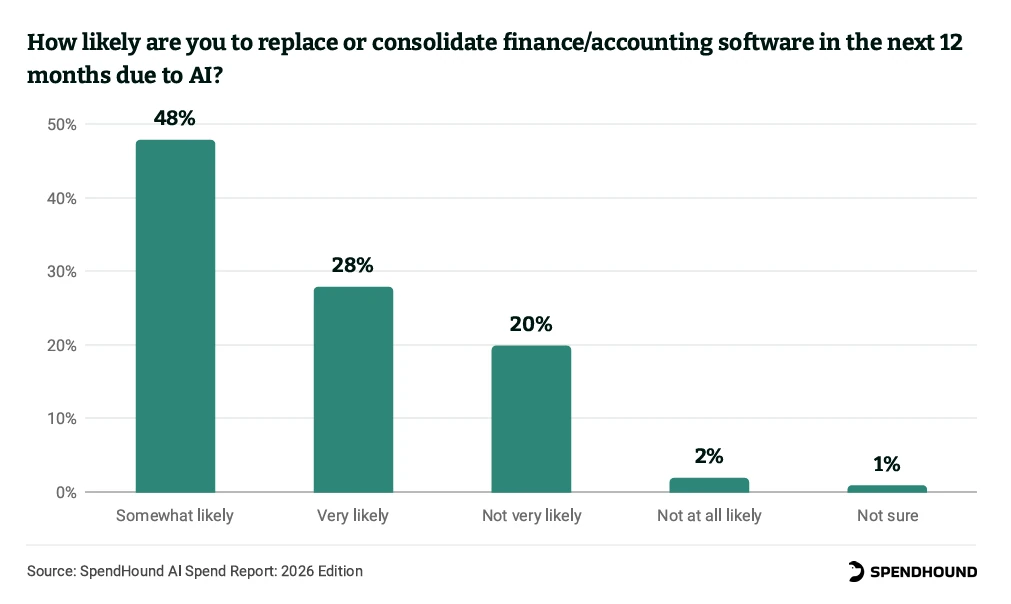
According to SpendHound’s 2026 AI Spend Report, 76% of finance and procurement leaders say they’re somewhat or very likely to replace or consolidate finance and accounting tools in the next 12 months, specifically because of AI capabilities.
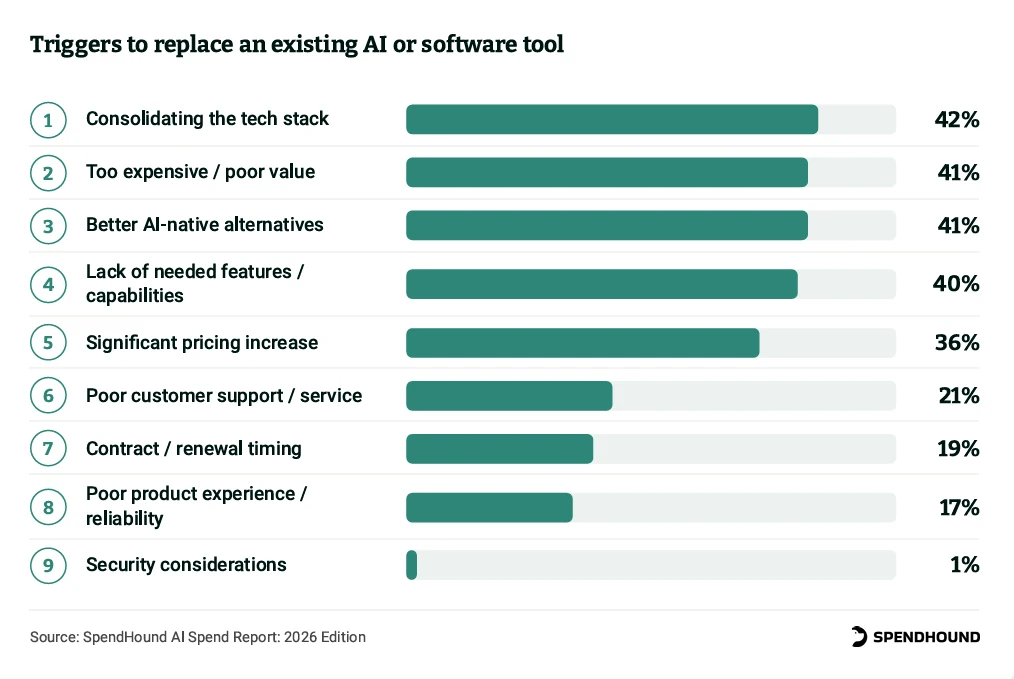
When we asked what would trigger a vendor switch, consolidating the tech stack ranked first at 42%. But two other reasons were essentially tied with consolidation: 41% cited tools that were too expensive or delivered poor value, and 41% cited the availability of better AI-native alternatives.
Everyone’s being given a mandate to expand how they’re using AI in their function. But AI for the sake of AI is meaningless. The real mandate should be to determine what AI capabilities can help your business solve an existing problem better — whether that means improving efficiency, increasing accuracy, reducing costs, simplifying workflows or getting more from the people and technology you already have.
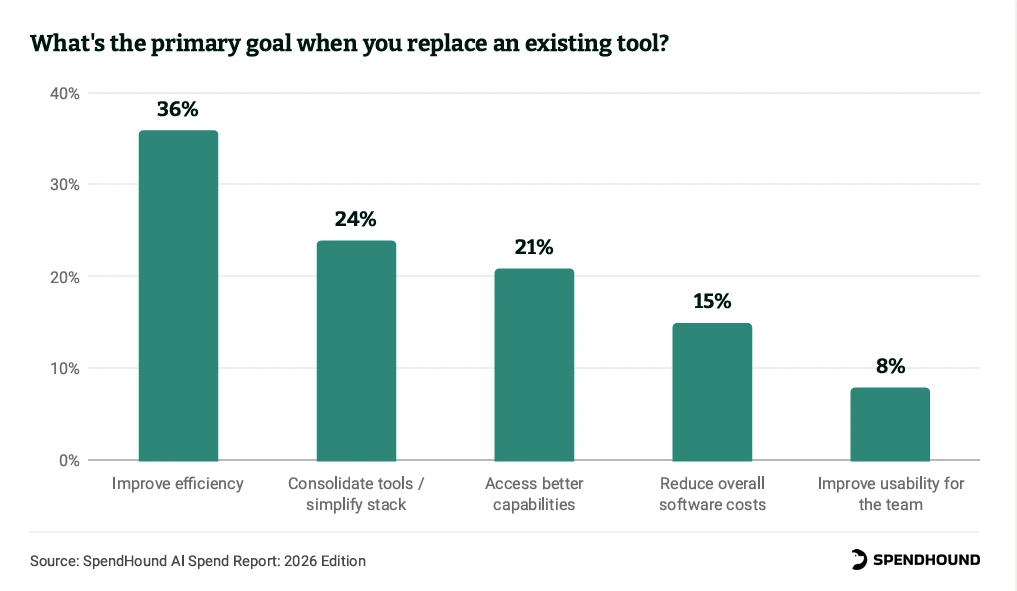
Our recent survey showed this in practice: When finance and procurement leaders replace an existing tool, improving efficiency is their most common objective (36%), ahead of consolidating the stack (24%), accessing better capabilities (21%) and reducing costs (15%).
So how should you evaluate your options as the capabilities of the software market change? Here are six questions to consider.
To state the obvious: For finance teams, a tool that produces an answer faster isn’t particularly useful if someone has to spend just as much time checking whether that answer is right!
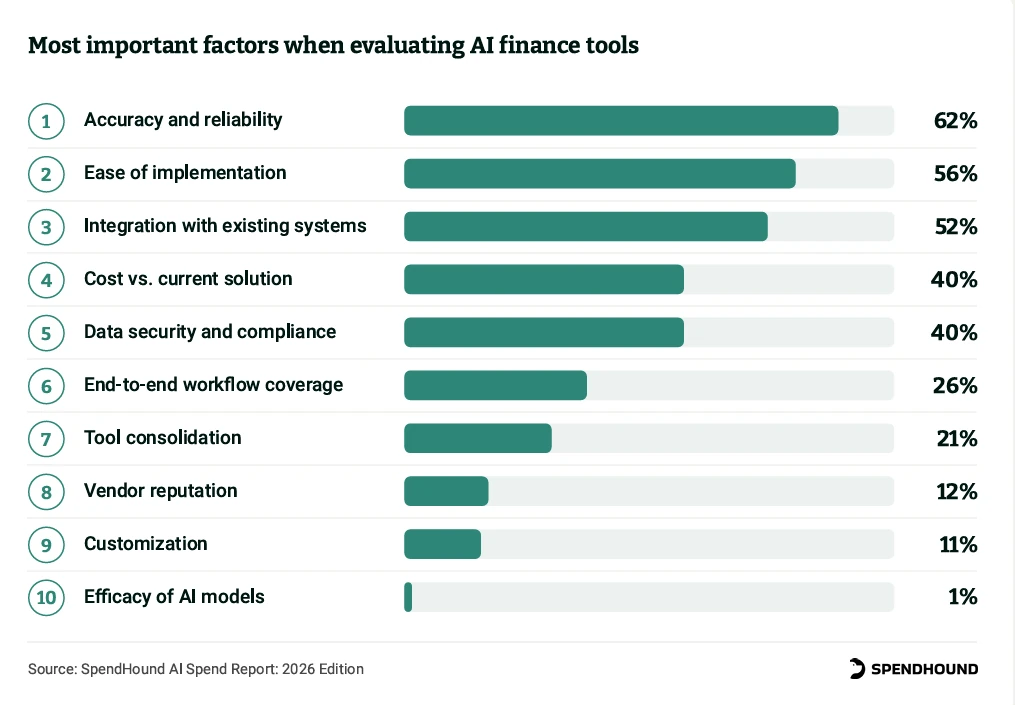
That helps explain why accuracy tops the list of criteria finance and procurement leaders use when evaluating software replacements. In our research, 62% identified accuracy as one of their top considerations.
Accuracy and reliability are also the most commonly cited barrier to broader AI adoption in finance, at 42%.
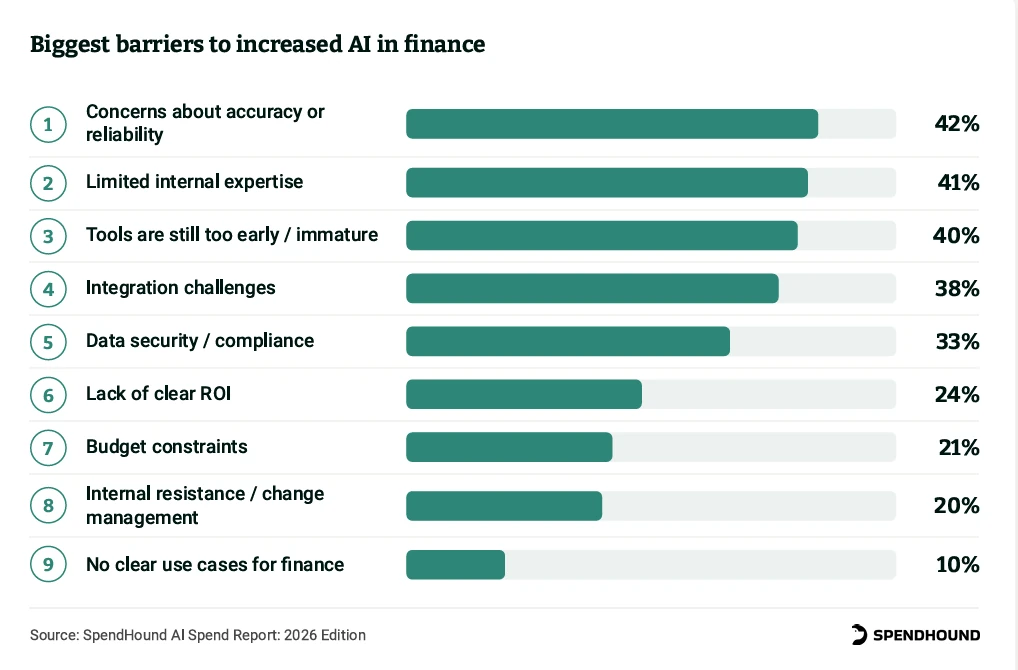
Accuracy is obviously important, especially for finance teams. But what “accurate enough” means will depend on the job. The consequences of an error in a first draft of internal commentary are very different from an error in a financial analysis used to make a business decision.
To assess accuracy, evaluate the tool against the actual work you expect it to perform. That can include questions such as:
A controlled demo can show you what a product is capable of. Testing it against the work your team actually does tells you whether those capabilities are dependable enough to be consistently useful.
A promising pilot isn’t the same thing as a successful deployment.
SpendHound’s research found that 42% of finance and procurement leaders are currently piloting finance-specific AI tools, while only 20% have deployed them in production. Another 27% evaluated finance-specific AI tools but chose not to deploy them.
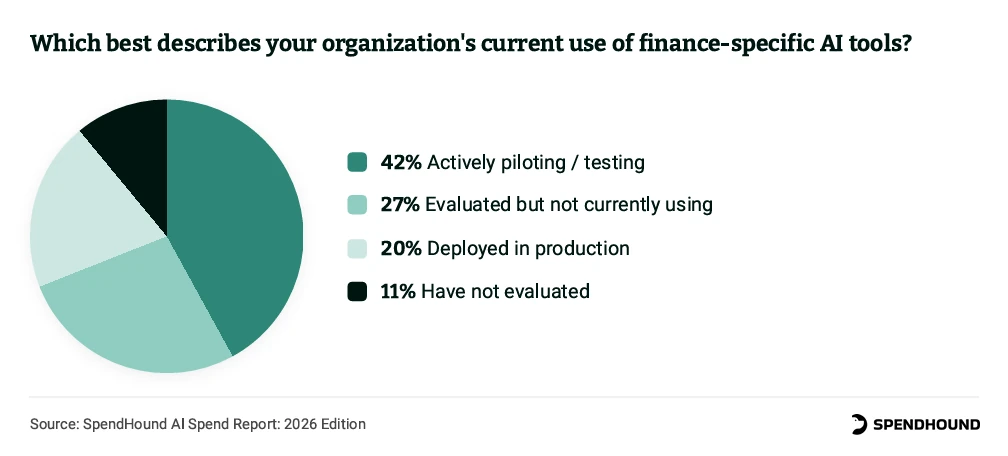
That gap is a reminder that implementation deserves just as much scrutiny as functionality. And finance leaders appear to recognize it: 56% cite ease of implementation as a top criterion when evaluating software replacements.
Before selecting a vendor, understand what it will take to get from contract signature to actual use.
Consider:
If a tool can perform a task, great. But the bigger question is how much time, money, and organizational effort it will take before your team can reliably use it to perform that task.
Finance teams rely on interconnected systems for accounting, planning, payments, procurement, data, reporting, and other workflows. A new tool may need a two-way flow of data from and to existing systems.
That makes integration a major part of AI vendor evaluation. More than half (52%) of finance and procurement leaders cite integration with existing systems as a top consideration when evaluating replacement software.
But don’t just treat integration as a yes-or-no checkbox on a vendor comparison sheet.
Consider these specific evaluation questions:
Your quoted price today can be a world away from what a tool will actually wind up costing.
Total cost may be affected by users, tokens, API calls, models, credits, workloads, or other forms of consumption. And as more employees use the product — or existing users rely on it more heavily — spend can increase quickly.
We’ve already seen how difficult those costs can be to predict. In SpendHound’s 2026 AI Spend Report, 46% of finance and procurement leaders said their organizations exceeded their AI budgets in 2025.
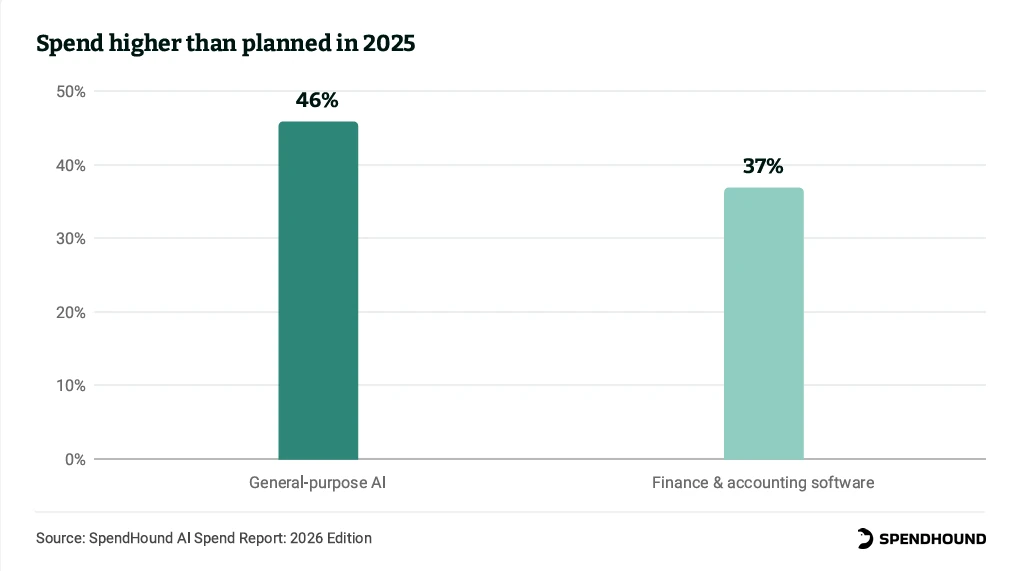
That unpredictability requires a different approach to planning, forecasting, and budgeting for AI spend.
So, before selecting a vendor, model what the product could cost under different levels of adoption and usage.
Specifically, you should look at:
That last point is easy to miss. Increased AI usage can drive additional consumption of cloud, data infrastructure, storage, observability, and other usage-based platforms. In other words, the total cost of an AI investment could extend beyond one vendor’s invoice.
SpendHound's AI Spend Visibility module gives finance, IT, engineering, and procurement teams daily visibility into OpenAI, Anthropic, Cursor, and Amazon Bedrock usage and costs, including spend by workspace, project, API key, model, and user. It pairs that usage data with real pricing benchmarks on AI enterprise contracts — what comparable companies actually pay — so you can see how your consumption tracks against what you expected when you evaluated the investment and whether the rate you signed is competitive. Identify what's driving a change before the invoice arrives, and walk into your renewal knowing what the contract should cost.
One of the biggest opportunities created by new AI capabilities is the possibility of doing work differently.
A product may now be able to automate part of a workflow that previously required several tools. An AI-native alternative may perform an existing job more effectively. Or new functionality from an incumbent vendor may make another product redundant.
That helps explain why consolidating the technology stack is currently the most commonly cited trigger for switching vendors, at 42%.
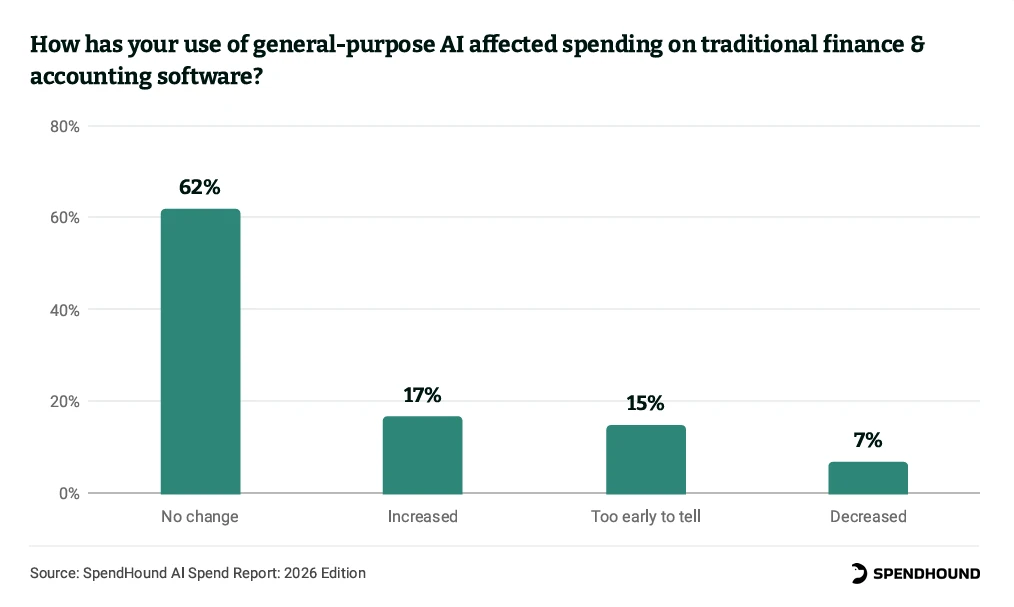
But, interestingly, so far we’re seeing AI expand software stacks much faster than it’s shrinking them. Only 7% of finance and procurement leaders in our research say general-purpose AI has reduced their spending on traditional finance software.
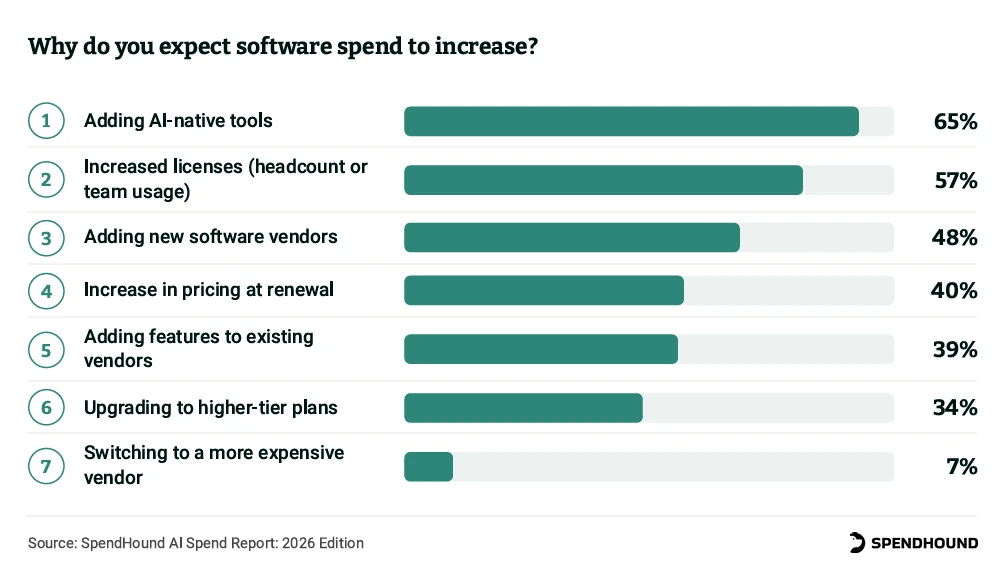
Meanwhile, 65% say adding AI-native tools is one of the top reasons they expect software spend to increase.
When evaluating a new vendor, be explicit about where it fits:
The incremental value of a new tool should ultimately justify its incremental cost and complexity.
AI might reduce manual work, allow the same team to handle more volume, improve accuracy, shorten a process, reduce outside spending, eliminate another software product, or help employees spend more time on higher-value work. There are lots of ways that AI can drive value.
To determine AI ROI, you need to start by defining the expected outcome upfront and deciding how you’ll measure it. If you're running a pilot, establish the evaluation period and success criteria before it begins. If the tool moves into production, continue measuring against those criteria as adoption and spending grow.
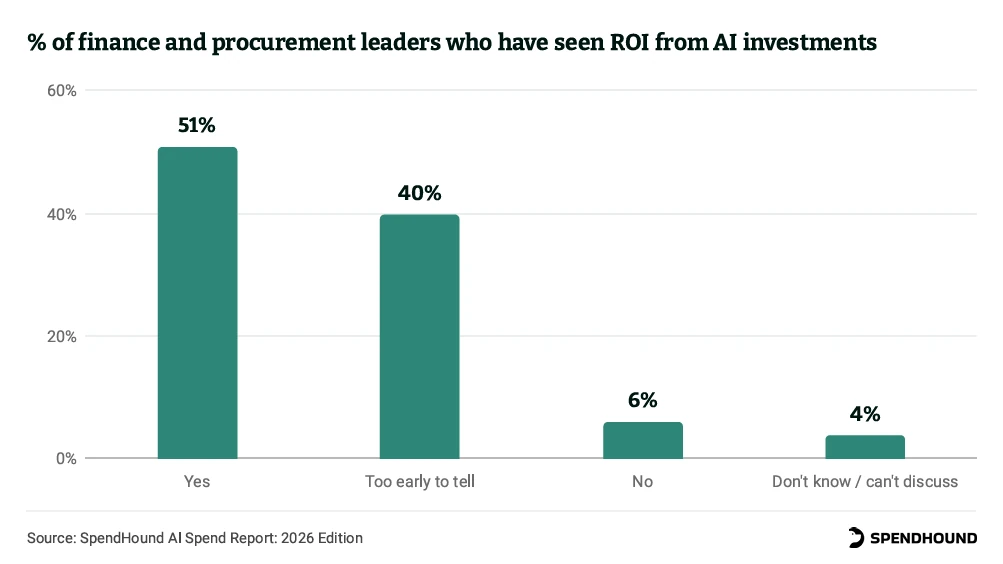
This matters because many businesses are still figuring out what they’re getting from their AI investments. While 51% of finance and procurement leaders in our research say they’re seeing clear, measurable ROI, 40% say it’s still too early to tell.
Not every investment needs to produce an immediate financial return. But every material investment should have a clear reason for being in the stack — and a way to determine whether it’s delivering on what you bought it to do.
For finance and procurement teams, vendor evaluation isn’t just a point-in-time purchasing exercise.
The AI vendor that was the best fit last year won’t necessarily remain the best option — and the tool that looks best during an evaluation today still needs to prove its value once it’s deployed.
Start with the business problem you need to solve. Evaluate whether the product can solve it accurately and reliably, what it will take to deploy, how it fits into your existing environment and what it will cost as usage grows. Then keep measuring whether it’s delivering the outcome that justified the investment in the first place and continuing to earn its place in your stack.
To learn more about how finance and procurement leaders are evaluating vendors, managing AI budgets and measuring ROI, download SpendHound’s 2026 AI Spend Report, based on a survey of 172 finance and procurement leaders combined with proprietary B2B spend data.
Download the 2026 AI Spend Report →
Want better visibility into what your AI investments actually cost, and how to pay less, as usage grows? SpendHound’s AI Spend Visibility module gives finance, IT, engineering, and procurement teams daily insight into OpenAI, Anthropic, Amazon Bedrock, and Cursor spend and usage, so you can see where AI dollars are going and what’s driving changes. Visibility plus pricing benchmarks give you the context — and market intelligence — to walk into your renewal knowing what the contract should cost.
When evaluating AI vendors, organizations should evaluate how well an AI tool solves the specific business problem they’re trying to address. Key considerations include accuracy and reliability, ease of implementation, integration with existing systems and workflows, total cost as usage grows, impact on the existing software stack, and measurable business outcomes.
Accuracy, implementation, and integration are among the most important criteria when it comes to AI vendor evaluation. In SpendHound’s 2026 AI Spend Report, 62% of finance and procurement leaders cited accuracy as a top consideration when evaluating replacement software, followed by ease of implementation at 56% and integration with existing systems at 52%.
For finance and procurement teams comparing AI vendor pricing, start by looking beyond the quoted contract price. AI costs may vary based on users, tokens, API calls, models, credits, workloads, or other forms of consumption. Compare fixed and variable costs, usage, overage rates, minimum commitments, and how pricing changes as adoption grows. Teams should also consider costs the tool may create elsewhere in the technology stack. Tools like SpendHound’s AI spend visibility help teams see what they're spending daily on Anthropic, OpenAI, Cursor, Amazon Bedrock, and more -- by usage, model, team, and user -- so costs can be controlled in real time. And pricing benchmarks provide teams with the marketing intelligence they need to know how much a contract should really cost.
AI can potentially help businesses consolidate their software stack, but consolidation isn’t a given. AI may allow companies to automate workflows, replace existing capabilities, or reduce their reliance on other tools. But, according to a recent SpendHound AI Spend Report, only 7% of finance and procurement leaders said general-purpose AI had reduced their traditional finance software spend, while 65% said adding AI-native tools was actually contributing to higher software spend.
AI is expanding what businesses can expect their software to do. SpendHound found that 76% of finance and procurement leaders are somewhat or very likely to replace or consolidate finance and accounting tools in the next 12 months specifically because of AI capabilities. Goals include improving efficiency, consolidating the software stack, accessing better capabilities, and reducing costs.
SpendHound’s AI research combines original survey research with proprietary software purchasing and spend data. The 2026 AI Spend Report includes survey responses from 172 finance and procurement leaders alongside SpendHound and YipitData data on software purchasing, AI adoption, procurement trends, and SaaS pricing dynamics. SpendHound’s broader benchmark data is derived from actual software purchasing data from more than 1,300 contributing companies, helping finance and procurement teams compare their own AI and software spending with what companies are actually paying in the market.