NEW
NEW RESEARCH
AI Spend Report: See how 172 leaders are budgeting for AI Get the report
WEBINAR
AI Spend in 2026: What finance should do next Watch now


New data from SpendHound’s 2026 AI Spend Report shows why AI spend is so difficult to predict. Here are six ways to build a more realistic budget.
Welcome to the wonderful world of AI pricing, where the price you agree to pay isn’t necessarily the price you actually wind up paying.
Traditional SaaS gave finance a relatively predictable unit to budget around. But AI is creating a bigger budgeting problem for finance teams as it combines fixed subscriptions with wildly variable costs tied to tokens, API calls, models, credits, and usage — all of which can grow quickly as adoption spreads.
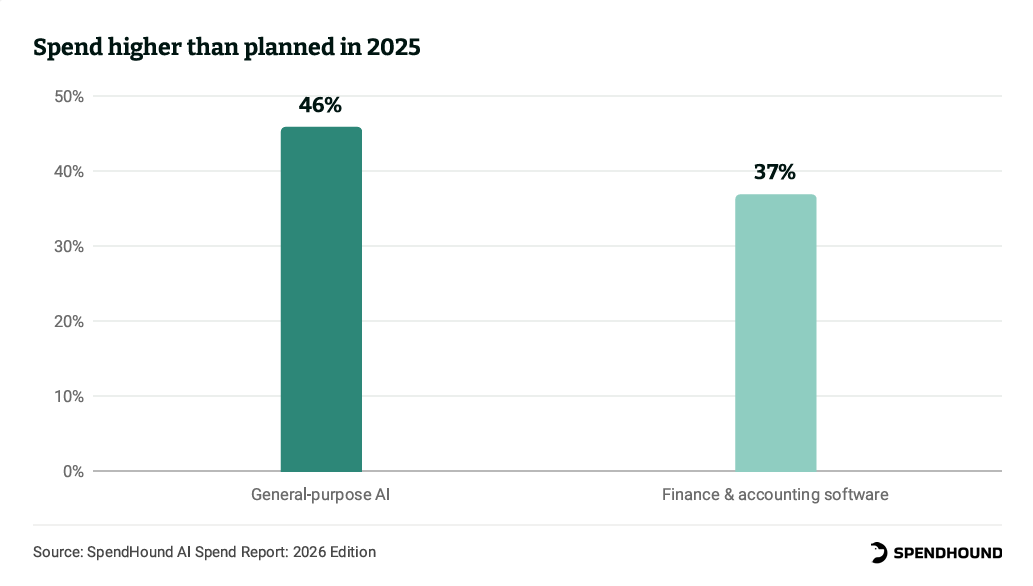
This budgeting problem is showing up in the numbers. In SpendHound's 2026 AI Spend Report, 46% of finance and procurement leaders said they exceeded their AI budgets in 2025, compared with 37% who exceeded their budgets for traditional finance software.
So what’s a finance or procurement leader to do?
Here are six ways to build a budget that can accommodate the uncertainty inherent in AI models.
AI spending can span engineering, IT, product, marketing, finance, and other business units. Different teams may buy their own AI applications, while engineering incurs separate API and infrastructure costs.
That fragmentation creates a basic budgeting problem built on one big question: Who owns the total number?
Within many companies, the answer is…complicated. According to our research, it’s really complicated: 22% of finance and procurement leaders said no single person owns the AI budget.
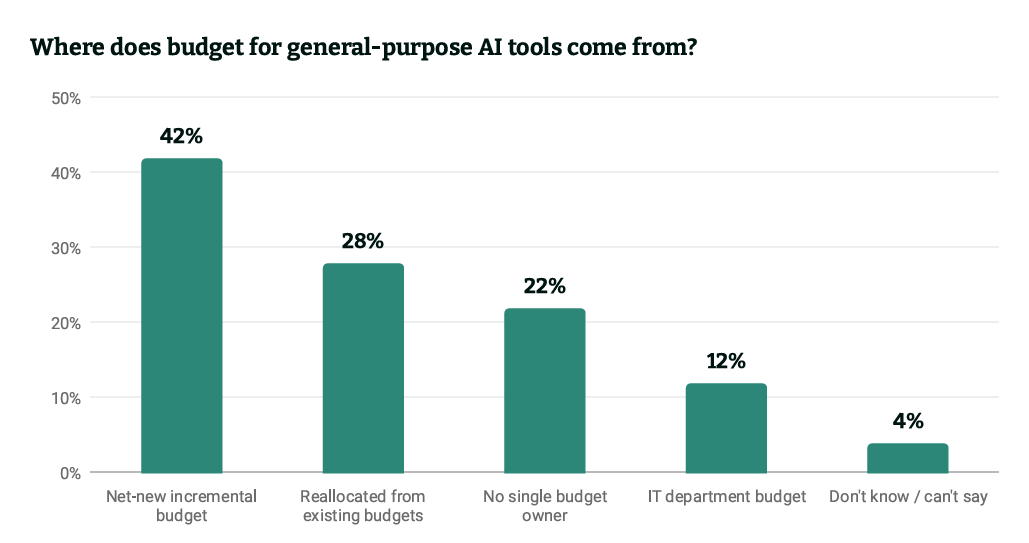
Individual teams don't necessarily need to give up control of their AI investments. But someone needs responsibility for consolidating those investments into a company-wide view — because you can’t build a reliable forecast around spend you can't see.
Start by identifying:
The goal is to establish a baseline for what you're spending, where it's coming from, and who’s accountable for the spend.
While it’d be nice to have one annual estimate to carry the entire budgeting load, AI adoption is moving too quickly for that.
So, instead of trying to predict one precise number, instead aim to model a range of possible outcomes based on the variables most likely to change.
For example:
Baseline: Current users and workloads continue at roughly their existing rate.
Growth: Adoption expands to additional teams and existing users increase consumption.
High consumption: Successful pilots move into production, API workloads accelerate, or automated use cases significantly increase usage.
SpendHound's data shows why that range matters. Run-rate spend across OpenAI, Anthropic, and Cursor grew nearly 4x from December 2024 to December 2025, then another 70% through April 2026.
This kind of scenario planning isn’t magic. You still won’t have an exact number of what you’ll spend down to the dollar. But it’s a useful exercise because it makes explicit the assumptions behind your budget, so you know exactly where to pay attention.
If the forecast assumes 500 users, three production workloads, and a particular level of API consumption, finance can monitor those assumptions throughout the year. When one changes, you know the forecast may need to change with it.
As AI becomes embedded in more SaaS products, finance teams increasingly need to budget around usage. Our recent guide to metered AI pricing looks more closely at how credits, tokens, commitments, and overages can affect what you ultimately pay.
To complicate your budget even further, the new AI tools you buy aren't necessarily the full cost of the AI you use.
In our research, only 7% of finance and procurement leaders said AI had reduced their spending on traditional finance software. Instead, for most organizations, AI is being added on top of the existing stack rather than replacing it.
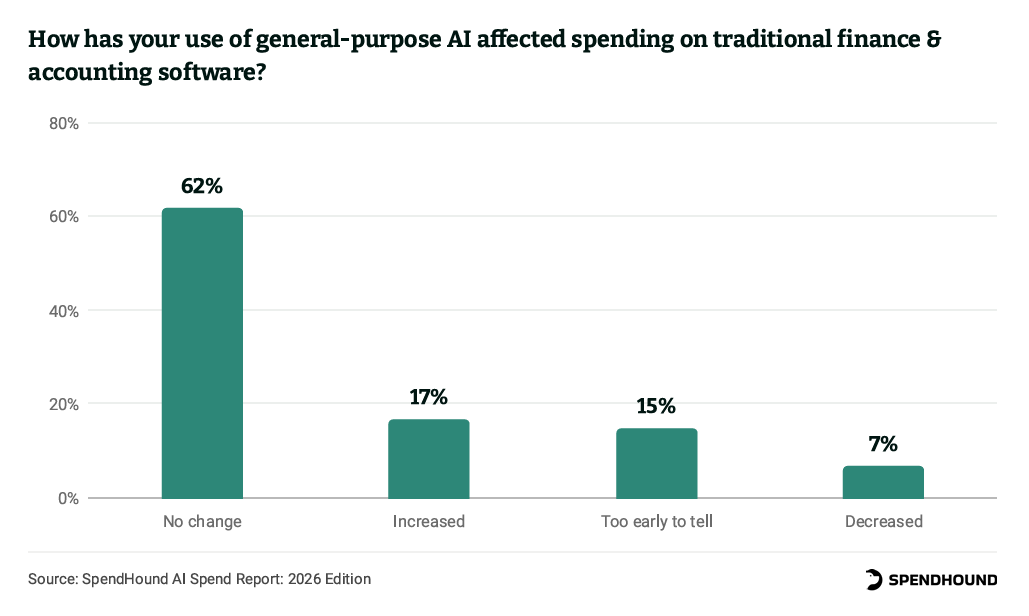
And not only are net-new tools being added, but transaction data from YipitData (the parent company of SpendHound) shows that AI early adopters are also spending more with existing vendors in their stacks, particularly data infrastructure providers such as Snowflake, Datadog, and Fivetran. As AI workloads grow, these tools can drive additional consumption of the infrastructure supporting them.
So when building your AI budget, you need to widen the scope to ask: If our AI usage grows, what else gets more expensive?
Depending on your environment, the answer could include data infrastructure, cloud services, observability, storage, or other usage-based platforms.
Building those dependencies into your scenarios gives finance a better picture of how AI is reshaping software budgets and the total cost of increased AI adoption.
A team tests a new tool. The pilot works. Adoption grows. More users are added. Before anyone formally revisits the decision, an experimental purchase has become part of the software stack.
That’s how today’s experiment turns into next year's fixed cost.
You need to distinguish between two types of spend in your AI budget:
Experimental spend: Temporary budget for testing tools, models, and use cases.
Production spend: Approved recurring costs for AI that has demonstrated enough value to remain in the stack.
For meaningful pilots, establish an owner, budget, evaluation period, and decision date upfront. At the end, make an explicit decision to expand, maintain, replace, or stop the investment. This not only helps you put some guardrails up on your experimental spending but also helps you button up future budgets.
Over time, finance can see how much the organization typically spends on experimentation, how frequently pilots become ongoing investments, and what those investments tend to cost as they scale. Instead of treating experimentation as an unpredictable exception, you can begin budgeting for it as a normal part of AI adoption.
The assumptions behind an AI budget don't stay assumptions for long. Once the year is underway, you can see what people are actually using. But how do the people who manage the budget get that information?
Finance may know what was budgeted. Engineering may know which APIs, models, projects, and workloads are driving consumption. Procurement may know the commercial terms. But without a consolidated view, no one has the complete picture.
That's why AI budgeting needs a tighter feedback loop between forecast and actual usage.
Finance should be able to answer questions like:
This is where spend visibility becomes part of the budgeting process.
SpendHound's AI Spend Visibility connects directly to OpenAI and Anthropic, refreshing usage and cost data daily to give finance and procurement a consolidated view of spend by provider, workspace, project, API key, model, and user. Instead of waiting for invoices, teams can compare actual consumption with the assumptions behind the budget as usage occurs.
Once you can see those changes, you can decide what should trigger a reforecast, whether that’s consumption exceeding plan by a set percentage, a pilot moving into production, a new team adopting AI, or a workload shifting to a more expensive model.
With visibility, you give yourself time to respond before spend explodes.
According to SpendHound’s AI Spend Report, 57% of finance and procurement leaders either lack confidence that they're paying a fair price for AI tools or believe they aren't.
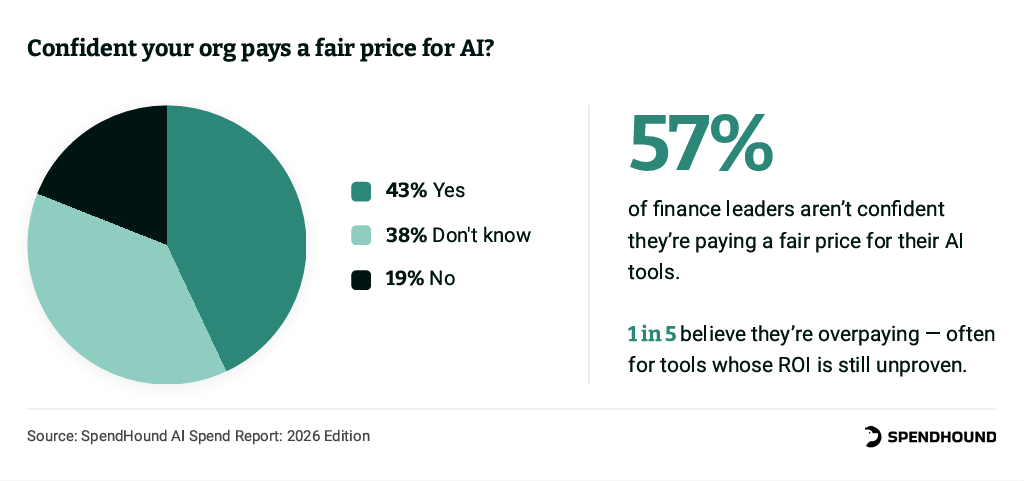
That’s because a usage forecast answers the question of how much you expect to consume, but it doesn’t answer the related — and critical question: what should that consumption cost us?
This uncertainty can flow directly into your budgeting process. If next year's budget simply carries forward an existing contract value or uses the vendor's latest quote as baseline, an above-market price will get baked into your plan.
That’s where pricing benchmarks come in.
Before setting the budget for a material AI vendor, compare your pricing with what similar organizations are actually paying. If the benchmark suggests your current contract is above market, your forecast can incorporate a more realistic — and better — negotiation target.
Our ChatGPT pricing guide and Claude pricing guide go deeper into current pricing structures, benchmarks, and negotiation considerations for teams preparing for those renewals.
Finance leaders appear to have learned from 2025's budget misses: Across 2026, 81% expect AI budgets to increase.
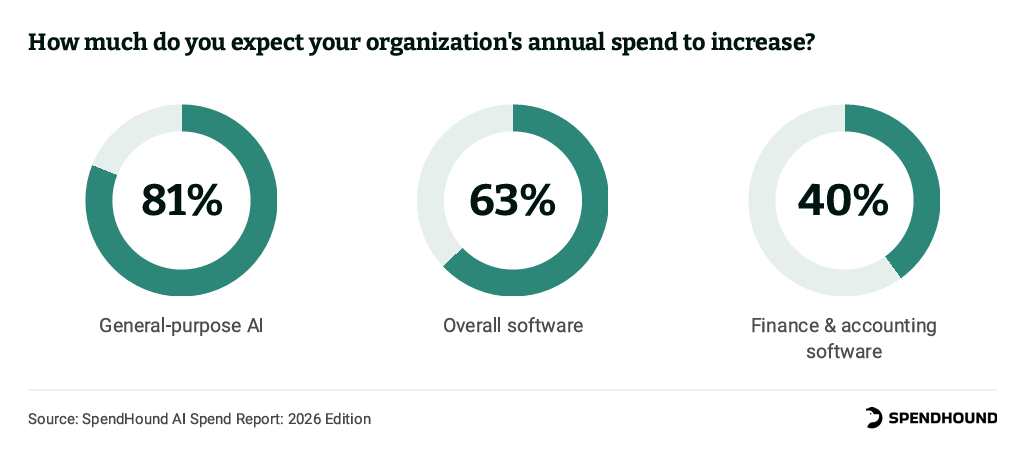
But a bigger budget isn't necessarily a better one.
Throughout the year, AI adoption, usage, pricing, and the technology supporting it can all change. Face it: You’re never going to be able to perfectly predict every variable, but you can build a process that helps you absorb new information as it arrives and adjust accordingly.
Combining these 6 practices helps you turn AI budgeting from a once-a-year prediction into an ongoing process for managing uncertainty.
To learn more about how businesses are managing AI budgets, measuring ROI, evaluating vendors, and adapting their software strategies, download our 2026 AI Spend Report, based on a survey of 172 finance and procurement leaders combined with proprietary spend data from 1,300+ companies.
Get the 2026 AI Spend Report →
If you’re struggling with AI visibility, check out SpendHound's AI Spend Visibility which gives finance and procurement teams daily insight into OpenAI and Anthropic spend and usage, so you can compare actual consumption with your forecast and understand what's driving changes before the invoice arrives.
Companies should base their 2026 AI budgets on expected usage and adoption rather than simply increasing last year’s budget by a set amount. SpendHound’s 2026 AI Spend Report found that 81% of finance and procurement leaders expect their AI budgets to increase in 2026. That tracks with actual spending: run-rate spend across OpenAI, Anthropic, and Cursor grew nearly 4x from December 2024 to December 2025, then another 70% through April 2026. Given that pace of change, companies should model multiple spending scenarios and adjust their forecasts as actual usage develops.
AI spending is harder to forecast because costs can fluctuate significantly based on usage, adoption, and the pricing model. Traditional SaaS typically gives finance a relatively predictable unit to budget around, while AI pricing can combine fixed subscriptions with variable costs tied to tokens, API calls, credits, and models. That unpredictability is already showing up in budgets: 46% of finance and procurement leaders surveyed by SpendHound said they exceeded their AI budgets in 2025, compared with 37% who exceeded budgets for traditional finance software.
Currently, 22% of finance and procurement leaders say no single person owns their organization’s AI budget, according to a recent SpendHound survey. Whether there is one person or function responsible for maintaining a company-wide view of AI spend or individual teams retain control over their own AI investments, organizations need to be able to see which AI vendors and products the company is paying for, which teams own them, fixed versus consumption-based costs, contract commitments and renewals, and who can authorize additional purchases or usage.
Companies should budget for both direct AI spending and the additional costs that increased AI usage can create elsewhere in their technology stack. Only 7% of finance and procurement leaders surveyed by SpendHound said AI had reduced their spending on traditional finance software. Transaction data from YipitData also shows AI early adopters spending more with existing data infrastructure providers as AI workloads grow. Depending on the company’s tech stack, increased AI usage can drive additional spending on cloud services, data infrastructure, observability, storage, and other usage-based platforms.
Finance teams can keep AI spending on budget by regularly comparing actual consumption with forecasts and reforecasting as necessary. That means tracking which providers, teams, projects, models, and workloads are driving changes in spend and establishing clear triggers for revisiting the budget. The key to keeping on track is real-time visibility into AI spend. SpendHound’s AI Spend Visibility, for example, refreshes OpenAI and Anthropic usage and cost data daily, allowing finance and procurement teams to compare actual consumption with their budget assumptions as usage occurs.
SpendHound gets its software and AI spend intelligence from actual customer purchasing and spend data, direct provider integrations, and original research with finance and procurement leaders. Its benchmark data includes SKU-level market pricing from more than 1,300 contributing companies, while the broader platform analyzes SaaS and AI spend across contracts, ERP/AP data, and direct provider integrations. For the 2026 AI Spend Report, SpendHound combined this proprietary spend data with survey responses from 172 finance and procurement leaders.