NEW
NEW RESEARCH
AI Spend Report: See how 172 leaders are budgeting for AI Get the report
WEBINAR
AI Spend in 2026: What finance should do next Watch now


The reaction to Gong's new credit-based AI pricing has been… loud. Buyers are frustrated, procurement teams are recalculating budgets, and social feeds are full of people trading horror stories about surprise overage bills.
But the noise around any single vendor misses the point. Gong isn’t the story. Gong is an early, visible example of a shift that's coming for nearly every software category you buy: AI usage is getting metered and priced accordingly — and metered usage is hard to budget for.
The real question every software and AI buyer is about to face is simple: What happens to your bill when AI usage gets metered — and how do you stay in control of it?
We have a point of view on this, because at SpendHound, we track actual, observed software spend from 1,300+ companies across 10,000+ vendors. So, while a lot of SaaS and AI buyers are flying blind — reacting to their own invoices one renewal at a time — we can see how spend is actually moving across the market, in real time.
Here's what that visibility shows.
The early warning sign shows up in our data
Let’s use Gong as our working example. Looking at our observed spend panel, average annual spend per customer is already climbing sharply — even before the full credit rollout is even reflected:
And critically, the curve steepened right as AI features scaled. This isn't a smooth, gentle climb tracking inflation or seat growth. It's an inflection — the shape you'd expect when a vendor shifts the economics of the product itself.
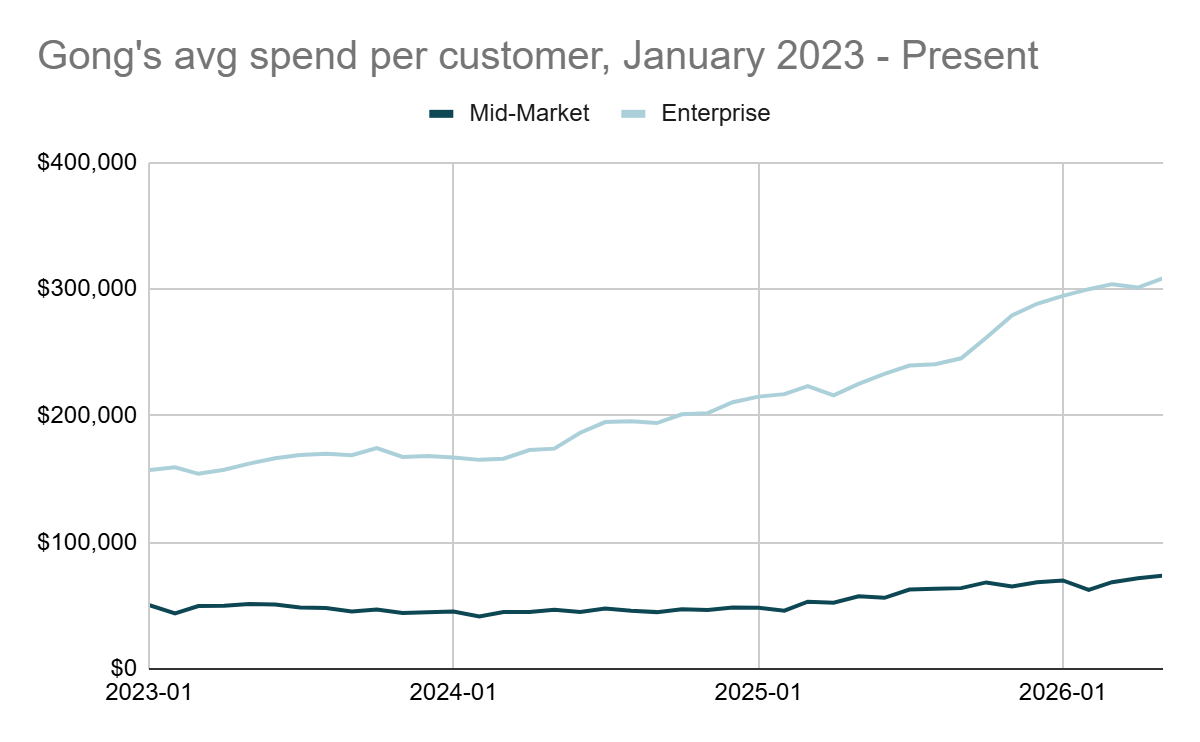
Note that the pricing change is weeks old so it’s not yet reflected in our data. But we know that credit- and token-based pricing tends to push this number up, not down, because it decouples your cost from a predictable unit (a seat) and reattaches it to an unpredictable one (usage). So we’ll be tracking Gong spend from here and expect to see it rise considerably.
You can follow along by checking out our Gong pricing page in our marketplace, where we track what companies actually pay for SaaS using pricing intelligence and benchmarks based on real contracts from 1,300+ customers, updated monthly.
For a decade, software budgeting had a reliable anchor: the seat. You knew roughly how many people would use a tool, you multiplied by a per-seat rate, and you had a number you could defend to finance.
Consumption-based AI pricing removes that anchor.
Three things make metered AI spend uniquely difficult to control:
The result is the pattern we're now seeing across the market: teams exhausting annual AI budgets in a single quarter, or a single month, on usage they couldn't see coming.
You can't manage what you can't see — and you can't negotiate what you can't benchmark.
Here's the playbook we suggest to negotiate AI pricing:
Figure out whether your real usage looks like seats, consumption, or a mix. A team using an AI assistant a few times a day is a completely different cost profile than a product team piping documents through an API around the clock. Estimate your likely usage under the vendor's actual pricing model before you react to a quote.
The vendor's rep can see the distribution of what hundreds of similar companies pay for the exact product you're negotiating. Most buyers can see two data points: their own last invoice, and a rumor from a peer. Close that gap with real benchmark data before you respond to the quote — not the vendor's list price, and not a range from a consultant.
On a metered contract, the terms matter as much as the rate:
The leverage is in the weeks before the renewal date. Once you're inside the auto-renewal window, you're negotiating from the back foot. Calendar the renewal date, notice period, and opt-out window the moment you sign, and strip auto-renewal entirely if you can. This matters more for AI than for legacy SaaS, because AI tools evolve fast enough that a multi-year lock-in can trap you with a vendor that's fallen behind.
AI pricing and model performance are changing faster than any other software category. Avoid terms that make switching hard — long commitments, restrictive minimums, or pricing that only works if you stay put. The model that leads today may not lead in six months.
Every one of those tactics depends on the same thing — knowing what the market actually pays.
That's the gap SpendHound closes. Our benchmark dataset is built from 1,300+ companies contributing de-identified spend data across 10,000+ AI and SaaS vendors. It's not a survey and it's not list price. It's real, product-level spend from companies actually buying these tools, matched to your company size, use case, and commit structure.
That volume does more than hand you a number. It shows whether a vendor is raising prices because it's winning customers or losing ground — which tells you exactly how hard you can push. In Gong's case, we can already see the per-customer trend accelerating; benchmark data is what turns that observation into negotiating leverage on your renewal.
Metered AI pricing isn't inherently bad, but it is inherently harder to control, and vendors have a decade-long head start on visibility. The buyers who stay in control will be the ones who can see where spend is heading across the market, not just on their own invoice.
If you're staring at an AI renewal right now, or you just want to understand what credit-based pricing is about to do to your bill, let's talk. SpendHound gives you real spend data on what companies actually pay for AI vendors, plus procurement experts who negotiate these contracts every day.
Prepare yourself before you sign or renew an AI contract.