NEW
NEW RESEARCH
AI Spend Report: See how 172 leaders are budgeting for AI Get the report
WEBINAR
AI Spend in 2026: What finance should do next Save your spot


SaaS and AI vendors are getting smarter. Google bundled Gemini into every Workspace agreement and used it to justify a 20–25% price increase, Salesforce runs a typical 9% uplift on renewals, and AI companies are rolling out consumption-based pricing that’s nearly impossible to forecast.
Meanwhile, most buyers are walking into renewals and new purchases the same way they always have, not knowing what other companies actually paid.
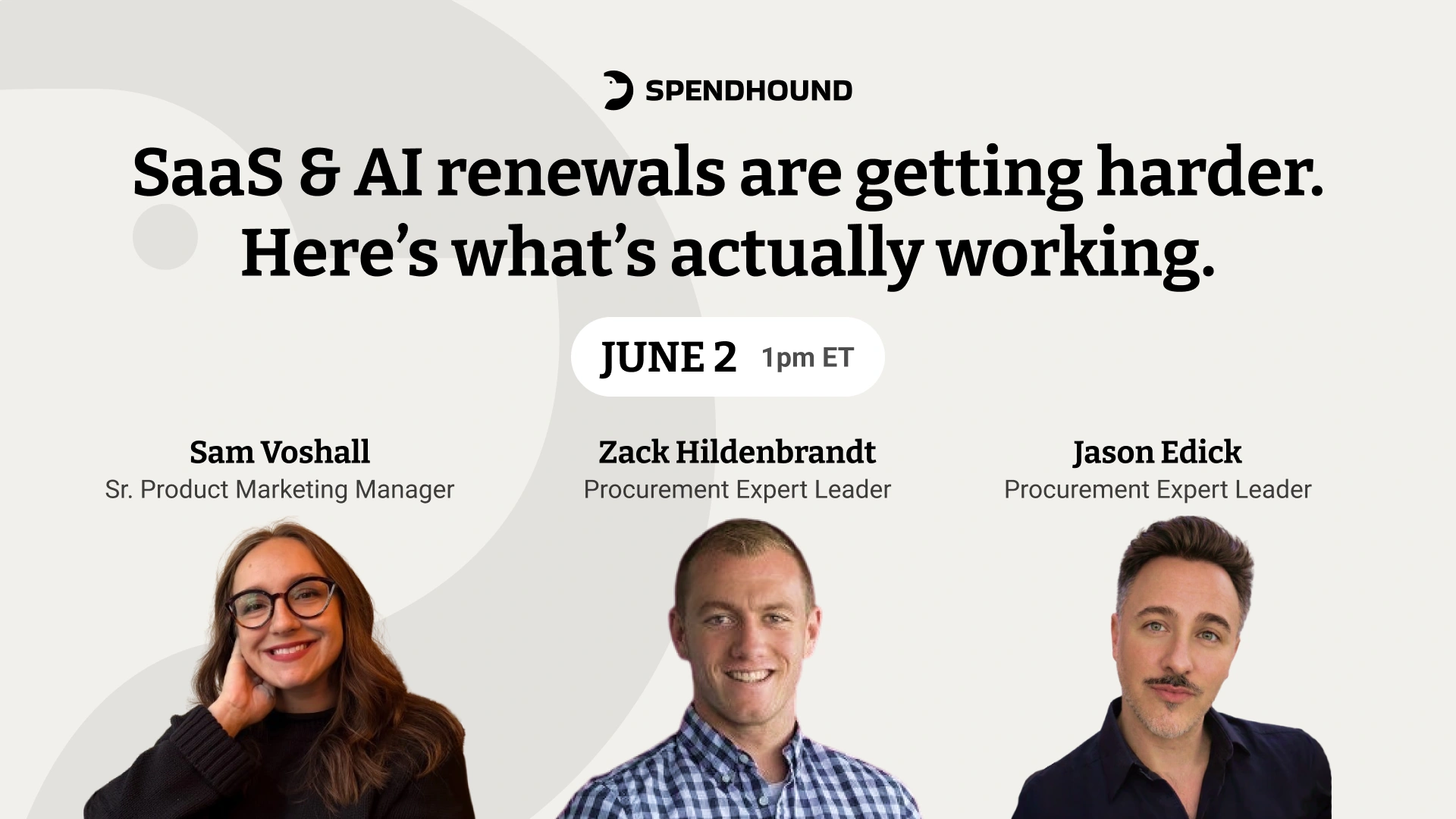
Enter the world our Procurement Expert (PE) team lives in every day. Jason Edick and Zack Hildenbrandt lead that team, where they spend their time on every detail of vendor pricing, negotiations, deal structure, and the levers that actually work.
In a recent working session with Sam Voshall, Jason and Zack shared what they’re seeing across customers: the trends making renewals harder, how the PE team builds leverage, and what a real PE engagement looks like end to end.
Key takeaways:
Zack opened the session by naming three trends he’s seeing across SpendHound’s 1,200+ customer base.
The stickiest vendors are raising prices on a reliable schedule. Google’s 20–25% increase last year came attached to a Gemini bundle, while Salesforce’s 9% annual uplift has become predictable enough to plan around.
“You can basically set your watch to a 9% price increase every time you come up for renewal with Salesforce.” — Zack Hildenbrandt
Bundling has replaced optionality. Vendors that used to let buyers pick and choose their product tiers are now packaging features together (whether they’re useful or not) and using the bundle as a mechanism for price increases. You end up paying for capabilities you didn’t ask for and have to negotiate later on.
The tactics that used to work are less effective against vendors who’ve seen them before. Threatening to switch works better when you have time to switch, and challenging a price increase lands differently when the vendor knows you’re weeks from your renewal date.
Most of all, AI adds an entirely new layer of difficulty to spend tracking. The consumption-based pricing models that most AI vendors use are structurally harder to manage than seat-based licensing.
“With SaaS, you know how many employees you’re going to have using a given tool. How many API calls or AI tokens or credits are consumed is a lot harder to project.” — Zack Hildenbrandt
Sam helped frame the PE team’s approach to benchmarks:
“A benchmark really just tells you your price percentile. It doesn’t tell you what to do with it. It doesn’t tell you how hard to push, what leverage you have.” — Sam Voshall
Jason then described what traditional benchmarking usually looks like: you might ask a Slack group, call former coworkers, or pay thousands of dollars for a 30-page market research report that yields a page or two of useful data.
SpendHound’s benchmarking is different. The team uses a proprietary, searchable data repository with pricing and contract data down to the product level, sourced from across SpendHound’s 1,200+customer base. When a customer opens a PE case, the team benchmarks comparable contracts — those within a 10–15% range of cost, license count, and usage — so the comparison is apples-to-apples.
But benchmarks are only one input. Zack outlined two additional layers the team builds into every engagement:
Timing intelligence: Not every vendor works the same way, but the PE team has mapped those patterns at the vendor level. One HR platform, for example, runs on monthly structures and doesn’t show quarter-over-quarter discounting.
Market dynamics. Is the vendor operating in a competitive category where alternatives are gaining ground? Or is it closer to a monopoly, where the practical switching cost is near-infinite and vendors know it?
“What I’ve personally seen in negotiations is that the order you play your cards sometimes matters as much as the cards themselves.” — Zack Hildenbrandt
Jason walked everyone through a real customer case to make the methodology clear:
When the customer brought the renewal to the PE team, Jason’s team benchmarked the core licensing (on average, slightly above market) and dug into the deal’s history. They found two years of consistent growth, no incremental discounting, a multi-year deal on the table, and a competitor offering a similar AI capability at zero cost.
After a 15-minute call, the PE team built a negotiation strategy and coached the customer on “layering in those leverage points at the right places,” as Jason explained.
The result: a 25% reduction in the overall contract and the AI coaching add-on included at no cost. A well over six-figure multi-year deal, significantly better than where it started.
Then Sam asked about what customers can bring to these PE engagements that tends to change outcomes more than standard renewal prep.
Zack’s answer: a 360-degree view of the tool’s internal standing.
"The larger the company, the more varied opinions can be on certain software tools. Having a full evaluation of a tool can help uncover some leverage that would otherwise go undetected.” — Zack Hildenbrandt
Jason reinforced the timing point about negotiating out annual uplift language. His answer was that persistence and escalation work more often than buyers expect. Vendors are rarely going to walk away from a relationship because a buyer pushed hard to remove a 3% annual uplift.
“It depends on how persistent you want to be. If you have the time to do it, I always say, get it done.” — Jason Edick
Both Jason and Zack agreed that anything below 5% at renewal is a win, 3% is solid, and removing consumer price index (CPI) language entirely is worth fighting for.
“I would recommend getting anything referring to CPI or any other measures of inflation out of the contract. Have a firm percentage increase instead.” — Zack Hildenbrandt
The session looked at three new SpendHound capabilities, two of them launching this month and one coming soon.
In-Platform Benchmarking launches at the end of June. Rather than opening a PE case and waiting for a report, customers will have instant visibility into their price percentile directly on each vendor page in the SpendHound dashboard, built from real contract data and updated weekly. Great for “at-a-glance” price checks, but for deeper support, the PE team remains customers’ best option.
Managed Negotiation is SpendHound’s newest vendor-facing, add-on service. It’s for situations where a customer wants SpendHound at the table to help close the last mile of a negotiation. The model is designed for renewals where the data and strategy are in place but execution support would materially change the outcome.
AI Spend Visibility is also entering beta. It gives customers a consolidated view of their OpenAI and Anthropic spend, including month-over-month trends, projected spend, and a breakdown by workspace, API key, and top users. As SpendHound aggregates more data across customers, customers can track how model market share is shifting in near real time.
The team also recapped two capabilities already available for SpendHound customers.
Vendor Trends is live and available through customer success. It surfaces market signals on which vendors are gaining or losing share across SpendHound's customer base, which matters before committing to a multi-year deal or evaluating whether a vendor's price increases are justified by actual market position.
Procurement Experts remain free and included in the platform for all SpendHound customers. Cases are opened from a vendor page or the PE tab, and customers receive a benchmark and analysis package within one to two business days.
The teams saving the most on SaaS and AI renewals are getting ahead of them early enough to have real options, combining benchmark data with their own internal leverage, and playing the negotiation in the right sequence.
If you have a renewal coming up in the next 60–90 days, don’t wait until the vendor starts the clock. And if you’re new to SpendHound and want to see how the platform and the PE team work, book a demo to get started.