NEW
NEW RESEARCH
AI Spend Report: See how 172 leaders are budgeting for AI Get the report
WEBINAR
AI Spend in 2026: What finance should do next Save your spot


In SpendHound’s AI Spend Report, 46% of 172 finance and procurement leaders spent more than planned on general-purpose AI last year, and 81% expect that spend to rise again in 2026.
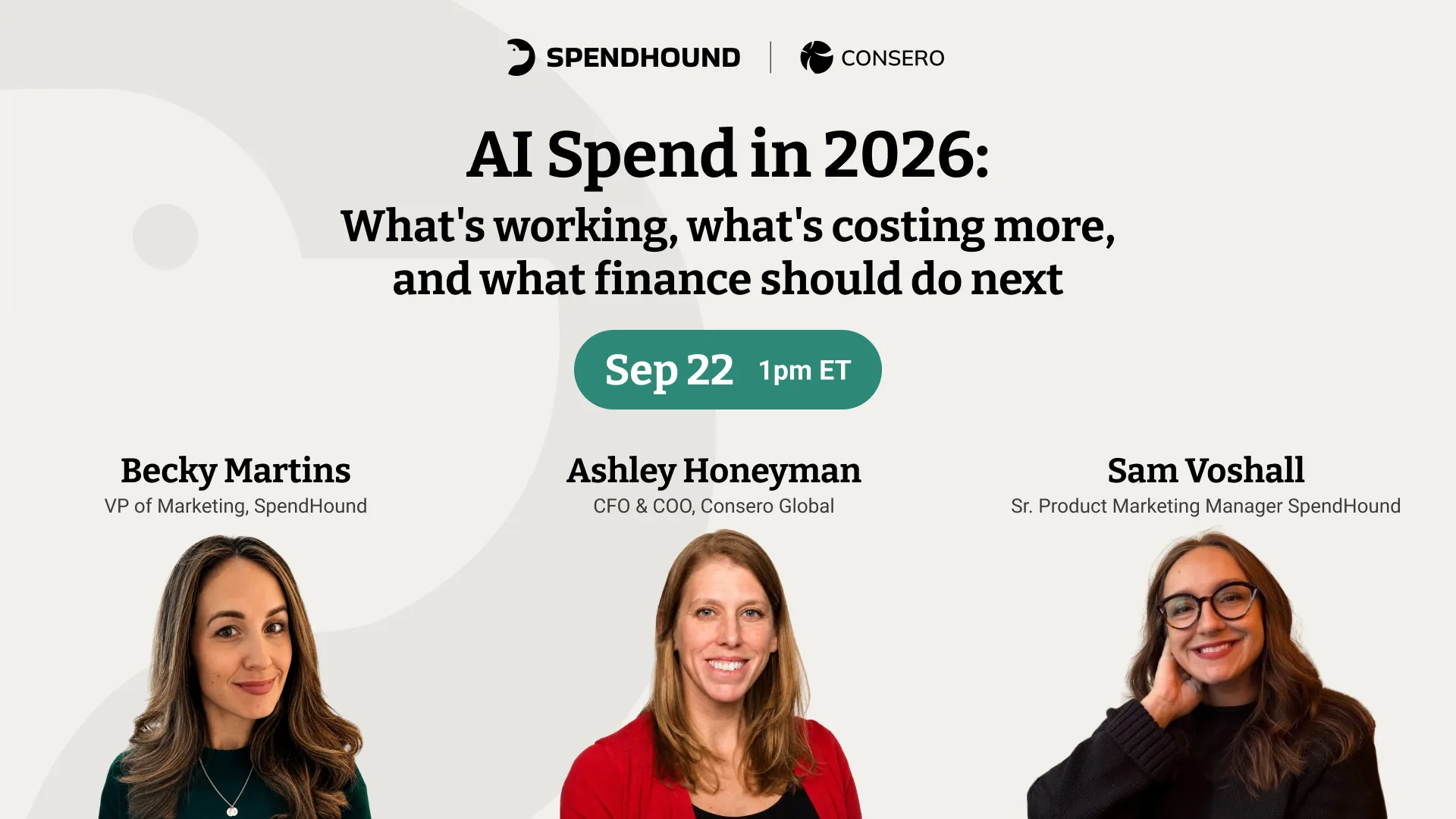
In our latest webinar, we spoke with Ashley Honeyman, CFO and COO of Consero Global, to get a finance exec’s perspective on these numbers and what finance teams should do next. Ashley also brought a customer’s view, since Consero uses SpendHound for its own renewals.
The session covered three questions. What happened to the AI budget? Where are teams getting ROI? And are you paying a fair price?
Key takeaways:
Ashley wasn’t surprised that most attendees had no AI budget to exceed. At Consero, R&D’s AI work stayed on budget, but ChatGPT and Claude licenses were a different story. Employees bought them on credit cards and used them for personal productivity, and she expects a lot of companies found the same thing.
“You did the budgeting for 2025 back in 2024, so you weren’t thinking about how to use AI tools at that time. 2025 was all about figuring it out and personal productivity.” — Ashley Honeyman
That’s why she reads the 46% as low. Plenty of teams had no AI line to go over. For a playbook on setting one, see SpendHound’s AI budgeting guide.
One of the polls asked: Who owns the AI budget? Answers were split between finance and IT, with engineering also in the mix.
SpendHound’s data shows how fast that budget is moving. Run-rate spend across OpenAI, Anthropic, and Cursor grew about 4x from December 2024 to December 2025, then rose another 70% by April 2026. Yet 22% of organizations have no single owner for it.
At Consero, IT sets the AI budget, finance approves and monitors it, and the company is within its AI budget for the year. Product and delivery teams build most of the AI use cases since they’re closest to the customer, but they don’t own the budget.
“The people that are driving how and where AI is spent are in product and delivery. I wouldn’t be surprised if this budget starts creeping to different places over the next few years.” — Ashley Honeyman
She still recommends IT as the first owner, because someone has to watch users and tokens every day. Plus, finance needs a seat too. A $20–$30 per-user plan can jump four or five times once a team moves to token-based pricing.
“When you switch from user-based to token-based, often you see a spike in your AI spend. And once you’re on tokens, it’s really hard to control that spend.” — Ashley Honeyman
In the Q&A, she named her go-to guardrail. Since enterprise plans (per-user) cap tokens by default, teams on usage-based plans should have IT limit tokens to specific people.
In SpendHound’s research, 51% of leaders report measurable ROI from AI, 40% say it’s too early to tell, and 6% say no. In the live poll, over half of attendees said their clearest return is employee productivity.
“When I first saw this I said, ‘51% are getting ROI? There’s no way.’ But it depends on how you measure ROI.” — Ashley Honeyman
A year ago, companies handed out licenses to see what would happen. Now they want cost savings, better quality, or more revenue to show for it. Consero runs every AI use case through a small team of builders, and each one ships with targets for quality, efficiency, and market impact. Quality comes first. Consero’s financials arrive 98% accurate, and the goal is 100%, so a model that’s 95% accurate would be a step backward. Humans stay in the loop, and AI never posts to the general ledger.
The report also shows returns vary by industry. 89% of manufacturing respondents report measurable ROI, compared with 44% in software and 21% in healthcare. Ashley expects software to keep gaining ground. Small squads now use Claude to write and test code, so a use case that took six months can ship in two weeks. For a framework, see how to measure AI ROI.
57% of leaders in the report aren’t confident they pay a fair price for AI, and 19% believe they’re overpaying. In the live poll, over half of attendees said they were somewhat confident. Ashley said she’s not confident at all.
Her reasons are practical. Cheaper LLMs from China keep entering the market. Costs jump when a team moves past roughly 150 users to tokens. She believes Consero pays about what peers pay, but she’s asking a harder question. Could the company route low-risk work to cheaper models and keep sensitive data on U.S.-based providers?
“AI and SaaS spend always links back to ROI. If I’m paying for something that I’m getting no benefit from, then I’m definitely overpaying.” — Ashley Honeyman
On one renewal, Consero asked SpendHound for competitor information. SpendHound flagged a competitor and ran a competitive analysis.
“We ended up getting half off on our current product. So we didn’t have to move off, but we knew who had lower benchmarks, and we were able to use it against them.” — Ashley Honeyman
76% of leaders are reconsidering existing vendors because of AI. Some Consero clients start with “we just need AI” and no goal behind it, so Ashley first asks what they want to improve, like a shorter close or better reporting.
From there, clients split two ways. Some have moved to AI-native ERPs like Rillet and Campfire. Others add AI to the systems they already run, like connecting Claude to their ERP and Salesforce for reporting. SpendHound’s AI vendor evaluation guide covers the questions to ask before you switch.
An attendee asked for tips on automating the close. Ashley recommended most finance leaders start somewhere else. A full close could take around 60 agents. Each one should run as deployed code rather than live in a model, or accuracy can drift.
She’d start with FP&A instead. Claude can draft board reports, as long as someone checks the commentary. It can run flux analysis against budget and prior month. One finance leader she knows compares two aging reports and gets a list of clients to follow up with, plus a draft message. That improves working capital, which gives the use case a clear ROI.
Becky closed by asking what this conversation will sound like in a year. Ashley expects the same themes with higher stakes.
“Instead of seeing ROI at all, it’s what ROI are you getting? Is it five, ten, fifteen, twenty percent? And where are you getting the most bang for your buck with AI?” — Ashley Honeyman
Sam showed how SpendHound helps teams prepare. AI Spend Visibility pulls spend from OpenAI, Anthropic, Cursor, and Amazon Bedrock into one dashboard, broken down by model, team, and API. It’s free for every company. In-Platform Benchmarking compares your AI contracts to real pricing from 1,500+ companies.
“AI is a hard budget to own. That’s what all of our data is showing us.” — Sam Voshall
If you want to see where your AI spend goes and whether you’re paying a fair price for it, complete a demo of AI Spend Visibility and get a $100 gift card.
To start with the research, download the 2026 AI Spend Report.