NEW
NEW RESEARCH
AI Spend Report: See how 172 leaders are budgeting for AI Get the report
WEBINAR
AI Spend in 2026: What finance should do next Watch now


New data from SpendHound's 2026 AI Spend Report reveals what's driving AI purchasing decisions. Here are six steps to build an AI business case that holds up before you buy and at renewal.
Money isn't the biggest obstacle to AI adoption.
According to SpendHound's 2026 AI Spend Report, 81% of finance and procurement leaders expect their AI budgets to increase this year.
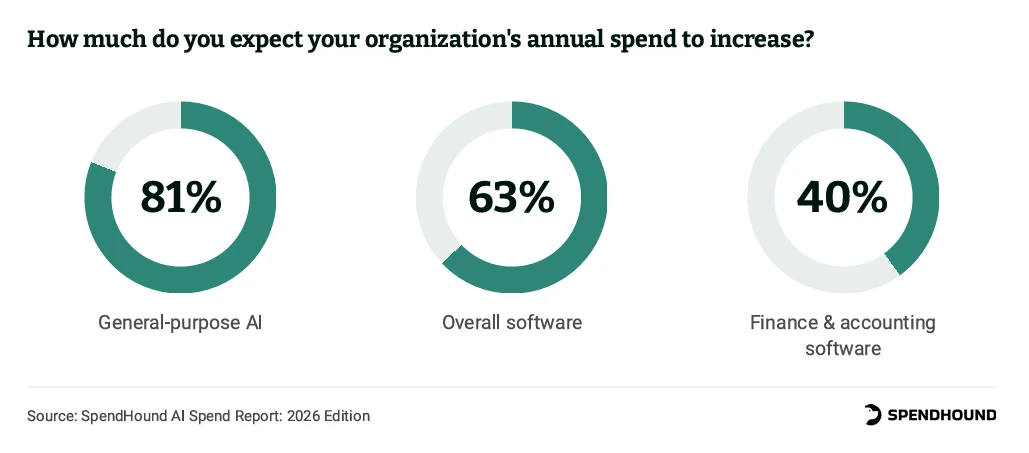
And just 21% cite budget constraints as a barrier to adoption.
So what are the more salient barriers? Our surveyed finance leaders stressed concerns around accuracy and reliability (42%), lack of internal expertise (41%), and immature technology (40%).
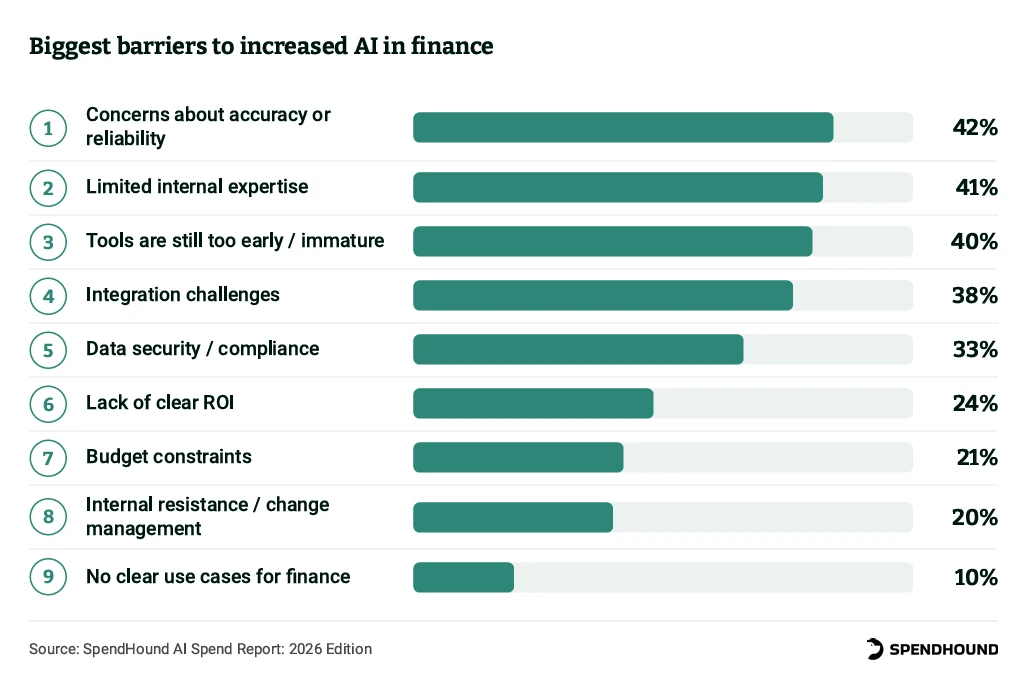
These concerns change the calculus for AI investments. Just because you have the budget, doesn’t mean you should buy. And even a compelling AI use case and price point aren’t reason enough if the technology can't reliably deliver or if getting the platform up and running requires more time and resources than expected.
With new tools entering the market, ambitious vendor claims, and limited evidence of long-term returns, even promising investments deserve a closer look. Here are six practical ways to evaluate AI tools and build a stronger business case, informed by our research and our work with finance and procurement leaders.
Before getting too far into a vendor evaluation, make sure there's a clear picture of what the tool is supposed to accomplish. This may sound obvious, but with the constant pressure to become AI-first, a surprising number of companies don’t seem to be starting with the use case and the expected ROI.
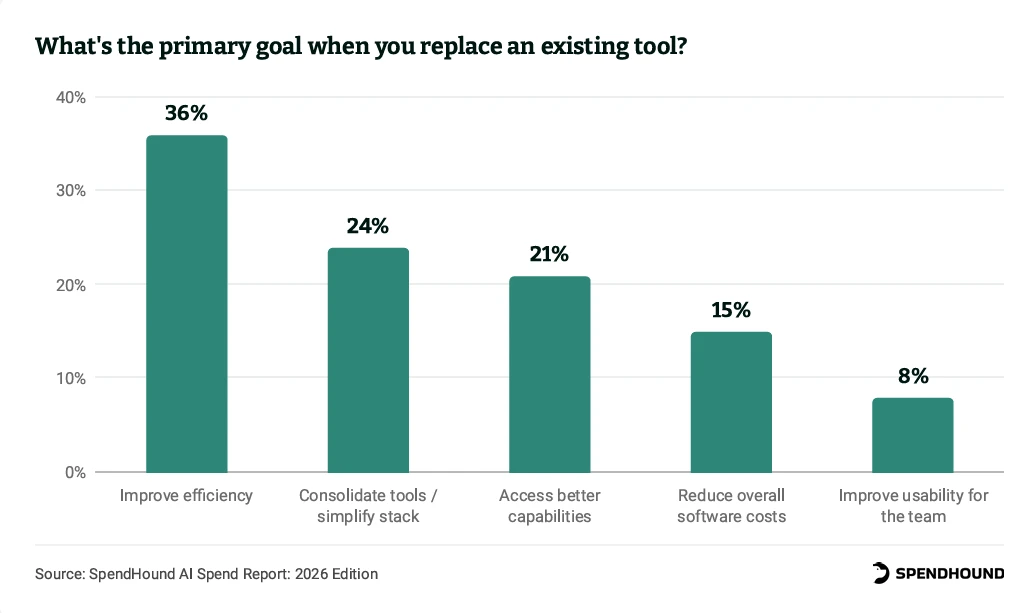
Our research found that improving efficiency is the top goal when companies replace software, cited by 36% of finance and procurement leaders. Reducing costs came in much lower, at 15%.
But you'll want to get specific about what those goals mean.
Say you're evaluating an AI tool that promises to speed up financial reporting. To build the business case, you should question the team that would use the tool:
That last question is especially relevant right now. AI capabilities are showing up in more of the software you're already paying for. Before adding another vendor, it's worth checking what you already have access to.
SpendHound’s Intake & Approvals does this check for you. When someone requests a new tool, it flags existing tools that overlap, so you catch the duplicate before you buy it, not in an audit.
The investment test: Can you identify a specific workflow the tool will improve, quantify the expected improvement, and explain what that improvement is worth to the business?
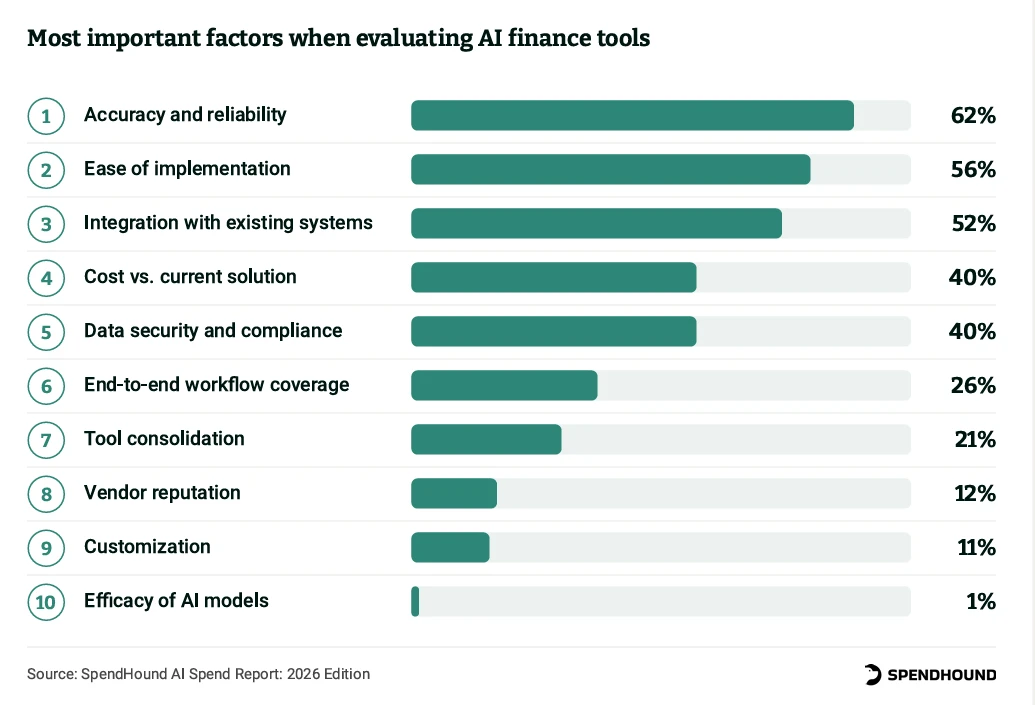
Accuracy is the number-one AI evaluation criterion according to our survey. That's not really surprising for finance teams, where a seemingly small error could have expensive consequences.
But how do you evaluate “accuracy”?
Consider a tool that uses AI to extract renewal dates, pricing terms, and other key details from software contracts. Processing hundreds of agreements in minutes could save a tremendous amount of time.
But if someone still needs to review every extracted field, or if the tool struggles with unusual contract language, the actual savings may be much smaller than advertised.
Here's how to pressure-test the economics:
The investment test: After accounting for the time and cost of reviewing and correcting AI outputs, does the tool still deliver enough value to justify the investment?
A vendor's quote rarely covers the full cost of getting a tool up and running. To estimate the rest, tease apart two questions:
Maybe the vendor has a capable product, but your data isn't in a format it can easily use. Or perhaps the tool works well on its own but requires custom integrations with several systems in your stack.
Ease of implementation and integration are important considerations. And this showed up in our research: 56% of finance leaders prioritize ease of implementation, 52% prioritize integration with existing systems, and 41% cite lack of internal expertise as a barrier to AI adoption.
These insights lead to some practical questions.
On the product side:
On your side:
This exercise can also reveal costs that aren't included in the vendor's quote.
A $25,000 annual subscription might look reasonable until you factor in the IT resources needed to connect it to your systems, clean up data, and provide ongoing support. You'll want those estimates from your internal teams, not just the vendor.
The investment test: Can you realistically deploy and support the tool with the resources you have, and does the business case account for everything required to get it up and running?
Here's an interesting finding from our survey: More than one in four finance and procurement leaders evaluated finance-specific AI tools and decided not to move forward.
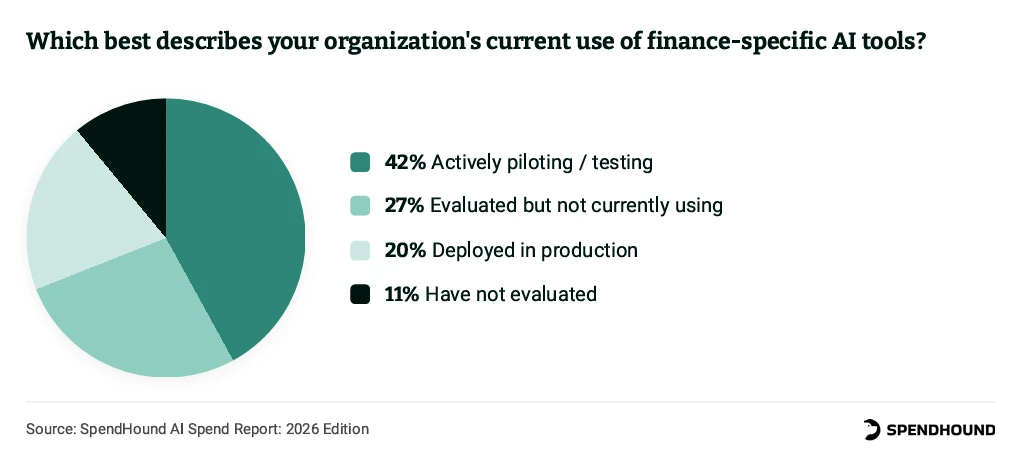
Given the concerns about immature technology, implementation, and internal expertise reflected elsewhere in our research, it's easy to see why a promising AI tool might not make it through the evaluation process.
And that's okay. A vendor evaluation should give you the information you need to make a decision — even if that decision is no.
Here’s a good quick rule of thumb:
Buy — If the tool solves a meaningful problem, performs well in testing, and has a credible business case, making a purchase makes sense.
Wait — If the use case is promising, but the product, integrations, or your internal capabilities aren’t ready, you may want to put this one on hold. But don’t keep the door to this evaluation open-ended for too long. Set a time limit for the decision so as not to waste your team’s time.
SpendHound Vendor Trends can help you decide how long to wait. It shows which vendors are gaining or losing category share, and which new ones are gaining traction, based on real spend movement across 10,000+ vendors, not reviews or analyst reports.
Walk away — If the tool duplicates capabilities you already have in your stack or just doesn’t offer enough value for the cost, you may want to focus your resources elsewhere.
The investment test: If you're not ready to buy, what specifically needs to change before you'd reconsider? And if nothing is likely to change the economics, is it time to move on?
Once you’ve determined that an AI tool is worth buying, there's another big question: Are you getting a good deal?
That can be tough to calculate with AI. Vendors use different pricing models, features are packaged differently, and consumption-based fees can make it difficult to compare one proposal with another.
For a closer look at how usage-based charges can change your software costs, see our guide to metered AI pricing.
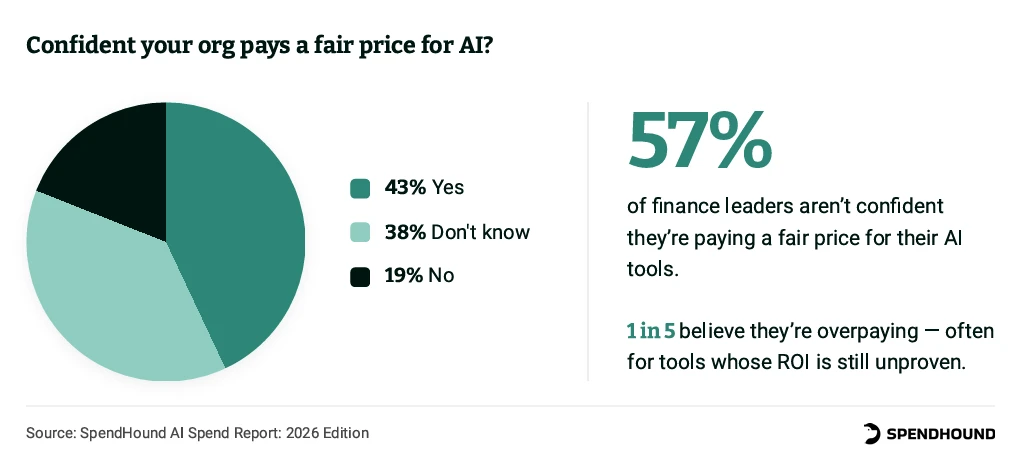
Our research shows just how much uncertainty exists around AI pricing: 57% of finance and procurement leaders lack confidence they're paying a fair price for AI tools or believe they aren't.
Here's where to focus your pricing diligence:
Benchmark against actual deals. Compare the proposed price with what similar companies are paying for comparable capabilities, license counts, and contract terms. List prices and vendor-provided comparisons won't necessarily tell you what's competitive.
This is where real contract data helps. SpendHound’s In-Platform Benchmarking compares your pricing to what 1,500+ companies actually signed, not list prices or quotes, adjusted for company size and industry. A price percentile shows whether you’re paying above or below market, and Deal Grader surfaces that score where you already manage renewals. If a vendor isn’t covered yet, a Procurement Expert can run a custom benchmark, included with the platform.
Model realistic usage. Look beyond the initial subscription cost. What happens if adoption is slower than expected? What happens if usage takes off? For consumption-based tools, understand the overage charges and how quickly costs could increase.
Once you’re live, check your model against reality. AI Spend Visibility shows token usage and cost across OpenAI, Anthropic, Cursor, Amazon Bedrock, Gemini/GCP, and ChatGPT Enterprise in one dashboard, updated daily, with cost broken out by model. It’s free and connects in minutes.
Check for overlap. Before adding another AI subscription, review what your existing vendors already provide. You may be paying for capabilities that are already available elsewhere in your stack.
Negotiate flexibility. AI usage is still evolving, so pay attention to minimum commitments, renewal increases, overage rates, and your ability to adjust license counts or consumption commitments.
The investment test: Do you know how the proposed price compares with what your peers actually pay, and have you modeled what the tool will cost at realistic levels of adoption and usage?
One of the most interesting findings in our research is that only about half of finance and procurement leaders say their companies are seeing measurable ROI from AI.
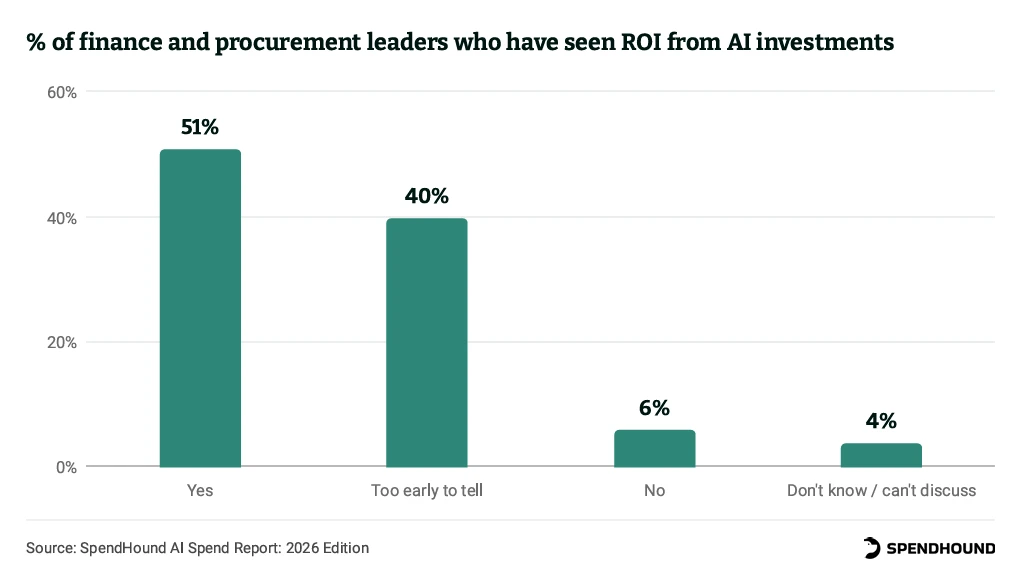
That doesn't necessarily mean the other half aren't getting value (especially with so many companies still relatively early in their AI journeys), but it does highlight how difficult it can be to establish whether an investment is paying off.
And that makes it especially important to agree on what success looks like before signing the contract.
You don't need an elaborate measurement framework for every AI application. But for a meaningful investment, you should be able to answer a few questions:
Just as important, decide when you'll review the results.
For a tool with an annual contract, you don't want to discover two weeks before renewal that nobody has been tracking usage or performance. Work backward from the contract's renewal and notice dates. SpendHound’s renewal calendar sends 30-, 60-, and 90-day alerts to the right owner by email and Slack, with spend history and contract terms attached. Give yourself enough time to gather results, talk with users, evaluate alternatives, and negotiate if necessary.
For a deeper look at how to assess returns, see our guide to measuring AI ROI, including how expectations should change as tools move from experimentation to ongoing spend.
The investment test: Will you have enough evidence, before your next renewal decision, to determine whether to keep, expand, renegotiate, or replace the tool?
With 81% of finance and procurement leaders planning to increase their AI budgets, the pressure to make smart investment decisions will only increase.
But you don’t need to overcomplicate this. Keep it simple: Know what problem you’re solving, what results you can reasonably expect, and what a fair price looks like.
And as the market and your business needs change, be ready to revisit those decisions because what's worth buying today may look very different a year from now.
Want to see where your AI spend is going? Connect your AI providers and see all your AI spend in one place, for free.
SpendHound also gives you pricing benchmarks, contract visibility, and Procurement Expert support, free for companies under 1,000 employees.
An AI business case should name the specific workflow the tool will improve; the expected gain in time, accuracy, or capacity; and the full cost. That cost includes implementation, integration, and the human review the outputs still need. It should also compare the proposed price with what similar companies pay; reach a buy, wait, or walk-away decision; and set the metrics you'll review before renewal.
The biggest barriers to AI adoption are accuracy and reliability concerns (42%), lack of internal expertise (41%), and immature technology (40%), according to SpendHound's 2026 AI Spend Report. Budget constraints rank considerably lower, cited by just 21% of finance and procurement leaders. These findings suggest that finance teams need to look beyond purchase price to assess whether an AI tool is reliable enough for its intended use, whether the organization has the resources to implement it, and whether its expected benefits justify the total investment.
Calculate net savings, not advertised savings. Test the tool on your own documents or data rather than a vendor demo. Track how often errors occur and how serious they are, and measure how long people spend reviewing and correcting outputs. Subtract that review time from the projected productivity gain. A tool that still needs every field checked may save far less than its pitch suggests.
Compare the proposal with what similar companies actually pay for comparable capabilities, license counts, and terms, not list prices or vendor-supplied comparisons. Then model costs at low and high adoption, check whether existing tools already cover the capability, and negotiate flexibility on commitments and overages. SpendHound's 2026 AI Spend Report found 57% of finance and procurement leaders aren't confident they pay a fair price for AI, and 19% believe they're overpaying.
A company should invest when an AI tool addresses a meaningful business need, performs reliably in testing, and offers a credible return relative to its total cost. Waiting may make sense when the use case is promising but the product, integrations, or internal resources aren't ready. Walking away is appropriate when the tool duplicates existing capabilities, solves a low-priority problem, or doesn't justify its cost. SpendHound's 2026 AI Spend Report found that 27% of finance and procurement leaders evaluated finance-specific AI tools but chose not to adopt them, reinforcing the importance of making purchasing decisions based on demonstrated value.
The 2026 AI Spend Report combines a survey of 172 finance and procurement leaders with SpendHound's proprietary spend data. SpendHound's pricing benchmarks come from real spend data contributed by 1,500+ companies, so finance teams can compare a vendor's proposal with what peer companies actually pay.